Synagogue Ben Ezra in Fustat, Old Cairo, Egypt, is believed to be one of the oldest synagogues in all of Egypt. It was previously a church but later became a synagogue in the 9th century, and it is historically important for its connection to the history of Egyptian Jews. It is no longer used as an active synagogue but instead functions as a Jewish museum and area for tourists; it is famous for its architecture, for the legends of Moses, and for the discovery here of the Cairo Genizah—a treasure trove of historical documents that are now at Cambridge University.
Table of contents [Show]
Synagogue Ben Ezra is one of the oldest Jewish temples in Cairo, situated in the district of Coptic Cairo, at the site of a former Christian church. It is famous for its historic significance, the mixture of styles in its architecture, and the finding of the Cairo Geniza—a treasure of ancient Jewish documents. Nowadays, it basically serves as a museum and a tourist attraction, not being used as a place of prayer anymore.
It is located in the historic Coptic quarter of Old Cairo, a large area with many churches and other religious sites, including the Ben Ezra Synagogue.
It derives its name from the great philosopher and scholar Abraham ibn Ezra, who, tradition has it, bought the building and grounds for the considerable sum. The synagogue was a church that had been sold to pay taxes and was named for Ben Ezra, who bought it for 20,000 dinars, although other sources attribute the purchase to Abraham ibn Ezra.
The Ben Ezra Synagogue has a long history, having its origins in the 9th century as a Coptic Christian church in Cairo.
The Ben Ezra Synagogue originally came from a church built in the 4th century that was sold to the Jewish community in 882 A.D. to pay church taxes. It was acquired by Abraham ben Ezra and became a synagogue named after him. Its fame is also linked to the discovery of its Genizah, an archive of thousands of ancient Jewish manuscripts.
The Synagogue Ben Ezra was the most significant centre of Jewish religious, intellectual, and social life within medieval Egypt. It was a place of worship, study, and congregation at the centre of communal life; a place where great scholars such as Maimonides made their influence felt; a site of pilgrimage by Jews throughout the region; and the repository of the Cairo Geniza, the great cache of ancient manuscripts that preserved the history of the community. The architecture of the synagogue further reflected its role: making use of local Coptic and Islamic artistic styles to provide a visual marker of the community's identity within wider Egyptian culture.
Local legend and tradition have it that the Ben Ezra Synagogue in Old Cairo is built on the site where the pharaoh's daughter found the baby Moses, hidden in a basket among the reeds of the Nile.
Read more about: The Hanging Church

In 1896, Agnes Smith Lewis and Margaret Dunlop Gibson discovered the Cairo Geniza, bringing fragments from a Cairo bookseller to Solomon Schechter. Schechter recognised the importance of the collection of almost 400,000 manuscripts that had been stored in a room above the Ben Ezra Synagogue; thus, the "discovery" of this enormous historical treasure trove was born. The Geniza serves as a depository for sacred and secular Hebrew and Judeo-Arabic documents, offering a unique window into daily life, religious practices, and culture in the medieval Middle East over a period of more than 1,000 years.
The Cairo Geniza is an enormous collection of some 400,000 manuscript fragments from the storeroom, geniza, of the Ben Ezra Synagogue in Old Cairo, Egypt. It contains Jewish and non-Jewish texts ranging over a thousand years from the 6th to the 19th century, preserved out of reverence for religious writings.
The manuscripts of the Geniza are important in that they open a revolutionary window on medieval Jewish and Mediterranean history. They provide unique insights into social and economic as well as religious life and a huge repository of religious and secular texts, many previously considered lost. In so doing, they reshaped academic understanding of such topics as biblical studies, Jewish law, liturgical practices, and daily lives among Jewish communities living under Islamic rule.
Religious writings: It was the Geniza that preserved a whole range of religious literature, such as prayers, hymns, works of theology, and commentaries that were otherwise believed to have disappeared.
Linguistic evolution: They provide important testimony to the evolution of biblical interpretation, the Hebrew language, and liturgical symbols.
Jewish-Islamic relations: These documents with translations provide a unique insight into the interaction between Jews and Muslims in the Middle Ages, showing quite clearly how many Jews under Islamic rule enjoyed far greater freedoms than their brethren in Christian Europe.
Religious practices of everyday life: They tell about Jewish life, from the punishments for unruly students down to the making of new legal documents for women in order to protect them against long-distance trade.
Read about: Gayer-Anderson Museum Cairo
Daily life is represented in the manuscripts, which go further to detail the trades of the people, ownership of property, and social relations.
Women's history: They are key to understanding women's history in these contexts-legislative innovations that extend protection in cases of a long-distance marriage and possible divorce.
Economic activity: The records are replete with economic activities, such as business contracts and court documents detailing trade and economic networks across the Mediterranean.
Linguistic evidence: The texts represent invaluable evidence of the colloquial Arabic spoken and written during the period, because most documents were written in Judeo-Arabic or Arabic in Hebrew characters.
Medical knowledge: They contain a vast number of medical notebooks that include recipes for various ailments, including but not limited to eye diseases, skin conditions, and gynaecological issues; thus, they shed light on how medicine was practised at the time.
Secular literature: It consists of a number of secular literary works that are unknown to scholars so far.
Revolutionised fields: The chance discovery of the Geniza manuscripts in the 1890s completely revolutionised academic study in the field of medieval Jewish history and cognate fields.
The Cairo Genizah preserves the largest and most significant collection of medieval Jewish manuscripts in the world. New discoveries are continually being found by scholars, along with development of new insights from this vast collection of documents.
Today, the Cairo Geniza documents are scattered among more than sixty university, museum, and private collections, with a major portion being held in the Cambridge University Library and the Jewish Theological Seminary
and the John Rylands Library. Major collections are held in Europe, North America, Egypt, and Israel, and many of these are being digitised to make the fragments accessible online to the public.

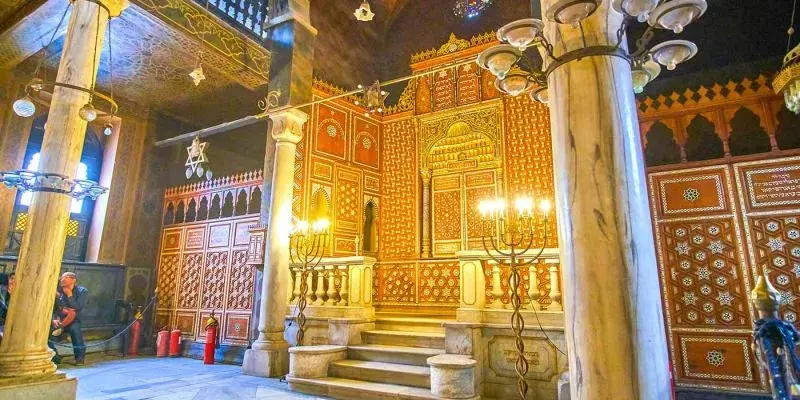
Synagogue Ben Ezra is basilica-shaped, with a two-tiered design: the first floor for men and the second floor for women, divided with steel bars. Inside, Jewish and Islamic styles are combined, with an octagonal marble "bima" in the middle to hold the Torah, ornate decorations with geometric and floral patterns from the Turkish period, stained glass windows, and chandeliers from Mamluk and other eras. Its exterior is famous for its complex Islamic geometric patterns.
Exterior:
The exterior has complex Islamic geometric patterns and intricate ornamentation.
Interior:
Layout The synagogue is basilica in style, having a two-storey building where the first floor is for men and the second floor for women.
Prayer Hall: The main floor is divided into three sections, with the central part being the largest. It contains an octagonal marble "bima" (platform for Torah reading) in the middle.
Decorations: The interior decoration is full of combined Turkish and Ottoman motifs of stars, rectangles, and pentagons.
Art and Features:
Read about: Saints Sergius and Bacchus Church
The plan of Synagogue Ben Ezra is longitudinal, unlike other synagogues that have a centralized plan. The synagogue’s architectural features are influenced by Jewish, Islamic, and Coptic styles: a central prayer hall with a Torah ark at the end and a bimah right in the centre, some of which have been carried out in wood with intricate carvings, Hebrew inscriptions, and stonework.
Longitudinal Plan: The main prayer hall of the synagogue is oriented longitudinally, differing from the typical circular or square plans that many other synagogues have adopted.
Entrance and Orientation: The entrance is oriented toward the southeast. The layout runs from the entrance to the eastern wall, to which the Ark was attached.
Central Prayer Hall: The central hall is the main area where its congregants may worship.
Bimah: The central raised platform in the main prayer hall from which the Torah is read is called a "bimah."
Torah Ark: The Ark, in which the Torah scrolls are kept, is at the eastern end of the hall, the direction of prayer.
Women's Gallery: There is a women's gallery in this synagogue, as was common in the old synagogues.
Architectural Blend: It represents a mixture of Jewish, Islamic, and Coptic styles.
Wooden Elements: It has ornate woodwork, like an elaborately designed wood ceiling, complex carvings on the ark, and intricately designed wooden doors and windows.
Stone and Inscriptions: Stone walls were adorned with Hebrew inscriptions and symbolic carvings of their Jewish tradition.
Mosaic and Tilework: The ark itself is decorated with arabesques and inlays of mother-of-pearl, testifying to a variety of artistic traditions.Chandeliers, stained glass, and extensive tile work adorn the interior of the structure.
Original Foundations: While the current structure dates back to 1892, its foundations go further, being those of an older synagogue. The design was influenced by local Coptic churches, such as the Church of St. Barbara.
Read more about: 10 Best Places to Visit in Egypt

Synagogue Ben Ezra in Old Cairo presents an interesting mix of Jewish, Islamic, and Coptic artistic traditions, mainly expressed through wood, marble, and stucco for geometric, floral, and arabesque decorations in general, along with different Hebrew inscriptions.
Geometric and Floral Motifs: Most of the walls and the ceiling of the synagogue are covered with stucco and carvings representing very complex geometric and floral (foliate) patterns. Such designs—most especially star and pentagonal patterns—represent styles popular during the Mamluk and Ottoman periods in Egypt.
Woodwork: Wood was a highly valued material and is a primary medium of decoration.
Torah Ark: Arabesques decorate this cabinet in which the Torah scrolls are kept, inlaid with mother-of-pearl. The doors, several of which are from the 15th century, demonstrate a central medallion design with entwined vegetal forms, as was the fashion in contemporaneous Islamic bookbinding and woodcarving. Remnants of paint and gold leaf remain as evidence that they were once brightly colored.
Bimah: The reading of the Torah is performed from the central, octagonal, raised marble platform.
Ceiling: The wooden beamed ceiling is intricately designed with detailed carvings.
Women's Balcony: The women's balcony on the upper floor consists of a columnar support with decoration that matches the variety of styles found throughout the synagogue.
Other features include marble columns, stained glass windows through which colorful light shines, and rich carpets.
Learn more about this tour: 15 Days Egypt Holy Family Trip
The Hebrew inscriptions are a central feature, serving a double function of decoration and devotion.
Dedicatory plaques come in the form of carved wood panels that served as permanent testimonies of donors' devotion, calling upon their remembrance. These fragments, now widely dispersed among museums and collections worldwide, often feature carved or incised text surrounded by intricate geometric and foliate ornament.
The decorative and inscriptional elements of the Synagogue Ben Ezra are themselves a unique cultural synthesis, reflecting the engagement of the Jewish community with local Coptic and Muslim artistic traditions in medieval and later periods of Egypt.
Let our local travel experts help you design the perfect itinerary. Whether you're seeking adventure, culture, or relaxation, we've got you covered!
The Ben Ezra Synagogue has been restored many times throughout its history, with the greatest and best-documented efforts including a major rebuild in the 1890s after the discovery of the Cairo Geniza and a 2022-2023 project that involved meticulous architectural restoration, cleaning, and maintenance of the structure, lighting, and ornaments. Originally built as a church before turning into a synagogue in 882 CE, this site has been rebuilt and repaired after events such as a destruction order in 1012 and subsequent fires over the centuries.

It is on the basis of such a combination that the cultural and religious importance of Synagogue Ben Ezra rests: being the oldest in Egypt, connected to the discovery of the Cairo Geniza, functioning as a symbol of religious coexistence and Egypt's multicultural heritage, and traditionally being associated with the discovery of baby Moses. This was a spiritual center, a community hub, and even a place for philosophical exchange; thus, its architecture also reflected the visual culture and history of Egyptian Jews within a dominant Muslim society.
Synagogue Ben Ezra is a historic Jewish place of worship in Old Cairo, Egypt, within an Islamic country and evoking a shared history with Islamic culture. Originally a Christian church sold to the Jewish community in the 9th century, it was adapted into a synagogue and now serves as a museum and tourist site. It is an enduring symbol, even today, of Egypt's multicultural heritage and the legacy that its once-thriving Jewish community left.
Its architecture is mixed, combining Jewish and local Islamic styles, reflecting Egypt's various cultures and religious coexistence through the centuries. The history of the Ben Ezra Synagogue combines with that of Christendom since it was a Christian church from the 4th century up to the 9th century, when it was sold to the Jews.
The synagogue plays an important role in interfaith heritage, providing a physical and communal hub through which bridges are built between the Jewish community and wider non-Jewish society. It acts as something more than a house of worship: a locus of education, cultural exchange, and community action aimed at engendering understanding and respect between peoples of different faiths.
Synagogues provide a platform for talks, mutual understanding, and discussion among faiths. Events such as interfaith discussions, cultural exchange events, and lectures open a safe space for people of various faiths—the Buddhists, the Christians, and the Muslims—to learn about each other's traditions and values.
Through these multifaceted roles, Synagogue Ben Ezra helps goodwill be converted into enduring collaboration and provides a concrete model for harmony in a world of great diversity.

You can visit the Ben Ezra Synagogue today, as it is a historical site open to the public in Coptic Cairo.
You can visit Synagogue Ben Ezra today; it is open daily in the area of Coptic Cairo. No specific entrance fee is charged, although donations are certainly appreciated.
General: Between 9:00 AM and 4:00 PM, or according to some sources, from 4:00 PM to 5:00 PM.
Days: Sunday to Thursday; some sources suggest that it opens daily, from Monday to Saturday.
Tickets: There is no particular entrance fee mentioned for the synagogue itself.
Tours: Admission is usually included in full-day Cairo tours, which can be booked through any tour agent. Tours are available as private, by bus, and full-day tours covering other Coptic and Islamic attractions.
Dress Code: Dress modestly to respect the religious site.
Photography: Photography within the synagogue may not be allowed.
Today, if one visits Synagogue Ben Ezra, he will see a two-story basilica-style building; the first floor is used by men, the second one-by women.
Wooden ceiling: The ceiling should be of wood, with an intricately designed wooden ceiling with detailed beams and carvings.
Hebrew Inscriptions: The walls have Hebrew inscriptions and symbolic carvings.
Discover our: Holy Land Tours
Head Covering: It is expected for all visitors, including children, to wear a head covering, most commonly with a kippah (yarmulke). You can bring one with you or look for some at the entrance.
Seating: At an Orthodox synagogue, such as this one, men and women sit in separate areas.
Nearby attractions to Synagogue Ben Ezra in Old Cairo include the Hanging Church, the Church of Saints Sergius and Bacchus, the Coptic Museum, and the Fortress of Babylon, all located within the Coptic Cairo area. Other key sites are also in Old Cairo, including the Mosque of Amr Ibn Al-As.
Let our local travel experts help you design the perfect itinerary. Whether you're seeking adventure, culture, or relaxation, we've got you covered!
The Egyptian government and other international bodies have focused much on the preservation of the Ben Ezra Synagogue, making it globally recognised as an essential part of the shared cultural heritage of the world ,primarily due to the discovery of the Cairo Genizah manuscripts.
Synagogue Ben Ezra is an important cultural and religious heritage site in Egypt but not presently a UNESCO World Heritage site. Its status as a heritage site is recognized by the Egyptian government, and hence it has been restored and is managed as a historical monument and museum by the said government. Its historical and cultural significance largely relates to its age, its architectural style, and especially its connection with the discovery of the Cairo Geniza.
Synagogue Ben Ezra has undergone a major restoration led by the Egyptian Ministry of Tourism and Antiquities, which lasted for one year and ended in September 2023. These moves form part of a wider government initiative to preserve Jewish heritage sites around the country, primarily for their historical and tourism value.
The main aim of the restoration carried out recently was to address the structural problems and the protection of the building from environmental damage.
Architectural Overhauling: Extensive work was executed on the structural aspect of the synagogue that, in its present form, dates back to 1892. This included repairing cracks in the walls and reinforcing the structure of the wooden ceiling to avoid collapse.
Protection of the Environment: One of the major focuses was ensuring that the roofs were insulated against moisture and water damage caused by rainwater intrusion, since the area, Old Cairo, is a geological hazard-prone zone.
Cleaning and Restoration: Interior elements cleaned included the walls, the signature floral and geometric decorations, and the octagonal marble bimah (Torah reading platform). The library in this synagogue was also heavily restored.
Technological approach: Restoration work involved treatments related to color layers damaged by air pollution, and the most modern equipment was used to ensure the stability of the monument in the long run.
The restoration of the synagogue was part of an integrated project that included developing and restoring other sites nearby within the complex of the Babylon Fortress in Old Cairo, including the southern part of its fortress wall.

Synagogue Ben Ezra contains a great deal of historical and cultural value for being Egypt's oldest synagogue, which contains an impressive mixture of Islamic and Jewish architectural styles. You can also see here the Cairo Geniza manuscripts, an impressive discovery of Jewish texts. Its location in Cairo, Coptic Cairo, adds even more to its appeal, where many faiths have coexisted through the ages.
Oldest Synagogue in Egypt: It goes back, at least, to the 9th century and represents testimony to one of the oldest Jewish communities in Egypt.
Biblical Significance: Tradition has it that the synagogue is built on the site where the pharaoh's daughter found baby Moses.
Discovery of the Cairo Geniza: The synagogue is famous for the discovery of the Cairo Geniza, a collection of medieval Jewish manuscripts of immense value found within its walls.
A symbol of coexistence: The site embodies the very coexistence of different faiths in Cairo.
Blend of architectural styles: It was originally built as a church and later changed into a synagogue, making it a fascinating blend of architectural styles with Islamic and Jewish influences.
Artistic features: It has artistic features, such as chandeliers donated by Mamluk Sultans, which are in testimony to its long history.
An atmosphere of spirituality and serenity. Spiritual connection: The quiet space, though no longer a functioning house of worship, invites meditation and contemplation on the multicultural history of Egypt.
A living history: It stands today as a historical and cultural site preserving the memory of Egypt's Jewish community.
Choosing the Egypt Online Tour to visit Synagogue Ben Ezra is a good idea because it's a historically significant site, featuring a diverse blend of architectural styles and religious history, which an organised tour can help you navigate with a knowledgeable guide.
Through our tour, you will explore the synagogue's connection to Jewish history in Egypt, including the famous Cairo Genizah collection, and understand its role in the country's multicultural past.
Our guided tour will help you understand the site's rich history, religious importance, and the significance of its artefacts in a structured way.