Standard
Standard hotelsComfortable, well located
Price on request
- Luxor 2 nightsSonesta St. George Luxor or similar
- Cairo 1 nightNovotel Cairo or Radisson Blu Cairo, or similar

A private four-day trip built around the total solar eclipse of 2 August 2027: the Pyramids of Giza on arrival, eclipse day at Karnak in Luxor, the Valley of the Kings, and a last day in Cairo, with both domestic flights included.
On 2 August 2027 the Moon's shadow crosses Egypt, and Luxor lies close to the centre line of the path of totality. Over the city the Sun is fully covered for a little more than six minutes, around 1 pm local time, one of the longest totalities of the century on land. This private four-day tour is built around that day: you watch the eclipse at Karnak, the great temple of the sun god Amun-Ra, and spend the days before and after on the sites most visitors come to Egypt for.
The route is short and tight. You land in Cairo on 1 August, see the Pyramids of Giza and the Sphinx, and fly to Luxor the same evening, so you wake up in the right city on eclipse morning. After the eclipse you visit Luxor Temple; the next morning you cross to the West Bank for the Valley of the Kings, the temple of Hatshepsut and the Colossi of Memnon, then fly back to Cairo. The last day covers the Egyptian Museum in Tahrir, the Citadel of Saladin and Khan el-Khalili before your flight home. A certified Egyptologist guides every sightseeing day, the vehicle is private for your group, and both domestic flights are included in the price.
If you have more time, the 15-day eclipse tour with a Nile cruise and the other trips in our Egypt solar eclipse 2027 tours add Aswan, the cruise and beach days around the same date. For the science and the timing of the day, see our guides on how long the Luxor eclipse will last and where to see the eclipse in Egypt.
It is a weaker fit if you dislike heat (early August is the hottest time of the year in Luxor), if you want a Nile cruise or Aswan, or if you would rather see Cairo slowly: the Cairo sightseeing is split between the arrival day and the departure day. A longer eclipse tour or a tailor-made trip gives you more room.
The pace is busy, because every day combines sightseeing with a flight or with the eclipse. The sightseeing is planned for the cooler morning hours where the program allows it. Expect walking on uneven ground in the sun, and sloping corridors inside the tombs.
Our representative meets you in the arrival hall of Cairo International Airport, helps with the visa and the formalities if needed, and walks you to your private air-conditioned vehicle. Your Egyptologist joins you, and you drive west across the city to Giza, about an hour depending on traffic. Your luggage stays with the vehicle for the day.
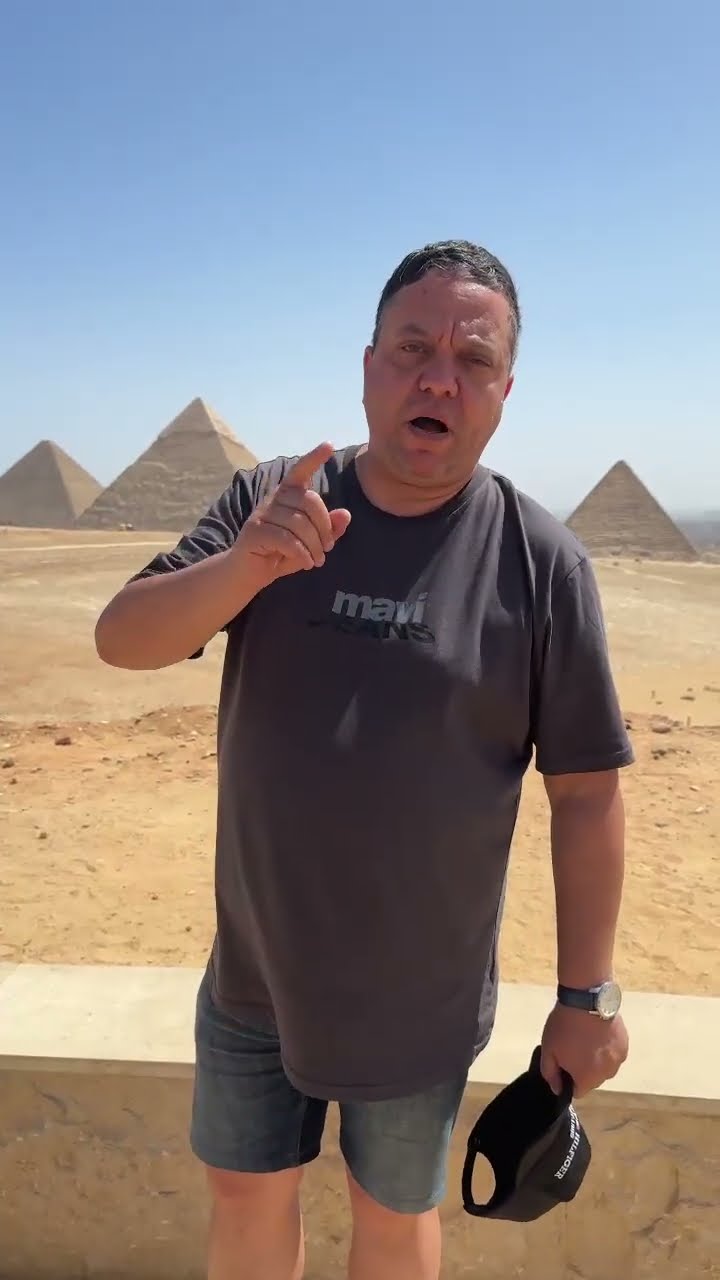
The three main pyramids on the Giza Plateau were built for the Fourth Dynasty kings Khufu, Khafre and Menkaure about 4,500 years ago. The Great Pyramid of Khufu is the largest of them, and the only one of the Seven Wonders of the Ancient World still standing. Your guide explains how they were built, how the plateau worked as a royal cemetery, and why the sides of the pyramids are aligned so closely to the four points of the compass. The panoramic viewpoint gives the classic view of all three pyramids together. Going inside the Great Pyramid needs a separate ticket bought at the site.
Below the pyramids you see the Great Sphinx, carved from the bedrock of the plateau, and the Valley Temple of Khafre, built of huge granite blocks, where the funeral rites of the king began.
Lunch is at a local restaurant near the plateau. In August the early afternoon is hot, so the visit is planned to end before the worst of the heat. You then transfer to Cairo airport for the domestic flight to Luxor, about 1 hour.
Our representative meets you at Luxor airport and drives you to your hotel, about 20 minutes. Your guide confirms the pick-up time for eclipse day and checks that everyone has eclipse glasses. Keep the evening quiet: tomorrow is the main day of the trip.
After breakfast your guide collects you from the hotel and drives you to Karnak, on the northern edge of Luxor. You arrive well before the partial phase begins, late in the morning. Access and the viewing places inside the temple on 2 August depend on the arrangements made by Egypt's Ministry of Tourism and Antiquities for the day; we confirm the details with your booking. While you wait, your guide walks you through the temple: the Great Hypostyle Hall with its 134 columns, the obelisks of Thutmose I and Hatshepsut, and the Sacred Lake.
The Moon starts to cover the Sun late in the morning. For about an hour and a quarter the light changes slowly: shadows sharpen, the air cools a little and the colours flatten. Watch this partial phase only through certified eclipse glasses. Totality comes around 1 pm local time and lasts a little more than six minutes over Luxor. In those minutes the sky darkens enough for bright planets and stars to appear, the solar corona shows around the black disc of the Moon, and a ring of sunset colours lies along the horizon. Only during totality is it safe to look without glasses; put them back on as soon as the first bright point of the Sun returns. The partial phase then runs on until the middle of the afternoon.
Karnak was the largest temple of Amun-Ra, the god who joined Amun with the sun god Ra, and it was enlarged by pharaohs over some 2,000 years. Watching the Sun disappear above it is the reason this tour starts in Luxor.
After lunch at a local restaurant you have a rest at the hotel through the hottest hours. Later in the afternoon you visit Luxor Temple, in the centre of the modern town, built mainly under Amenhotep III and Ramses II. One of the two obelisks of its entrance still stands; the other has been in the Place de la Concorde in Paris since 1836. In ancient times the Opet festival carried the statue of Amun from Karnak to this temple along the Avenue of Sphinxes, about 2.7 km long, which has been restored and reopened.
You are back at the hotel in the early evening. Dinner is not included, so the evening is free for a meal by the river.
You check out after an early breakfast and cross the Nile to the West Bank, about 30 minutes from the hotel. The Valley of the Kings holds more than 60 tombs cut into the hills for the pharaohs of the New Kingdom, between about 1550 and 1070 BC. The standard ticket opens three of the tombs open on the day; your guide chooses them with you. The tombs of Tutankhamun, Seti I and Ramses VI need a separate ticket bought at the site. Inside, the painted corridors show the king's journey through the underworld at night and his rebirth with the sun at dawn: a fitting subject the day after the eclipse. Our guide to the best tombs in the Valley of the Kings helps you choose.
At Deir el-Bahari, the temple of Queen Hatshepsut rises in three terraces against the cliffs. She ruled as pharaoh for about two decades in the 15th century BC, and the reliefs record her trading expedition to the land of Punt. The walk from the car park to the upper terrace is in full sun, so take water.
On the way back you stop at the Colossi of Memnon, two seated statues of Amenhotep III about 18 metres tall, which once stood at the entrance of his mortuary temple. Lunch is at a local restaurant on the West Bank.
You transfer to Luxor airport for the domestic flight to Cairo, about 1 hour. Our representative meets you on arrival and drives you to your hotel for the last night. The evening is free.
After breakfast you check out, and your luggage stays in the vehicle for the day. The Egyptian Museum on Tahrir Square, opened in 1902, was for more than a century the home of Egypt's great collections. Tutankhamun's treasures have since moved to the Grand Egyptian Museum at Giza and the royal mummies to the National Museum of Egyptian Civilization, but the old building still holds thousands of pieces: the Narmer Palette, which records the unification of Egypt around 3100 BC, Old Kingdom statues, and the gold and silver burial treasures of the kings of Tanis. Your Egyptologist chooses a route of about two hours through the key rooms.
The Citadel was begun by Salah ad-Din (Saladin) in 1176 to defend Cairo, and it remained the seat of Egypt's rulers for some 700 years. You visit the Mosque of Muhammad Ali, built between 1830 and 1848, with its large domes and slim minarets, and the terrace beside it, which looks over the minarets of medieval Cairo. Shoulders and knees should be covered, and shoes come off inside the mosque.
After lunch at a local restaurant you walk through Khan el-Khalili, a market since the late 14th century, with lanes of lamps, spices, silver and fabric. There is time to shop or to sit for a mint tea.
Your private vehicle takes you to Cairo International Airport, 30 to 60 minutes depending on traffic, for your international flight. Airlines usually ask you to be at the airport three hours before departure, so this day suits a flight in the late evening; if yours leaves earlier, tell us when you book and the day is shortened. This is the end of the tour.
Comfortable, well located
More space and better ships
Our highest level
Children pay less, see the children policy below. Christmas, New Year and Easter dates add 25%. Prices are per person in US dollars.
The dates are fixed by the eclipse: the tour runs from 1 to 4 August 2027. Early August is high summer. Daytime temperatures are often 40 °C or more in Luxor and around 35 °C in Cairo, with strong sun and little shade at the temples, and evenings stay warm. Hotels and domestic flights around 2 August are in very high demand, so rooms and seats are held only once a booking is confirmed; the earlier you book, the better the choice of hotels.
Many nationalities can buy a tourist visa on arrival at Cairo airport or apply for an e-visa in advance on Egypt's official portal, visa2egypt.gov.eg. The rules and the fee depend on your passport, so check them before you book your flights. Your passport should be valid for at least six months from the day you arrive. Because Day 1 starts with sightseeing, an e-visa obtained before travel saves time at the airport. The visa is not included in the tour price.
The currency is the Egyptian pound. Cards are accepted in most hotels and larger shops; keep some small notes for markets, toilets at some sites and personal extras, and for cold drinks on eclipse day. Tips are not included in the price. The tipping guide in the travel policies below gives the usual amounts; how much you give is your choice.
All prices are per person in US dollars. The price changes with the season (winter 1 October to 30 April, summer 1 May to 30 September), the accommodation level and the size of the group. Christmas, New Year and Easter dates add 25%. Your quote lists the final price and everything it covers. After the deposit, changes to your itinerary cost US$25 per request, plus any third-party fees.
A deposit of 30% of the total tour cost is required at the time of booking. The final payment is due 30 days before departure, and bookings made within 30 days of departure are paid in full. We accept Visa or Master Card by secure online payment, Visa or Master Card by email, and wire transfer. We confirm every booking by email.
No-show travelers are charged 100%. During peak events in Egypt, hotels and Nile cruises do not refund deposits. Groups of more than 10 people may have different terms.
Add each child and their age in the enquiry form so the quote is exact.
Optional visits, such as a hot air balloon ride in Luxor, a Sound and Light show or a felucca ride, are not in the price. Tell us which ones you want and we add them to your quote with their cost.
Not included in the price: Overseas flights; Visa upon arrival; Trip coverage; Tips; Uncovered meals and beverages.
Tipping is customary in Egypt and is not included in the price. A usual amount for a private tour is US$8 to 10 per person per day for your guide, US$4 to 5 for your driver and US$5 to 8 per person per day for the crew on a Nile cruise. Your guide can advise you on the day.
The eclipse is on Monday 2 August 2027. Over Luxor the partial phase begins late in the morning, totality comes around 1 pm Egypt summer time and lasts a little more than six minutes, and the partial phase ends in the middle of the afternoon. Exact times to the minute depend on where you stand; your guide confirms them for Karnak before the day.
Clouds are very rare over Luxor in early August, which is one reason the city is a favoured place to watch this eclipse. The tour runs on the same plan whatever the weather.
No. Bring certified eclipse glasses (standard ISO 12312-2) for each person, and a proper solar filter for any camera lens, binoculars or telescope. Ordinary sunglasses do not protect your eyes during the partial phases.
Expect 40 °C or more in Luxor in the middle of the day and around 35 °C in Cairo. The sightseeing is kept to the cooler hours where the plan allows, with a rest at the hotel after the eclipse. Children can join; make sure they drink often, wear hats and keep their eclipse glasses on during the partial phases.
Yes. Because the tour is private, nights can be added in Cairo or Luxor, or the trip can be extended to Aswan, a Nile cruise or the Red Sea. Hotel space around 2 August is limited, so tell us early what you would like to add.
Independent reviews on the platforms travelers already trust.
Amazing Egyptian vacation! We did an 11 day private tour of Cairo, cruise on the Nile between Aswan and Luxor and a 4 day stay in Hurghada. The guided tours were very interesting, with extremely knowledgeable guides, attentive and helpful.
Egypt package to the Pyramids of Giza and Saqqara was a fascinating journey through Egypt's ancient past ,guide knowledge, the majesty of the pyramids, and the historical depth of Saqqara made this tour truly enriching!
our honeymoon to Egypt ,Giza and Saqqara was a magical escape into history The pyramids looming in the distance, the quiet serenity of the desert, and the ancient wonders of Saqqara created moments that will be with me forever!
We always use the cookies this site needs to work. With your permission we also use the optional ones listed under Settings. You can change your choice at any time. Privacy policy