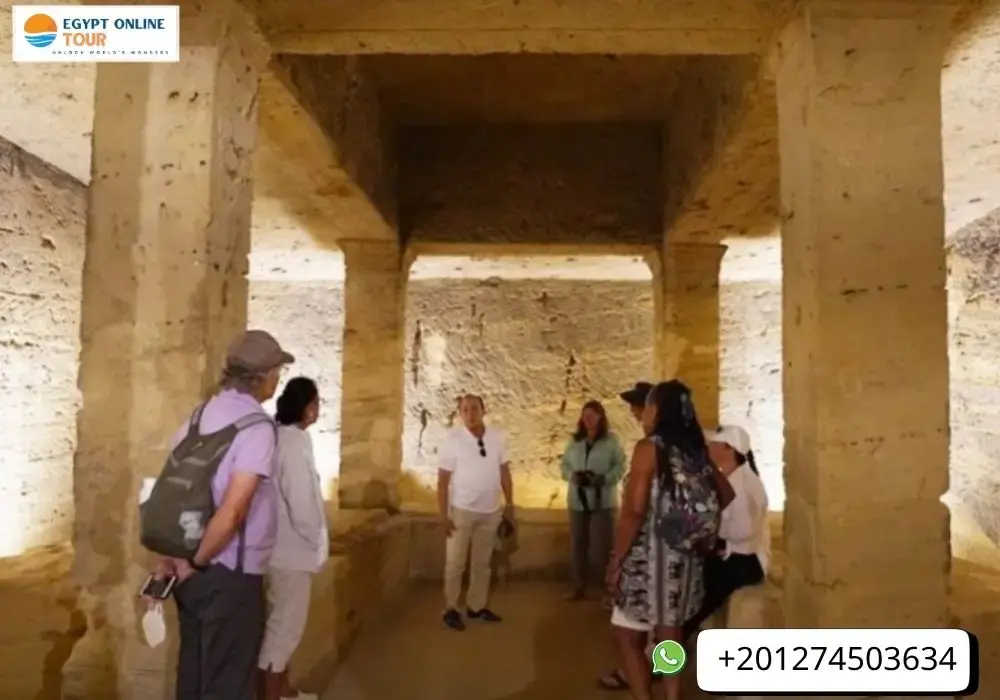
The Catacombs of Kom el Shoqafa are a three-level underground tomb complex in the Karmouz district of Alexandria, cut into the rock in the 2nd century AD and used for burials until the 4th century. They are the best place in Egypt to see Egyptian, Greek and Roman funerary art mixed in one design: the god Anubis appears here in Roman armour. The site is open daily from 9:00 to 17:00, and the official foreign ticket was EGP 200 (student EGP 100) on the latest ministry price list we could check.
Our guides include the catacombs in almost every Alexandria day. This guide explains what you see on each level, the history and the discovery, and the practical details: tickets, time needed, steps, photos and what to combine it with.
Kom el Shoqafa at a glance
| Item | Details |
|---|---|
| Location | Karmouz, western Alexandria, a few minutes from Pompey's Pillar |
| Date | Cut in the 2nd century AD; burials until the 4th century |
| Discovered | 1900, when a donkey fell into the access shaft |
| Layout | Spiral staircase, rotunda, banquet hall, main tomb, hundreds of burial niches, on three levels |
| Opening hours | Daily 9:00 to 17:00 |
| Ticket (foreigners) | EGP 200 adult, EGP 100 student (ministry list updated November 2024; check at the gate) |
| Time needed | 45 minutes to 1 hour |
What does Kom el Shoqafa mean?
"Kom el Shoqafa" is Arabic for "mound of shards". Families who came to the tombs to eat and drink in memory of their dead broke the clay jars and plates they had used, rather than carry them home, and over the centuries the broken pottery built up into a mound above the tombs. The name stayed long after the tombs were forgotten.
History and discovery
Alexandria was founded by Alexander the Great in 331 BC and became the capital of the Ptolemies, then a great city of the Roman Empire. Its people were Egyptian, Greek, Roman and more, and their burials mixed traditions. Kom el Shoqafa was cut in the 2nd century AD, in the time of the Antonine emperors. It probably began as the tomb of one wealthy family and grew into a larger burial place used by others, as more chambers and niches were added.
The tombs were then forgotten for some 1,500 years. In 1900 a donkey pulling a cart fell through the ground into the access shaft, and the excavations that followed revealed the whole complex.
What you see inside, level by level
The spiral staircase and the central shaft
You enter down a wide spiral staircase wound around a round shaft. The bodies of the dead were lowered on ropes down this shaft to the lower levels, while the mourners walked down the stairs. Light still comes down the shaft today.
The rotunda
The stairs lead to a round hall around the central shaft, the hub from which the other rooms open.
The triclinium: the funeral banquet hall
To the left of the rotunda is the triclinium, a room with three stone benches cut into the rock, where families lay down to eat a memorial meal, as Romans did at dinner. Look for the low couches: they explain the mound of shards outside.
The main tomb
Down a second stair is the heart of the complex: a small temple-like tomb. Its facade is Egyptian in form, with two columns with papyrus and lotus capitals, but the details are Greek and Roman. Two large serpents guard the door, each wearing the double crown of Egypt and carrying symbols of Greek gods, with a Medusa head above them. Inside, three sarcophagi are cut out of the rock in niches; they were never meant to be moved.
On the walls the scenes are pure Alexandria. A mummy lies on a lion-shaped bed, attended by Egyptian gods in traditional style. Beside the door to the burial chamber, Anubis, the jackal-headed god of embalming, stands in the armour of a Roman soldier, and nearby a figure with a jackal head has the body of a serpent. These mixed images are the reason to come.
The burial galleries
Around the main tomb run corridors lined with hundreds of loculi, rectangular niches for individual burials, each once closed with a slab. These show how the complex became a shared burial place.
The third level
The lowest level was flooded by groundwater for most of the 20th century. Restoration has reduced the water, but parts of the lower level can still be wet or closed. Do not expect to walk all of it.
The Hall of Caracalla
A separate group of chambers, entered from the rotunda area, held the bones of both people and horses. It is often linked with the Roman emperor Caracalla, who ordered a massacre of young Alexandrians in AD 215, but that link is a theory and not proven. The hall is sometimes closed.
Monuments in the garden
In the open area above the catacombs you see stone sarcophagi, statues and a small tomb façade brought here from other ancient cemeteries of Alexandria. Spend ten minutes here before or after going down.
Why the catacombs matter: three cultures in one tomb
| Influence | Where you see it |
|---|---|
| Egyptian | The temple-shaped tomb, the mummy on a lion bed, Anubis, Thoth, Horus, the winged sun disc |
| Greek | Medusa heads, the serpent of good fortune (agathodaemon), the realistic carving of faces |
| Roman | The banquet hall, the shared galleries of loculi, Anubis in Roman military dress |
Nowhere else in Egypt shows so clearly how people in Roman Alexandria held on to the old Egyptian promise of eternal life, while expressing it in the style of the Greek and Roman world they lived in.
Flooding and conservation
Groundwater is the great enemy of the catacombs. Alexandria is low-lying, and over the 20th century the rising water table flooded the lowest level and damaged the soft rock and the plaster of the lower chambers. Pumping and drainage works have lowered the water, which is why parts of the third level can now be seen, but the problem has not gone away: after wet winters some areas may be closed again. The soft limestone also suffers from salt and humidity, so please do not touch the reliefs, however tempting the details are.
With a guide, on a tour or alone?
- Alone: easy to reach by taxi or app, and the site is compact. Good if you already know the story and only want to look.
- With a licensed guide: the best way to understand the mixed symbols of the main tomb. Guides cannot be hired reliably at the gate, so arrange one in advance.
- On a day tour from Cairo: the catacombs, Pompey's Pillar, Qaitbay and the Library in one day, with transport. The most practical choice if you are based in Cairo.
Visiting the catacombs: practical tips
Tickets and hours
Buy the ticket at the gate. The ministry list last updated in November 2024 gives EGP 200 for a foreign adult and EGP 100 for a foreign student, with hours from 9:00 to 17:00; some travel listings show older, lower prices. Prices in Egypt rise often, so carry a little more than the listed price, and a card in case cash is not accepted. Arrive at least an hour before closing.
How long do you need?
About 45 minutes to an hour, including the garden. The catacombs are compact; most of the time goes on looking closely at the reliefs in the main tomb.
Best time to visit
Alexandria is milder than Cairo all year, and the catacombs stay cool underground, so any season works. Mornings are calmer, before coach groups arrive from Cairo around midday. In winter, Alexandria can be rainy and windy; that is also when lower areas are most likely to be wet or closed.
Steps, air and mobility
- You walk down a long spiral staircase and back up the same way; some steps are uneven, with handrails in places.
- The air underground is cool but humid; in summer it is a welcome break from the heat.
- The galleries are lit, but some corners are dim. Wear shoes with grip, because floors can be damp.
- The site is not suitable for wheelchairs, and those with knee problems should take the stairs slowly.
Photography
Rules on photography have changed over the years. Ask at the ticket office; when photos are allowed, flash is not.
How to get there and what to combine it with
The catacombs are in western Alexandria, a short drive from the centre and the Corniche. Use a taxi, a ride-hailing app or your tour car; parking is close to the gate. From Cairo, Alexandria is about two and a half to three hours by road or by train, so most visitors see the catacombs on a day trip or as part of a stay of a night or two.
A classic Alexandria day, in this order:
- Kom el Shoqafa in the morning.
- Pompey's Pillar and the Serapeum, a few minutes away. Our article on the Serapeum of Alexandria explains the site.
- Lunch by the sea.
- The Citadel of Qaitbay, on the site of the ancient Lighthouse.
- The Bibliotheca Alexandrina, if it is open on your day.
Our guide on what to see in one day in Alexandria gives the full plan, and should you visit Cairo or Alexandria helps if you are short on time.
Plan it with us
Our Alexandria archaeological day tour covers the catacombs, Pompey's Pillar, Qaitbay and the Library with a private Egyptologist and car from Cairo. More options are in our Alexandria day tours.
Kom el Shoqafa: quick answers
Why is it called Kom el Shoqafa?
The name means "mound of shards" in Arabic: visitors to the tombs broke the jars and dishes from their memorial meals and left them on the site.
How much time should I allow?
About 45 minutes to an hour, including the garden of sarcophagi above.
What are the opening hours?
Daily from 9:00 to 17:00 on the ministry's list. Arrive at least an hour before closing.
How were the catacombs discovered?
In 1900 a donkey fell through the ground into the access shaft, and excavation revealed the tombs.
Is Kom el Shoqafa suitable for children?
Yes, for children who can manage stairs. Most enjoy the spiral staircase and the "dog-headed soldier".
Ahmed Samir writes and updates the Egypt travel guides of Egypt Online Tour, a licensed tour company based in Cairo (ETAA licence 1466). Our travel advisors review each guide before it is published.
All guides by Ahmed Samir