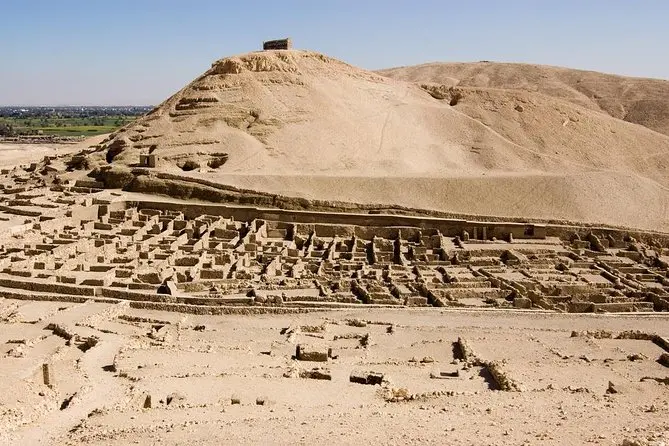

Luxor Temple was built mainly in the 14th century BC, by Amenhotep III, who reigned around 1390 to 1352 BC. Ramesses II added the great entrance pylon, the obelisks and the first courtyard about a century later (around 1279 to 1213 BC), and later rulers, from Alexander the Great to the Romans, kept changing it. So the honest answer to "when was the Luxor Temple built?" is: over about 1,500 years, with the core you see today finished roughly 3,400 years ago.
Our guides walk through Luxor Temple with travellers almost every day, and the best way to understand it is to read it as a timeline: each part was added by a different king, and you walk from the newest (at the entrance) to the oldest (at the back). This guide follows that order.
Luxor Temple timeline at a glance
| Period | Ruler | What was built |
|---|---|---|
| About 1473 to 1458 BC | Hatshepsut | The oldest surviving structure, a shrine for the sacred boats, later rebuilt into the courtyard of Ramesses II |
| About 1390 to 1352 BC | Amenhotep III | The core of the temple: sanctuary, hypostyle hall, the great sun court and the colonnade of 14 columns |
| About 1336 to 1295 BC | Tutankhamun and Horemheb | Decoration of the Great Colonnade with scenes of the Opet Festival |
| About 1279 to 1213 BC | Ramesses II | The first pylon, two obelisks, six colossal statues and the peristyle court |
| 380 to 362 BC | Nectanebo I | The sphinx-lined avenue to Karnak in its final form |
| About 330 BC | Alexander the Great | A new granite shrine for the sacred boat inside Amenhotep III's sanctuary |
| Late 3rd century AD | Romans (Diocletian) | A legionary fort around the temple; one hall turned into a shrine of the imperial cult |
| From the 4th century AD | Christians | Churches inside and around the temple |
| 13th century AD | Muslims | The mosque of Abu al-Haggag, built on the buried first courtyard and still in use |
Dates follow the Ministry of Tourism and Antiquities; Egyptologists' dates for the New Kingdom vary by a few years.
Who built the Luxor Temple?
Amenhotep III, the main builder
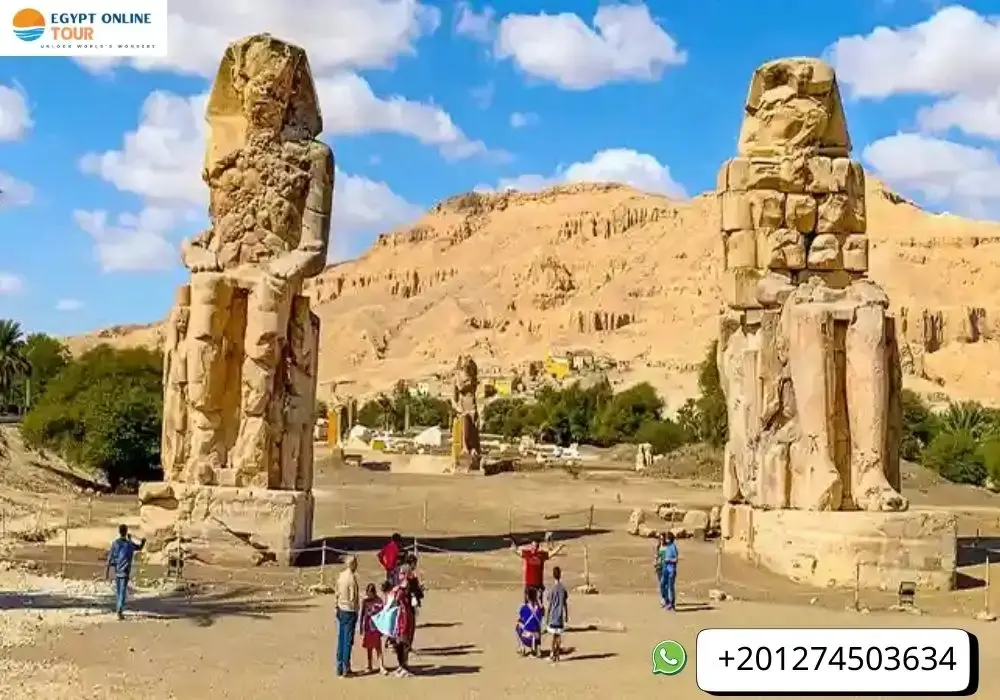
Amenhotep III ruled Egypt at the height of its wealth, and he rebuilt Luxor on a grand scale. His work is everything behind the colonnade: the elegant sun court with its double rows of papyrus columns, the hypostyle hall and the inner rooms. In one of those rooms the walls show his "divine birth", the story that the god Amun fathered him, which was the point of the whole temple: to prove the king was the son of the god. He also built the Colossi of Memnon across the river; read our King Amenhotep III article for more about him.
Ramesses II, the showman at the entrance
Ramesses II gave the temple its public face. His pylon, about 65 metres wide, is carved with his version of the Battle of Kadesh. In front of it stood two red granite obelisks, about 25 metres tall, and six colossal statues of the king (two seated, four standing). He also added the large peristyle court, which he built at an angle to the main axis so that it would include Hatshepsut's older boat shrine.
The others who left their mark
Tutankhamun and Horemheb finished the reliefs of the Great Colonnade, where you can still follow the Opet procession boat by boat. Alexander the Great, who presented himself as pharaoh, had a new shrine built for Amun's boat, and he is shown on its walls as an Egyptian king making offerings. In the Roman period the temple became part of a military camp; the painted Roman frescoes of the emperors in the former offering hall were restored in recent years.
Why was Luxor Temple built?
Unlike most Egyptian temples, Luxor was not built for one god's daily cult. The ancient Egyptians called it Ipet-resyt, the "Southern Sanctuary", and it existed for the Opet Festival. Every year, during the Nile flood, the statues of Amun, his wife Mut and their son Khonsu travelled in sacred boats from Karnak to Luxor, along the river or the avenue of sphinxes. At Luxor the king met the god in the sanctuary, and his royal power was renewed. In the New Kingdom the festival lasted from 11 days under Thutmose III to more than three weeks under Ramesses III.
That is why the temple faces north, towards Karnak, instead of facing the river like most temples. It is the end point of a sacred road.
How was the Luxor Temple built?
The temple is built mostly of sandstone from the quarries of Gebel el-Silsila, about 160 km south of Luxor, between Edfu and Kom Ombo. The blocks were cut in the quarry, loaded onto barges and floated north on the Nile, ideally during the flood when the water came closer to the building sites. The obelisks and colossal statues are of granite from Aswan. Cruise ships still sail that stretch of the river: the 3-night program of the deluxe-class M/S Lady Carol stops at Kom Ombo and Edfu on Day 2, on its way from Aswan to Luxor.
The builders used no mortar to bind the blocks; they were cut to fit and set with a thin gypsum mortar as a lubricant. Ramps of mudbrick and rubble were used to raise them, and the columns were built from drums, then carved and painted in place. Traces of the original paint survive in the inner rooms and are clearer after the cleaning of recent years.
What happened to the temple after the pharaohs
When the old religion ended, the temple did not. Roman soldiers lived in it, Christians built churches in its courts, and from the Middle Ages the town of Luxor grew over and inside it. By the 19th century the temple was half buried under houses, with only the tops of the columns and the pylon visible. In the 13th century the mosque of Abu al-Haggag, a Sufi saint of Luxor, was built on top of this rubble, which is why its door today hangs several metres above the floor of Ramesses II's courtyard.
Clearing started in the 1880s under Gaston Maspero, and the houses were moved away over the following decades; the mosque stayed and is still used for prayer. In 1989, workers found a buried cache of statues in the sun court of Amenhotep III; the finest are now in the Luxor Museum. In 1979 the temple became part of the UNESCO World Heritage site "Ancient Thebes with its Necropolis".
The missing obelisk in Paris
Only one of Ramesses II's obelisks still stands at the entrance. The other was given to France by Muhammad Ali Pasha and has stood on the Place de la Concorde in Paris since 1836.
How big is the Luxor Temple?
- Length: about 260 metres from the pylon to the sanctuary.
- The Great Colonnade: 14 papyrus columns in two rows, about 19 metres tall.
- The standing obelisk: about 25 metres.
- The Avenue of Sphinxes: about 2.7 km to Karnak, reopened to visitors in November 2021 after decades of excavation.
Karnak is far bigger, a complex of temples built over 2,000 years; Luxor is compact and easy to read in one visit. Our facts about Karnak Temple explain the difference.
Luxor Temple facts our guests remember
- More than 3,000 years of worship in one place. Egyptian gods, the Roman emperor cult, Christian churches and a working mosque have all used the same site.
- The temple leans. The axis bends twice, between the pylon, the court of Ramesses II and the colonnade, to keep older shrines in place and to line up with the road to Karnak.
- Ramesses II signed other kings' work. Several colossal statues in his court were made for earlier kings and re-inscribed with his name.
- The sphinxes changed shape. The ones near Luxor Temple have human heads with the face of Nectanebo I; nearer Karnak they have ram heads, the animal of Amun.
- A golden parade came back. When the Avenue of Sphinxes reopened in November 2021, Luxor staged an evening procession along it in memory of the Opet Festival.
- It was buried by a town. Old photos from the 1850s show houses and pigeon towers built on the roof of the colonnade.
Visiting Luxor Temple today
| Opening hours | Daily, 6:00 to 20:00 (official hours at the time of writing) |
|---|---|
| Foreign adult | EGP 500 |
| Foreign student | EGP 250 |
| Egyptian adult / student | EGP 40 / 20 |
| Time needed | 1.5 to 2 hours |
We last checked these prices on the Ministry's site on 5 November 2026. Tickets are sold at the gate (cards are accepted) and the temple is also covered by the Luxor Pass.
Day or night?
Luxor Temple is the one temple in Egypt we recommend seeing after dark. It sits in the centre of town, it stays open into the evening and the floodlights bring out the carvings in a way daylight does not. The best plan is to arrive about an hour before sunset: you see the reliefs in daylight, the pylon turns gold, and you leave under the lights. Early morning, right at opening, is the alternative if you want photos without people. If you arrive by river, the temple comes on your first day: the 4-night program of the deluxe-class Chateau Lafayette starts in Luxor with Karnak and Luxor Temple.
A route through the temple
- Start at the end of the Avenue of Sphinxes and the pylon with the obelisk and seated colossi.
- Enter the court of Ramesses II and look up at the door of the Abu al-Haggag mosque.
- Walk through the Great Colonnade; find the Opet procession on the walls.
- Cross the sun court of Amenhotep III, the most elegant space in the temple.
- Finish in the inner rooms: the Roman frescoes, Alexander's shrine and the birth room.
Practical tips
- Wear comfortable shoes; the ground is uneven and sandy.
- Photos are free for phones and cameras without a tripod; flash is not used inside.
- Carry water in summer; even at night it can be 30°C between May and September.
- From the Corniche hotels you can walk; from the West Bank take the public ferry or a motorboat.
Luxor Temple pairs well with Karnak on a half day; read what to see on the Luxor East Bank and how many days you need in Luxor to plan the rest.
Plan it with us
Our private East Bank tour in Luxor covers Luxor and Karnak temples with an Egyptologist, and you can choose a late-afternoon start to finish at Luxor Temple under the lights. For more ideas see our Luxor day tours.
Luxor Temple: quick answers
Who built the Luxor Temple?
Amenhotep III built the core around 1390-1352 BC. Ramesses II added the pylon, obelisks, colossi and first court; Tutankhamun, Horemheb, Alexander the Great and the Romans added later parts.
How old is the Luxor Temple?
The main temple is about 3,400 years old. Its oldest surviving part, Hatshepsut's shrine, is a little older.
Which god was Luxor Temple built for?
For Amun, with Mut and Khonsu, and for the kingship itself: it was the setting of the yearly Opet Festival.
Is Luxor Temple open at night?
Yes, the official hours run to 20:00, so you can see it lit after sunset for most of the year.
Ahmed Samir writes and updates the Egypt travel guides of Egypt Online Tour, a licensed tour company based in Cairo (ETAA licence 1466). Our travel advisors review each guide before it is published.
All guides by Ahmed Samir