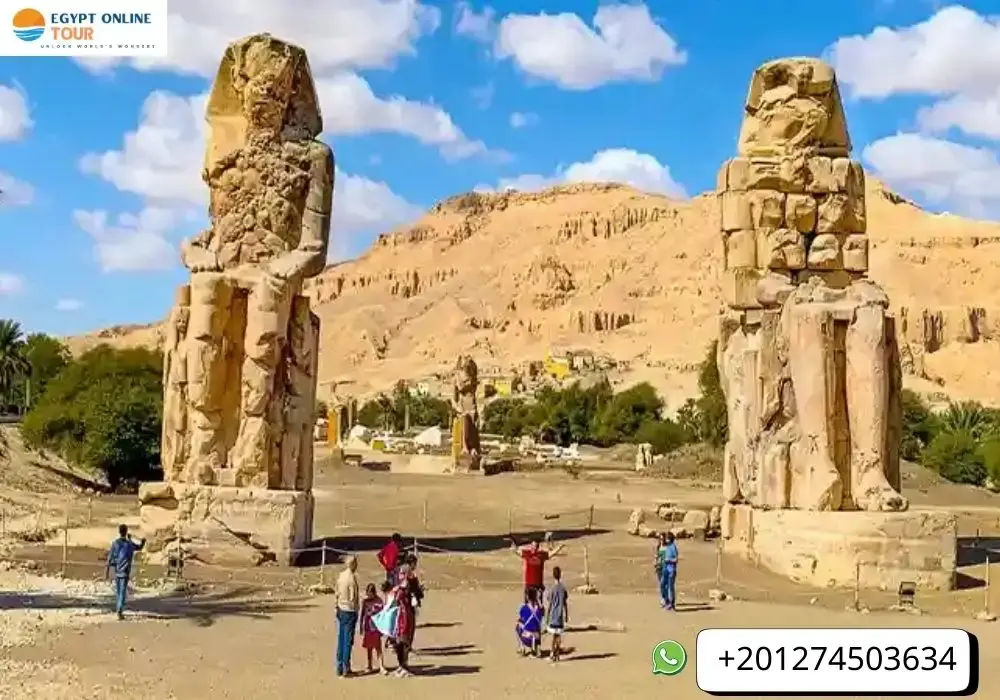
If your trip includes Luxor, you’ve probably heard the name Colossi of Memnon — two massive statues standing like guardians of time itself. If you’re wondering what makes the Colossi of Memnon so fascinating, you’re in the right place.
This isn’t just an ancient ruin; it’s the story of a powerful pharaoh from over 3,400 years ago, surrounded by legends that once linked the statues to mysterious sounds carried by the wind.
What Are the Colossi of Memnon?
The Colossi of Memnon are two massive stone statues standing on Luxor’s West Bank for more than 3,400 years. Today, they are the most prominent remains of a once-enormous mortuary temple built for King Amenhotep III, one of the most powerful rulers of ancient Egypt.
While the temple itself disappeared over time due to floods and earthquakes, the two statues have remained standing as silent witnesses to history.
What makes this site truly remarkable is that you’re not just looking at old stone structures — you’re standing in front of symbols of an empire that once dominated the region.
This was a place filled with royal ceremonies and sacred rituals, and that’s why the Colossi remain a key stop on any West Bank tour in Luxor
Two Seated Statues of Amenhotep III
The statues represent King Amenhotep III seated formally on his throne, facing east toward the sunrise — a powerful symbol of rebirth and renewal in ancient Egyptian belief.
Carved along the sides of the throne are smaller figures representing members of the royal family. This artistic detail symbolized authority, stability, and divine kingship.
In ancient times, these statues stood at the entrance of the king’s mortuary temple, serving as the first monumental sight visitors would encounter.
Many of our Egypt tour packages feature the Colossi of Memnon as a key stop in Luxor.
Date of Construction (18th Dynasty)
The Colossi were built during the 18th Dynasty of the New Kingdom, around the 14th century BC. This period marked one of the most prosperous and culturally advanced eras in ancient Egyptian history.
The reign of Amenhotep III, in particular, was known for peace, wealth, and ambitious architectural projects.
The statues were carved from quartzite sandstone, transported from distant quarries — an impressive logistical and engineering achievement for its time.
Moving and erecting stone blocks of this scale demonstrates the extraordinary organization and technical skill of ancient Egyptian builders.
Enjoy a private sunrise visit to the Colossi of Memnon with our Luxury Egypt Tours.
History of the Colossi of Memnon
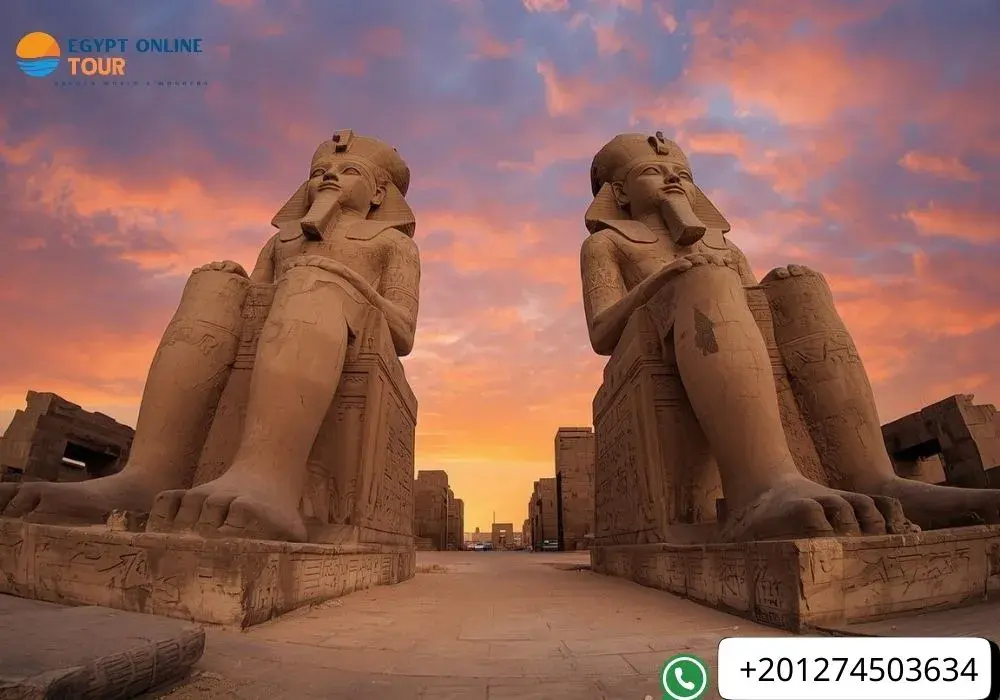
Where Are the Colossi of Memnon Located?
Hey everyone! The giant statues Colossi of Memnon are standing on Luxor’s West Bank, right in front of what used to be Amenhotep III’s mortuary temple, most of which has disappeared over time.
This spot is perfect for anyone wanting to explore the West Bank’s historical treasures, especially American tourists arriving on a Nile cruise.
With egyptonlinetour.com, you can reach them easily in about 10 minutes from the Valley of the Kings in air-conditioned cars, all organized with a clear map of distances — something you won’t find with other tour operators.
Exact Position on Luxor’s West Bank
The statues are located in modern-day Sheikh Abd el-Qurna village, just northwest of the Valley of the Kings, overlooking the Nile to the east, so the morning sun beautifully lights them up.
Originally, they guarded the entrance to a massive temple even larger than Karnak at the time, but floods and earthquakes destroyed most of it.
GPS coordinates: 25.7206° N, 32.6108° E — easy to reach from any hotel in Luxor or from the cruise dock. The area is open with no walls, so you can view the statues from afar or walk right up to them.
Every Luxor and Aswan Nile Cruise route features the legendary Colossi of Memnon.
Distance from the Valley of the Kings
The Colossi of Memnon are about 5 km (roughly 3 miles) from the Valley of the Kings, around 10 minutes by tour car or 15 minutes on foot if you enjoy a short walk.
This makes them a convenient and essential stop before visiting the Valley of the Kings and the Temple of Hatshepsut.
If coming from Luxor Airport, it’s about 12 km (20 minutes by car), and from the cruise dock in Corniche, around 7 km (15 minutes).
With the West Bank Full Day tour from egypt online tour ($150), you get the Colossi + Valley of the Kings + lunch all organized — no need to pay separately for each stop like most other tour operators.
Dimensions and Construction Details
Guys, the Colossi of Memnon are a true ancient Egyptian engineering masterpiece, over 3,400 years old! Each statue weighs around 720 tons — roughly like 10 elephants standing side by side.
With egyptonlinetour, you can see them on a Luxor tour with a guide explaining how they were moved and constructed.
Height and Scale
Each statue is about 18 meters (60 feet) tall, not counting the base which adds roughly 4 meters. They sit on thrones, with small carvings of King Amenhotep III’s wife Tiy and the Nile god Hapy at their knees.
The northern colossus is broken above the waist, while the southern one remains mostly intact. Standing in front of them makes you feel tiny — their height is like a 6-story building.
Back in ancient times, they symbolized Amenhotep III’s power before the god Amun, and today, they attract thousands of American tourists taking selfies with these massive statues.
Our Luxury package in Egypt From USA ensures a smooth, guided experience at the Colossi of Memnon.
Material Used (Quartzite Sandstone)
The statues are carved from pink quartzite sandstone, extremely hard and durable, sourced from the Red Mountain near modern Cairo.
Unlike regular sandstone, this stone resists wind, floods, and sun for thousands of years, and shines with a subtle pink hue under sunlight.
The southern statue is carved from a single solid block, while the northern statue was repaired in layers by the Romans after an earthquake — that’s why both have survived until today. Truly, the ancient Egyptian engineering here surpasses anything of its time.
Transportation of the Stone Blocks
The massive blocks were moved about 675 km (420 miles) from quarries near Cairo to Luxor. They used large wooden sleds, lubricated with water and fat, and then floated them down the Nile in giant boats to avoid damage.
This took months of work with thousands of laborers under the supervision of Amenhotep’s chief architect, Amenhotep son of Hapu.
Imagine 720 tons moving without tractors or modern machinery! This is a true testament to the genius of ancient Egyptians.
In 2025, archaeologists even discovered some of the transport tools in excavations. On our tours, you’ll see a miniature model in the museum and understand how they did it without metal or machines.
Adventure meets heritage in the9-Day Tour of Cairo, Luxor, and Aswan, including the Colossi of Memnon.
Why Are the Colossi Called “Memnon”?
These two statues, the Colossi of Memnon, weren’t originally called that by the ancient Egyptians.
They are statues of King Amenhotep III, but the Greeks and Romans gave them the name “Memnon” because of a strange story: the northern statue used to make a sound every morning!
Greek Mythology Connection
Memnon was an Ethiopian hero in the Trojan War, leading his army to defend Troy against the Greeks. When Achilles killed him, his mother Eos, the goddess of dawn, asked Zeus to honor him and make him partly divine, so his voice would rise every morning like music.
Greek travelers who visited Egypt in the 2nd century BC saw the northern statue making this sound and said, “This is Memnon greeting his mother at dawn!” They named the site Memnonium and inscribed Greek and Latin poems and messages on the statues, which are still visible today.
The 15 Days Marvelous Tour Package in Egypt offers an in-depth West Bank exploration including the Colossi of Memnon.
The “Singing Statue” After the Earthquake
In 27 BC, a powerful earthquake struck Luxor and broke the northern statue above the waist, creating cracks in the stone. When morning wind passed through, it made a wailing, lyre-like sound every sunrise.
Romans and travelers would come to hear it and even write messages on the stone: “We heard Memnon’s voice today!” The sound continued for about 200 years until Emperor Septimius Severus repaired the cracks in 200 AD.
After the repair, the sound disappeared, but the statue became stronger. Today, American tourists love imagining that moment when they see the statue on our organized morning tours.
Damage and Restoration History
Guys, the Colossi of Memnon have survived floods and earthquakes for over 3,400 years, but it was the Roman-era earthquake that made the northern statue world-famous.
With egyptonlinetour, you’ll get to see all the restoration traces up close on a 2026 Luxor tour, with a guide explaining every crack and the story behind it. Here’s a quick timeline showing the main damages and restorations — info you won’t find on Wikipedia or from competitors.
Earthquake of 27 BC
In 27 BC, a massive earthquake hit Luxor, breaking the northern statue above the waist and creating cracks in the chest and neck. Later floods buried the temple foundations under debris.
The southern statue survived better but developed minor cracks. This earthquake also triggered the so-called “Singing Era”, as morning winds passing through the cracks created a lyre-like sound.
Roman visitors came to hear it, treating the site almost like an oracle temple, which made it even more famous than the Sphinx in ancient times.
See the Colossi of Memnon as part of the cultural journey in the 8 Days Cairo to Abu Simbel and Back Overland tour.
Modern Conservation Efforts
Since the 1990s, Egyptian and Japanese teams have been running continuous restoration projects. In 2025, they discovered new temple fragments and reinforced the foundations against moisture. They used 3D laser scanning to map the cracks and injected wind-resistant materials. The project continues into 2026 with UNESCO funding.
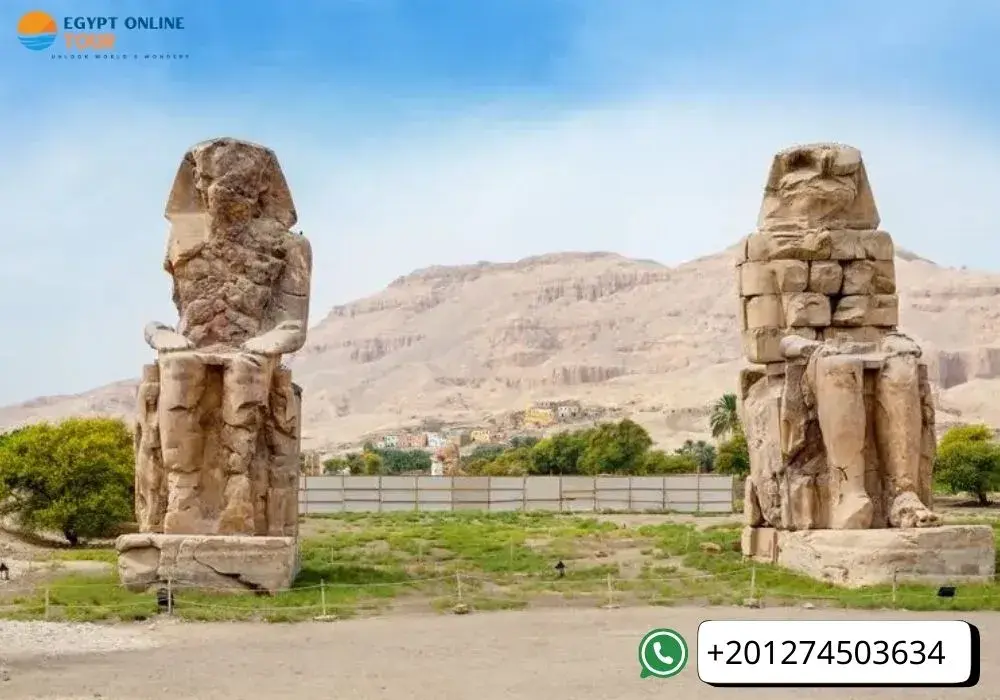
When Was the Colossi of Memnon Built?
The Colossi of Memnon, built circa 1350 BCE, are a powerful and enduring testament to the might and skill of Egypt. After all these yearss they still have the power to amaze.
- Each statue was carved from quartzite sandstone which came from quarries around Cairo, some 700 km from Luxor.
- The transportation of these massive blocks was a feat of engineering that would have required approximation so there is a definite suggestion based on circumstantial evidence that sledges, wooden rollers and the shifting of stones carried by the floodwaters of the Nile played a role in the process.
- When they were brought to Thebes, the statues were erected at the gateway of an immense mortuary temple nearly 700 meters long and 550 meters wide.
- Earthquakes in 27 B.C. and subsequent centuries caused severe damage, especially to the northern statue, whose cracks caused the mysterious “singing” that was heard at sunrise.
But despite centuries of erosion, the Colossi still stand at their original ssite as among the oldest and largest statues of man in existence, serving as silent witnesses to the power of Amenhotep III and the wise prowess of ancient Egyptian builders.
Let our local travel experts help you design the perfect itinerary. Whether you're seeking adventure, culture, or relaxation, we've got you covered!
Landmarks Nearby the Colossi
Going to view the Colossi of Memnon normally fits into a larger excursion. Many tours begin here before venturing more into the West Bank, as they are like a starting point for all the stunning historical sites in Luxor.
- Valley of the Kings (4 km away) is one of the most important places to visit nearby. This is where more than 60 Pharaohs are buried, including the famous tomb of Tutankhamun. Hidden rooms inside hold riches and inscriptions that reveal how ancient Egyptians buried their leaders.
- Located 5 km away, the Temple of Hatshepsut is a gorgeous structure erected into Deir el-Bahari's cliffs for Queen Hatshepsut. Among Egypt's most remarkable buildings, it has layers and columns. Well known for its massive entry gates and elaborate carvings highlighting Ramesses III's military victories, Habu (3 km distant) is the temple where he was honored.
- Ramesseum, located 2 km away, is a temple that Ramesses II built. It is sometimes called the "Mansion of Millions of Years". In the past, it had huge statues nearly as large as the Colossi of Memnon.
- Valley of the Queens (6 km away): Here lie the wives and children of kings, including the famous tomb of Queen Nefertari
- Luxor Temple is in the city of Luxor (East Bank), right in the center.The distance between them is about 4–5 km by road, which takes around 15–20 minutes by car (including crossing the Nile bridge).
Ever wondered when the breathtaking Luxor Temple was built?Read the full story in our article: When Was the Luxor Temple Built
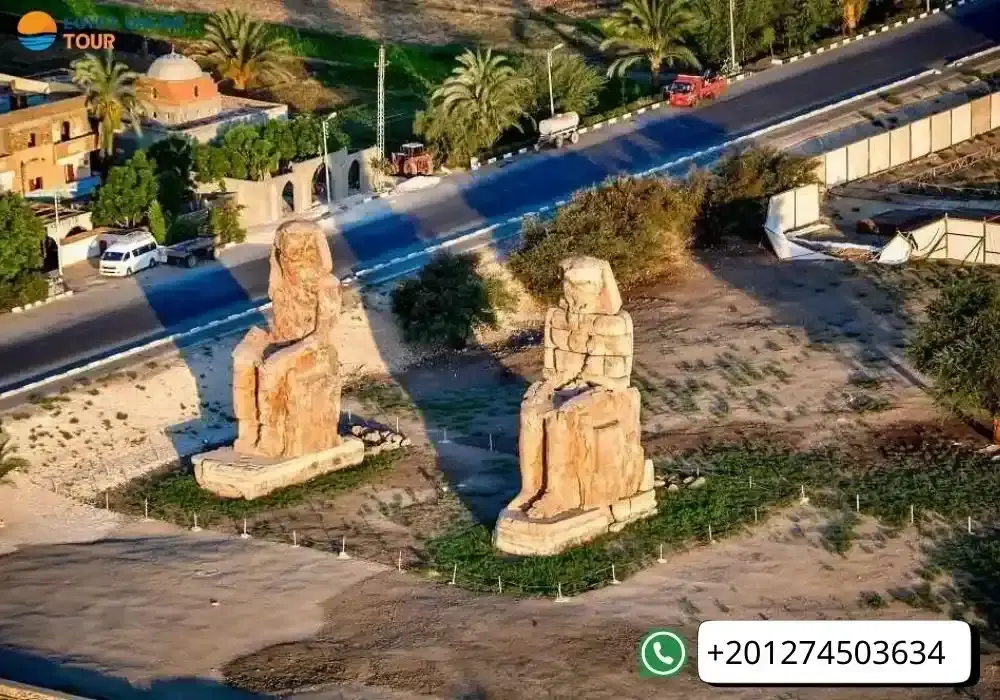
Unique Legends and Myths
Apart from being works of art and engineering marvels from ancient Egypt, the Colossi of Memnon are encased in centuries of stories that changed them into among the most well-known features of the ancient world. From strange sounds at sunrise to artistic inscriptions left by international visitors, the sculptures came to stand for mystery, faith, and cross-cultural interaction.
The Story of the Singing Statues
Apart from being works of art and engineering marvels from ancient Egypt, the Colossi of Memnon are encased in centuries of stories that changed them into among the most well-known features of the ancient world. From strange sounds at sunrise to artistic inscriptions left by international visitors, the sculptures came to stand for mystery, faith, and cross-cultural interaction.
One of the most interesting stories linked to the Colossi is about the "singing statues. " A strong earthquake hit in 27 BCE, causing the northern state to crack in the middle.
When the sunlight first hit the damaged stone, it warmed up fast. As the air squeezed through the cracks, the stone made a weird but lovely sound, which some said was like a harp or a soft bell ringing. People from long ago described the noise as an eerie whistle or hum. The locals thought it was the spirit of Memnon, greeting his mother, who was the goddess Eos (known as Aurora in Roman myths).
This strange sound usually happened at sunrise, making it feel even more magical and fitting with how Egyptians connected the sun's rise to new beginnings. For many years, listening to the statue "sing" was seen as a good sign.
Travelers, poets, and even emperors visited Luxor to experience this wonder. However, after some repairs were done during the reign of Roman Emperor Septimius Severus in the 3rd century CE, the sound eventually disappeared, but the tale of the singing Colossi continued on.
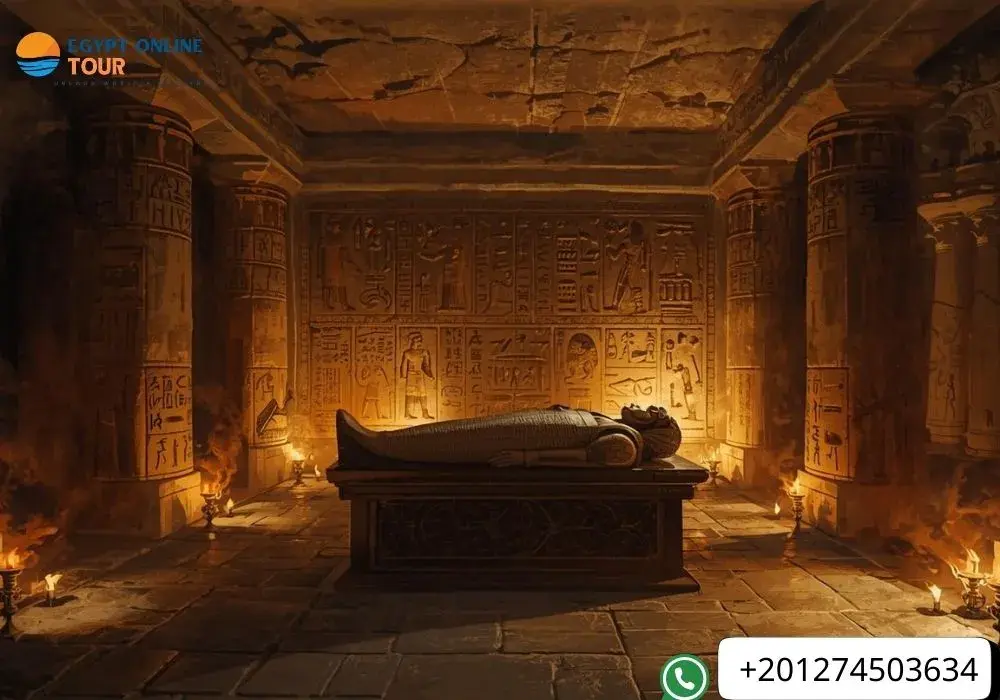
Visiting the Colossi of Memnon Today
Hey everyone! Visiting the Colossi of Memnon is easier than ever in 2026. These massive statues are almost free to visit, and they make a perfect quick stop for American tourists cruising the Nile.
Entrance Fee
Access to the statues is mostly free—no separate tickets are needed. If you get a West Bank ticket (~$12), it covers all West Bank attractions, including the Valley of the Kings, Hatshepsut Temple, and the Colossi themselves—cheaper and easier than paying separately.
On egyptonlinetour tours, everything is pre-paid, so no waiting in lines, perfect for large American groups.
Opening Hours
The statues are open daily from 6 AM to around 5 PM, even on holidays.
- In summer (May–September), they open earlier at 5 AM to beat the heat, closing around 6 PM.
- Winter (October–April) is ideal for Americans visiting on vacation, with temperatures around 20–25°C (68–77°F).
Sunrise is the best time for photos—the golden light hitting the pink sandstone creates stunning shots. Our morning tours start around 5:30 AM from the Marriott Hotel or cruise dock.
Tickets
No online booking is needed. If you want a local guide, it costs about $10 per hour, but joining an organized tour is better for safety and learning all the historical stories.
The West Bank ticket (~$12) includes the statues plus three tombs in the Valley of the Kings.
Everything comes with an English-speaking guide and a full service, far better than competitors who sell tickets without explanations.
How Long to Spend at the Site
The site is perfect as a stop between Valley of the Kings (10 minutes north) and the Ramesseum Temple (5 minutes south).
A full West Bank tour with us can take 6–8 hours, including lunch on the Nile and Starbucks in Qurna, so you finish the day happy and relaxed.
- 20–30 minutes is enough to walk around and take photos from all angles.
- 1 hour if you want a guide to tell the story of the North Statue’s “singing” phenomenon.
- 2 hours if you’re interested in holograms and recent archaeological excavations nearby.
Our 8 Days Cairo, Luxor, Aswan Classic Tours include a sunrise stop at the Colossi of Memnon with expert historical guidance.
Best Time to Visit the Colossi of Memnon
If you’re planning to visit the Colossi of Memnon, the timing makes a huge difference in your experience. Weather and lighting affect both your comfort and photos.
We’ll give you a full guide on the best months to visit, with tips for American travelers.
Weather Considerations in Luxor
Here, you’ll learn about Luxor’s weather throughout the year and how to pick the right time to avoid extreme heat and heavy crowds.
- Winter (October–April): Days are mild at 68–82°F (20–28°C), nights 50–59°F (10–15°C). Low humidity and calm Nile make it perfect for Americans visiting in December–February, plus Delta flights are cheaper.
- Summer (May–September): Extremely hot, reaching up to 104°F (40°C), with desert winds. Crowds drop about 70% because tourists avoid this time.
- Ramadan (March 2026): Some sites close early, around 4 PM.
- Spring (April–May): Ideal for photography, with rare desert flowers around the statues.
Sunrise vs Midday Visit
Here, we’ll explain the best time of day to see the statues so you get amazing photos and enjoy your visit comfortably.
- Sunrise (5:30–6:30 AM): Best time to visit. The golden sunlight hits the pink quartzite stone like a masterpiece, the weather is cool, and there are almost no crowds—perfect for Instagram shots with the Theban mountains in the background.
- Midday (11 AM–2 PM): Too hot, harsh shadows, the stone looks pale instead of pink, and cruise tourists make it crowded. It’s the least ideal time for a visit.
Try to choose a morning tour starting from your hotel or cruise ship, finish before the heat sets in, and enjoy a complimentary Nile coffee to start your day full of energy.
How the Colossi Fit Into Luxor Tours
If you want to visit the Colossi and enjoy the West Bank without stress or wasting time, the Colossi of Memnon are a must-stop.
For those coming on a Nile cruise, with egyptonlinetour.com, they’re included in every West Bank tour at no extra cost, giving you a complete experience.
The Colossi of Memnon are a highlight in our 10 Days Cairo, Aswan, Luxor & Hurghada Overland Tour, combining ancient wonders with Red Sea relaxation.
Included in West Bank Programs
Standard West Bank tours usually stop at the Colossi first or second after crossing the ferry, just 10 minutes from central Luxor, along with the Valley of the Kings + Temple of Hatshepsut + Ramesseum in a full 8-hour day.
- Perfect if your time is limited.
- Tours typically start at 7 AM from your hotel or cruise.
- Spend 20 minutes at the statues for photos and exploration, then continue the tour.
- The full ticket is $12 and covers all sites—cheaper and better than competitors who add extra fees.
Quick Stop on Nile Cruises
On Nile cruises from Luxor to Aswan, the Colossi are a short stop at the Qurna West Bank pier:
- About 7 km from the Valley of the Kings, 15 minutes by tour bus.
- Quick 10-minute selfie stop with a Nile lunch.
Large ships like Mina Egypt and Rex offer daily stops. - Our 4-night packages ($2500) include all activities plus an optional hot air balloon ride—better than competitors who charge extra.
Photography at the Colossi of Memnon
For photography lovers, the Colossi are Instagram heaven: the pink sandstone, the mountains, and the Nile create stunning shots. You’ll get a photography guide showing the best angles to make your photos look amazing.
Best Viewing Angles
Choosing the right angle at the Colossi of Memnon will give you stunning photos that show the pink stone and massive statues at their best.
- Front view at sunrise: golden light hits the faces perfectly.
- North statue from the right side: shows Roman cracks.
- South statue from below: highlights the massive size.
- Avoid midday: the sun is harsh and details are lost.
- Use a wide-angle lens (14–24mm) to capture the full throne with Tiya and Hapy.
- Drone flights allowed above 50 meters with guard permission.
Surrounding Landscape Backdrop
The surroundings make every photo a masterpiece:
- Golden Theban Mountains to the east of the Nile.
- Green fields in front of the statues.
- Tombs and inscriptions in the background.
- Sunrise or sunset: the pink-orange sandstone glows like a painting.
- Winter is perfect for morning mist adding drama.
- Our morning tours give a full hour for photography before the crowds, making your shots stand out on Instagram and TikTok.
it the Colossi and enjoy the West Bank without stress or wasting time, the Colossi of Memnon are a must-stop.
Read about: Tips on traveling to Egypt
How to Reach the Colossi Easily
- The Colossi are located just 15 minutes by car from Luxor city center, on the West Bank of the Nile.
- Options for reaching the site include:
- Taxi or private car hire, offering comfort and flexibility.
- Tour buses and group tours, often including the Colossi as the first stop on a West Bank itinerary.
- Traditional Nile ferries, followed by local transport, for an authentic experience.
- Many organized tours, such as those by Egypt Online Tour, include the Colossi as part of a larger exploration of West Bank highlights like the Valley of the Kings and Hatshepsut’s Temple.
How Much Does It Cost to Go to the Colossi of Memnon?
- Visiting the Colossi is completely free of charge, a rare bonus compared to many other archaeological sites.
- Travelers only need to budget for transportation or tour guide fees.
- Several travel companies bundle the visit into comprehensive West Bank packages, which can also include tombs, temples, and even hot-air balloon rides.
- For a truly memorable experience, combine your visit with a sunrise balloon flight over Luxor, giving you a bird’s-eye view of the Colossi and surrounding landmarks.
Read about: How to Spend Summer Vacation in Egypt
Final Notes for Visitors
The Colossi of Memnon are more than just two statues; they are an introduction to the history, spirituality, and enduring myths of ancient Thebes. By preparing properly for your visit, you can ensure that your experience is safe, comfortable, and unforgettable. Whether you’re there at sunrise to enjoy the golden glow or in the late afternoon for stunning photographs, the Colossi promises a memory that will last a lifetime.
Read about: How Much Does It Cost to Go to Egypt
Colossi of Memnon Facts
The Colossi of Memnon are not only historical but also fascinating because of their unique features and stories. Here are some quick facts every visitor should know:
- Height: Each statue stands about 18 meters (60 feet) tall.
- Material: Carved from quartzite sandstone transported nearly 700 km from quarries near Cairo.
- Weight: Each colossus weighs around 720 tons, showing the engineering genius of ancient Egyptians.
- Age: Built around 1350 BCE during the reign of Pharaoh Amenhotep III.
- Purpose: Served as guardians of Amenhotep III’s mortuary temple, now mostly in ruins.
- Greek legend: The statues were named “Memnon” by the Greeks after a Trojan War hero.
To understand this better, explore our detailed article: What did Greek replace Egyptian gods name with , which explains how mythology shaped the identity of monuments like the Colossi of Memnon.
- Famous phenomenon: One statue was believed to “sing” at sunrise after being cracked by an earthquake.
- Global fame: Roman and Greek travelers carved inscriptions on the statues, which are still visible today.
Read about: Facts about The Temple of Karnak
Ready to Experience the Colossi of Memnon in Person? Let Egypt Online Tour Plan It for You
Now that you’ve discovered the history of the Colossi of Memnon, their 3,400-year legacy, the story behind the name “Memnon,” the legend of the singing statue, the best time to visit, top photography angles, and how they fit into West Bank tours and Nile cruises… there’s only one step left: experience it for yourself.
With Egypt Online Tour, you don’t just visit the site — you experience it in depth:
- Full West Bank tours including the Valley of the Kings, Hatshepsut Temple, and the Colossi.
- Flexible schedules that match Nile cruise arrivals and American travel plans.
- Professional English-speaking guides.
- Modern air-conditioned vehicles for comfort in Luxor’s climate.
- Smart timing to visit at sunrise before the crowds.
- 4- and 5-night Nile cruise packages with optional hot air balloon rides.
- Full support from booking until you return to your hotel.
We don’t just sell a ticket — we design a complete travel experience that lets you feel the greatness of ancient Egypt right in front of you.
Turn your Luxor trip into a story worth telling, not just another stop on a map. Contact us today and secure your spot before the season fills up.
Let our local travel experts help you design the perfect itinerary. Whether you're seeking adventure, culture, or relaxation, we've got you covered!
Conclusion
A journey to the Colossi of Memnon is not just about visiting two giant statues, it is an encounter with over 3,400 years of history, an experience that blends ancient Egyptian grandeur with timeless myth and legend.
These monumental figures of Pharaoh Amenhotep III, once guardians of the largest mortuary temple in Thebes, continue to inspire awe among travelers from every corner of the globe. The stories of the “singing statues,” recorded by Greek and Roman visitors, remind us how this site has captured imaginations for millennia.
To elevate your visit, Egypt Online Tour offers expertly guided trips, tailored itineraries, and seamless travel services that ensure every detail is taken care of. With over 20 years of trusted experience, they transform your exploration into a truly unforgettable adventure. Book your journey today and let the Colossi of Memnon tell you their timeless story in person.