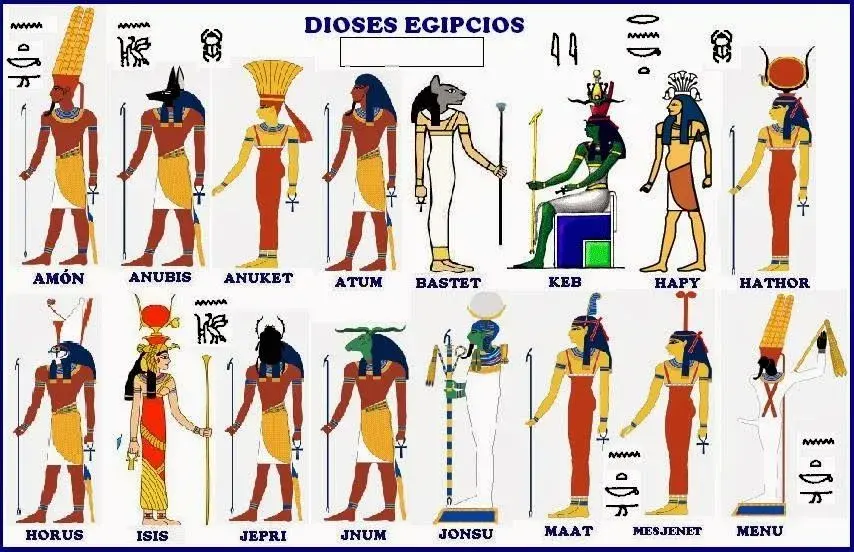
The Greeks did not replace the names of the Egyptian gods with Greek gods; they did two other things. First, they wrote the Egyptian names in Greek form, so Wsir became Osiris, Aset became Isis, Heru became Horus, Inpu became Anubis and Djehuty became Thoth: the names we still use today are Greek. Second, they matched each Egyptian god with the Greek god who seemed most similar, so Amun was called Zeus, Thoth was Hermes, Hathor was Aphrodite and Osiris was Dionysus.
This matching is called interpretatio graeca, "Greek translation", and it grew from Herodotus in the fifth century BC to the three centuries of Greek Ptolemaic rule. Below is the full list, how it worked and the places in Egypt where you can still see it on temple walls.
The Greek names of Egyptian gods
Ancient Egyptian was written without vowels, so the exact pronunciation of the gods' names is uncertain. The forms used in modern books, guidebooks and films mostly come through Greek writers:
| Egyptian name (transliterated) | Greek form we use today | God of |
|---|---|---|
| Wsir (Usir) | Osiris | The dead, the afterlife, rebirth |
| Aset (Iset) | Isis | Magic, motherhood, protection |
| Heru (Hor) | Horus | Kingship, the sky |
| Inpu (Anpu) | Anubis | Mummification, cemeteries |
| Djehuty | Thoth | Writing, wisdom, the moon |
| Imen (Amun) | Ammon | The hidden creator god of Thebes |
| Sutekh / Set | Seth (also Typhon) | Storms, the desert, disorder |
| Sobek | Souchos | Crocodile god of the Nile and Fayoum |
| Imhotep | Imouthes | The deified architect of the Step Pyramid, healer |
| Har-pa-khered (Horus the Child) | Harpocrates | The child Horus |
Even the name of the country is Greek. Egyptians called their land Kemet, "the black land", after its dark Nile soil. The Greek Aigyptos probably comes from Hut-ka-Ptah, "the temple of the soul of Ptah", a name of the great temple at Memphis.
Egyptian gods and their Greek equivalents
When the Greeks met Egyptian gods, they asked "which of our gods is this?" and gave the answer they found most natural. Many pairs go back to Herodotus, who visited Egypt around 450 BC; others became common under the Ptolemies.
| Egyptian god | Greek equivalent | Why they were matched |
|---|---|---|
| Amun (Amun-Ra) | Zeus (Zeus Ammon) | King of the gods |
| Osiris | Dionysus (also Hades) | A god who dies and returns; ruler of the dead |
| Isis | Demeter (later also Aphrodite and Selene) | A mother goddess who searches for a lost loved one |
| Horus | Apollo | Young god linked with light and kingship |
| Thoth | Hermes | God of writing, messages and knowledge |
| Anubis | Hermes (Hermanubis) | Guide of souls to the underworld |
| Hathor | Aphrodite | Love, beauty, music and joy |
| Ptah | Hephaestus | Craftsman god |
| Neith | Athena | Warrior goddess and wisdom |
| Bastet | Artemis | Protective goddess of the home and women |
| Ra | Helios | The sun |
| Montu | Ares | War |
| Min | Pan | Fertility, the wild Eastern Desert |
| Imhotep | Asclepius | Medicine and healing |
| Geb and Nut | Cronus and Rhea | The earth and the sky, parents of Osiris and Isis |
| Set | Typhon | The chaos monster who fights the order of the gods |
| Taweret | Eileithyia | Childbirth |
The matches were never exact. Thoth was a moon god with an ibis head who kept the records of the dead; Hermes was a quick-witted messenger. Isis had no clear twin in Greece, which is why she was linked to several goddesses at once.
Greek city names that honour Egyptian gods
Under Greek rule, many Egyptian towns got Greek names after the god the Greeks thought was worshipped there. Several are still used by archaeologists:
- Heliopolis ("city of Helios"): Iunu, the city of Ra, now a district of Cairo.
- Diospolis Magna ("great city of Zeus"): Thebes, modern Luxor, city of Amun.
- Hermopolis: Khemenu, city of Thoth, near modern Minya.
- Apollonopolis Magna: Edfu, city of Horus. See our Edfu temple guide.
- Aphroditopolis: cities of Hathor, such as Atfih south of Cairo.
- Panopolis: Akhmim, city of Min.
- Crocodilopolis: Shedet in Fayoum, city of Sobek.
- Cynopolis ("dog city"): a centre of Anubis in Middle Egypt.
Serapis: a god made for Greeks and Egyptians
The clearest example of the two religions meeting is Serapis. Early in Ptolemaic rule, in the third century BC, the new Greek kings promoted a god who joined Osiris and the Apis bull of Memphis (Osiris-Apis, Greek Oserapis) with the look of a bearded Greek Zeus. Serapis was worshipped in a great temple in Alexandria, the Serapeum, together with Isis and the child Harpocrates, and his cult spread around the Mediterranean. You can visit the site of the Serapeum of Alexandria, where Pompey's Pillar still stands.
Isis herself became one of the most popular goddesses of the Roman Empire, with temples from London to the Black Sea.
Did Egyptians stop using the Egyptian names?
No. Inside the temples the priests went on using the Egyptian names and hieroglyphs. The Ptolemaic temples of Edfu, Dendera, Kom Ombo and Philae, built under Greek kings, are carved entirely in the Egyptian style with Egyptian gods; the Greek pharaohs are shown in traditional dress making offerings to Horus or Hathor. Greek names were used by the Greek-speaking ruling class, in Greek documents and by later Roman writers, and that is how they reached us.
Did Egyptians speak Greek?
After Alexander the Great took Egypt in 332 BC, his general Ptolemy founded a dynasty that ruled from Alexandria until Cleopatra VII died in 30 BC. Greek became the language of government, law and trade, and remained so under Roman and Byzantine rule until the Arab conquest of 641 AD. Most Egyptians, however, went on speaking Egyptian, written in demotic script. Later, Egyptian Christians wrote their language with the Greek alphabet plus a few signs from demotic: this became Coptic, still the liturgical language of the Coptic Church.
Are there still Greeks in Egypt?
Yes. The Greeks of Egypt, called Egyptiotes, were for centuries one of the country's largest foreign communities, centred in Alexandria and Cairo; estimates of their peak in the first half of the 20th century run from about 76,000 in the 1927 census to several hundred thousand by other counts. Most left after the 1952 revolution and the nationalisations of the 1950s and 1960s. A few thousand remain today. The Greek Orthodox Patriarchate of Alexandria, Greek schools and churches are still active, and the poet Constantine Cavafy, the best-known Egyptiote, lived in Alexandria. You can visit his apartment, now the Cavafy Museum.
Where to see Egyptian and Greek gods together
- Kom el-Shoqafa catacombs, Alexandria: Anubis dressed as a Roman soldier and Egyptian gods carved in a Greco-Roman style. See our Kom el-Shoqafa guide.
- The Serapeum and Pompey's Pillar, Alexandria.
- The Greco-Roman Museum, Alexandria: statues of Serapis, Isis and Harpocrates.
- Edfu, Dendera, Kom Ombo and Philae: Ptolemaic temples where Greek kings honour Egyptian gods.
For the Egyptian gods themselves, read our guide to ancient Egyptian gods and their temples.
Plan it with us
Our Alexandria archaeological day tour includes Kom el-Shoqafa, the Serapeum and Pompey's Pillar, and the 5 days Cairo and Alexandria tour pairs the pharaonic sites of Giza with Greek and Roman Alexandria.
Egyptian and Greek gods: quick answers
What is the Greek name for Thoth?
Thoth is itself the Greek form of the Egyptian Djehuty. The Greeks identified him with Hermes, and later with Hermes Trismegistus.
Who is the Greek equivalent of Horus?
Apollo. The child Horus was called Harpocrates.
What did the Greeks call Egypt?
Aigyptos, probably from Hut-ka-Ptah, a name of Ptah's temple at Memphis. Egyptians called their land Kemet.
Who is the Egyptian equivalent of Aphrodite?
Hathor, goddess of love, music and joy. In Roman times Isis was also linked to Aphrodite.
Ahmed Samir writes and updates the Egypt travel guides of Egypt Online Tour, a licensed tour company based in Cairo (ETAA licence 1466). Our travel advisors review each guide before it is published.
All guides by Ahmed Samir