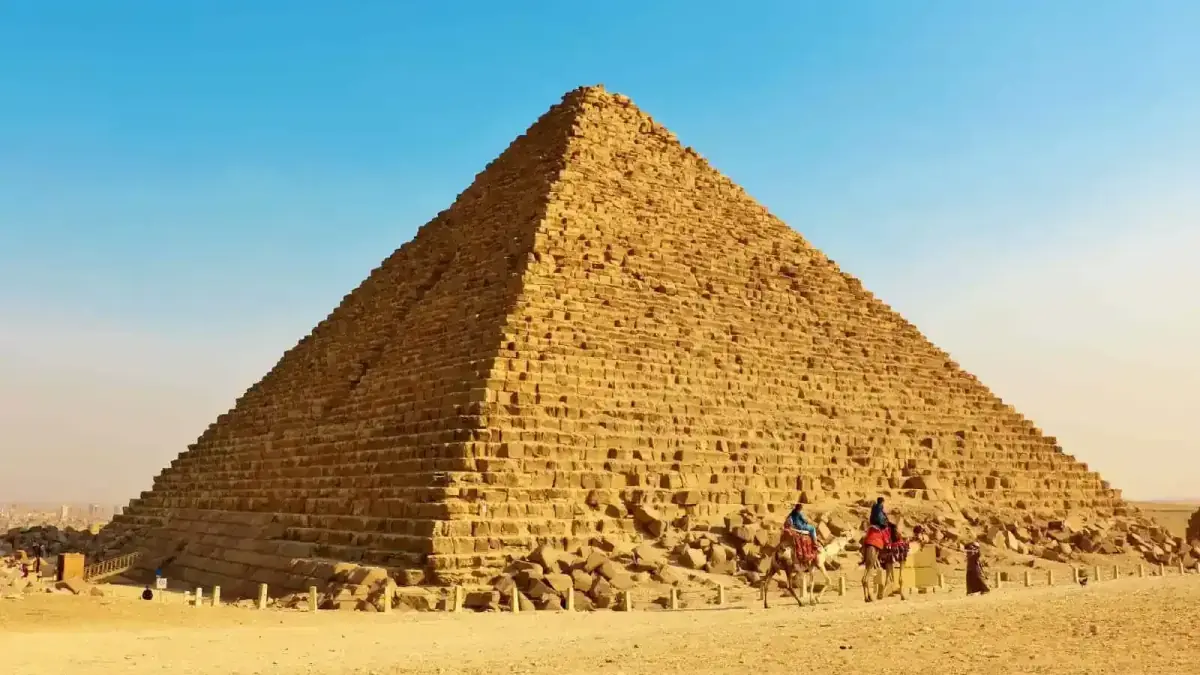
The Pyramid of Menkaure is the third and smallest of the three great pyramids of Giza, built for King Menkaure of the 4th Dynasty around 2500 BCE. It stood about 65.5 metres high (about 61 metres today), with a base of roughly 102 by 105 metres, and it is the only Giza pyramid whose lower courses were cased in red granite from Aswan. You can go inside with a separate ticket and walk down to the granite-lined burial chamber.
Menkaure's pyramid has less than a tenth of the volume of the Great Pyramid, but our guides often call it the most interesting interior on the plateau: it has the first decorated chamber ever built inside a pyramid, and its story includes a sarcophagus lost at sea and a sultan who tried to pull it down. This guide covers the king, the building, the chambers, the discoveries, and how to visit.
Pyramid of Menkaure facts at a glance
| Fact | Figure |
|---|---|
| Built for | King Menkaure (Mycerinus in Greek), 4th Dynasty, Old Kingdom |
| Date | around 2500 BCE |
| Original height | about 65.5 m (215 ft); about 61 m today |
| Base | about 102.2 x 104.6 m (200 cubits) |
| Slope | about 51 degrees 20 minutes |
| Volume | about 235,000 cubic metres (Khufu: about 2.6 million) |
| Casing | lowest 16 courses in red Aswan granite, the rest in fine white limestone |
| Satellite pyramids | three, on the south side, known as G3-a, G3-b and G3-c |
| Entrance | north face, about 4 m above the base |
Who was King Menkaure?
Menkaure was a king of the 4th Dynasty, generally considered the son of Khafre and the grandson of Khufu, the builders of the two larger pyramids. Estimates of his reign range from about 18 to 28 years. The Greek historian Herodotus, writing some two thousand years later, described him as a just and pious king who reopened the temples his predecessors had closed. Historians treat this as a later legend, but it shows how Menkaure was remembered.
The finest portraits of any Old Kingdom king are Menkaure's. In his valley temple the American archaeologist George Reisner found, between 1908 and 1910, a series of statue groups ("triads") showing the king with the goddess Hathor and the god of a province, and a pair statue of Menkaure with his queen. Three intact triads are in the Egyptian Museum in Tahrir; the pair statue and other pieces are in the Museum of Fine Arts, Boston.
Where the pyramid stands on the Giza plateau
The pyramid stands at the south-west corner of the Giza pyramid field, about 450 metres south-west of the Great Pyramid of Khufu, with Khafre's pyramid between them. From the city it is the pyramid at the back of the classic three-pyramid view. Like the others, its complex had a mortuary temple against its east face, a causeway and a valley temple at the edge of the desert.
Why is the Pyramid of Menkaure so small?
Nobody knows for certain. The theories historians discuss are:
- Space: the best rock on the plateau had been taken by Khufu and Khafre.
- Resources: after two giant projects, the state may have chosen a smaller pyramid built with more expensive materials, granite from Aswan, more than 800 km up the Nile.
- Time: the king seems to have died before the work was finished; his successor Shepseskaf completed the temples in mud brick.
After Menkaure, no king built at this scale again. For how the pyramid shape developed, see our facts about the ancient pyramids of Egypt.
Construction: limestone and Aswan granite
The core is local limestone from the plateau. The outer casing was meant to be red granite on the lower part and fine white Tura limestone above. The lowest 16 courses, rising over 20 metres, were laid in granite, but most of the blocks were never smoothed: you can still see the rough outer faces with the extra stone left for the final dressing, which stopped when the king died. Around the entrance on the north side and on part of the east face the granite was finished. Only some courses survive in place today.
The 2024 casing project
In January 2024 Egypt's Supreme Council of Antiquities and Waseda University announced a project to put fallen granite blocks back onto the base. After strong criticism from archaeologists and a review panel led by Zahi Hawass, which opposed reinstalling the blocks, the plan was dropped within weeks. What you see is the pyramid as it has stood for centuries.
A possible second entrance
Some researchers have suggested since 2019 that a second entrance may lie behind the smoothed granite on the east face. A 2025 study using three non-destructive scanning methods found two air-filled anomalies behind those blocks. Their meaning is not known yet, and nothing has been opened.
Inside the Pyramid of Menkaure: the chambers
The interior is compact and you can see all of it in about 15 minutes. In order, from the entrance:
- The descending passage: from the north face, lined with granite where it passes through the masonry. It is low: you walk bent over for most of the way down.
- The panelled chamber: a small room whose walls are carved with the "palace facade" pattern of recessed niches. It is the first decorated chamber inside any pyramid.
- The portcullis passage: three slots for sliding granite blocks that sealed the tomb.
- The large rectangular room: cut in the bedrock, with a niche at the west end. It may have been the first burial chamber before the plan was enlarged.
- The burial chamber: below it, lined with red Aswan granite, more than 6 metres long, roofed with granite beams cut on the inside into the shape of a vault.
- The six storerooms: reached by a short stair, probably for canopic jars and burial goods.
There are no painted scenes or inscriptions; the interest is the architecture and the granite work. Our guides tell travellers who are claustrophobic or have back problems to skip it: the passage is low, narrow and warm.
The discoveries: a sarcophagus lost at sea
The British officer Howard Vyse found the entrance in 1837. With the engineer John Perring he reached the burial chamber and found a basalt sarcophagus carved with the same palace-facade panelling as the antechamber. It was shipped to England in 1838, but the ship, the Beatrice, sank in a storm, and the sarcophagus has been on the sea bed ever since. Only Vyse's drawings record it.
In the upper room Vyse also found the lid of a wooden coffin with Menkaure's name and part of a human body, both now in the British Museum. Radiocarbon dating later showed the coffin dates from about 1200 to 850 BCE, more than a thousand years after the king, so it was made when later Egyptians restored the burial. The body is from the early Islamic period.
Saladin's son and the scar on the north face
In 1196 Sultan al-Aziz Uthman, son of Saladin, ordered the pyramid to be demolished. His workers spent eight months on the job and managed to remove only one or two blocks a day before giving up. The large vertical gash you see on the north face is the result.
The satellite pyramids and temples
- G3-a, the easternmost and largest, is a true pyramid with a smooth slope; Reisner linked it to Queen Khamerernebty II, but this is not proven.
- G3-b and G3-c are step pyramids that were never cased. G3-b held a small granite sarcophagus.
- The mortuary temple on the east side was begun in stone and finished in mud brick by Shepseskaf.
- The valley temple, where the triads were found, is not part of the visit.
Menkaure vs Khufu and Khafre
| Khufu (Great Pyramid) | Khafre | Menkaure | |
|---|---|---|---|
| Original height | about 146.6 m | about 143.5 m | about 65.5 m |
| Base side | about 230.3 m | about 215.3 m | about 102-105 m |
| Casing | white limestone | white limestone; granite on the lowest course; some casing survives at the top | granite lower courses, limestone above |
| Inside | Grand Gallery and King's Chamber | plain passage and burial chamber | decorated antechamber, granite burial chamber |
| Famous neighbour | the boat pits | the Great Sphinx and valley temple | the queens' pyramids |
Read more in our Pyramid of Khafre facts and our guide on whether you can go inside the Great Pyramid.
Visiting the Pyramid of Menkaure: tickets and hours
| Ticket | Foreign adult | Foreign student |
|---|---|---|
| Giza plateau (outside of the pyramids, the Sphinx) | EGP 700 | EGP 350 |
| Inside the Pyramid of Menkaure | EGP 280 (separate ticket) | EGP 140 |
The Ministry of Tourism and Antiquities lists the plateau as open daily from 8:00 to 16:00, and confirms that the plateau ticket does not include entry inside the pyramids. We last checked on 4 November 2026. The interior ticket is sold at the plateau ticket office, in limited numbers, and payment at the ticket office is usually by card. Not every pyramid interior is open every day: the antiquities authority rotates them for conservation, so ask at the gate or check with your guide the day before.
Our tips for the visit
- Go early. Be at the gate at 8:00. The coach groups reach the plateau from about 9:30, and the interior is hot by midday.
- Walk the south side. Behind Menkaure and its queens' pyramids the crowds thin out and you can photograph the granite courses close up.
- The panorama point. The viewpoint in the desert south-west of Menkaure gives the famous picture of the pyramids lined up in one frame. It is a long walk; most visitors drive or ride there.
- Which interior to choose: if you only want one, the Great Pyramid is the most impressive inside; Menkaure is the quieter and cheaper alternative with the decorated chamber.
- Season: November to February is the most comfortable; in summer finish outdoor visits before 11:00.
- Bring: water, a hat, small notes for tips, and shoes with grip for the sandy slopes.
Read our guide on whether it is safe to visit the pyramids of Giza for advice on touts and camel rides.
Plan it with us
Our Giza pyramids and Saqqara tour includes a private Egyptologist, who will take you inside the pyramid that is open that day, and a driver. The Grand Egyptian Museum tour pairs well with it, and our Cairo day tours list more ways to combine the plateau with the city.
Pyramid of Menkaure: quick answers
How tall is the Pyramid of Menkaure?
About 65.5 metres originally and about 61 metres today, less than half the height of the Great Pyramid.
Can you go inside the Pyramid of Menkaure?
Yes, with a separate ticket sold at the plateau (EGP 280 for a foreign adult and EGP 140 for a student at the time of writing), on the days its interior is open. The passage is low and narrow.
Why is the Pyramid of Menkaure smaller?
The reasons are not known for certain. Historians point to less space on the plateau, the high cost of the Aswan granite casing and the king's death before completion.
Where is the sarcophagus of Menkaure?
On the sea bed. Howard Vyse shipped the basalt sarcophagus to England in 1838 and the ship, the Beatrice, sank in a storm.
Is it worth going inside the Pyramid of Menkaure?
Yes, if you are comfortable in low passages. It is quieter than the Great Pyramid and has the first decorated chamber built inside a pyramid and a granite burial chamber.
Ahmed Samir writes and updates the Egypt travel guides of Egypt Online Tour, a licensed tour company based in Cairo (ETAA licence 1466). Our travel advisors review each guide before it is published.
All guides by Ahmed Samir