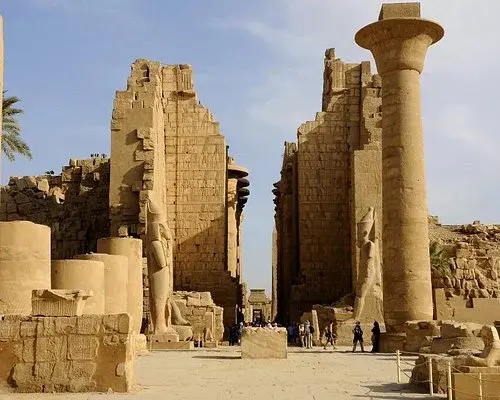
Have you ever heard of Karnak Temple? It is one of the most important tourist attractions in Luxor and tourists worldwide visit. In this article, we will learn some facts about the temple of Karnak, when it was built, the most important tourist places to visit, and other important details about this great edifice.
Where is the Temple of Karnak?
First, let's find out Where is the Temple of Karnak? Karnak Temple is located in the Arab Republic of Egypt, specifically on the banks of the Nile River in Luxor Governorate. It is one of the temples that has been rooted since ancient times, as it is considered a mother who embraces all religious temples. It contains many temples that were built over a period of nearly two thousand years.
Who built Karnak Temple?
Construction of the temple began in the Middle Kingdom, but many expansions and additions were made during the New Kingdom, especially during the reign of King Ramses II. Work on the temple continued for centuries, with many pharaohs contributing to its development. Thus, it can be said that the Karnak Temple is the result of the efforts of a group of pharaohs over a long period and not the construction of a single individual.
Read about: Did Thoth Built The Pyramids
When was Karnak Temple built?
The Karnak Temple is one of the largest temples in the ancient world! It was built during the Central Kingdom around 2000 years BC. During that period, the temple was relatively modest in size, but Kings Ramses and Tutankhamun significantly contributed to its expansion. In the subsequent generations after the reigns of the two kings, each pharaoh contributed further expansions to the temple, transforming it into a grand and sprawling complex.
Take a look at: When Was the Great Sphinx Built
About Karnak Temple
At the beginning of our talk, we will learn some information and Facts about The Temple of Karnak. The ruins near the Karnak Temple indicate that it was considered a sacred site before and with the extension of the modern era when it became a main temple for Amun-Ra in 1971 BC, and the ancestors also took it as a special place to honor their god Amun-Ra.
The worship of Amun-Ra and its strong influence continued until the rule of Akhenaten in the period 1379-1362 BC when orders were issued from the pharaohs to worship one god, the sun, and to desecrate, abolish, and destroy all other gods.
Akhenaten also moved his capital to Tell el-Amarna, which led to a decline in the sacred status of the Karnak Temple, but his campaign was short-lived as Tutankhamun was able to restore the religious status of the Karnak Temple, including Amun-Ra.
You can enjoy a special trip through Egypt Classic Tours
Facts about The Temple of Karnak
Karnak Temple is one of the largest and most important temples. It contains a group of monuments and facts that distinguish it from other temples. Here are Facts about The Temple of Karnak:
- Karnak Temple is the largest religious building ever.
- in addition to its importance as a religious place, it was an administrative center and a treasury for the state, and it was a palace for the pharaohs of the New Kingdom.
- Karnak Temple includes huge historical columns, the base area of which is 16.46 square meters.
- The god Amun-Ra, worshiped in Karnak Temple, was attended by over eighty thousand servants and slaves, with approximately 5,000 statues dedicated to his honor.
- Karnak Temple covers an area of 1.5 kilometers.
- The Hypostyle Hall, also known as the Great Column Hall, spans an area of 16,459 square meters, making it the largest chamber within any religious structure worldwide.
- The construction of the Karnak Temple involved about 30 pharaohs for two thousand years.
Enjoy spending a special time and making the best memories with8 Days Cairo to Abu Simbel and Back Overland
Maybe like:Strange Facts About The Pyramids
Karnak Temple History
Here are some important points about historical Facts about The Temple of Karnak:
- Karnak was constructed to honor the birth of Amun, the revered supreme deity of ancient Egypt.
- The funds for construction were raised from taxes and spoils from military victories.
- The temple went through eras of construction, destruction, and renovation over more than 1,500 years, from the Eleventh Dynasty to the end of the reign of Ramesses.
- Construction work at Karnak continued for 2,000 years beginning in the Twelfth Dynasty, with successive pharaohs adding their shrines and gateways.
- In the Sixteenth Dynasty, some 81,322 people worked in the temple, including priests and peasants.
- Construction of the main hypostyle hall began during the reign of Amenhotep III (1375 BC) and was completed during the reign of Ramesses IV.
- The remaining inscriptions include scenes of the pharaohs’ victories, including those of Shoshenq I and the events of the Opet Festival.
You can visit Egypt and enjoy the best moments with Egypt Luxury Tours
Karnak Temple architecture
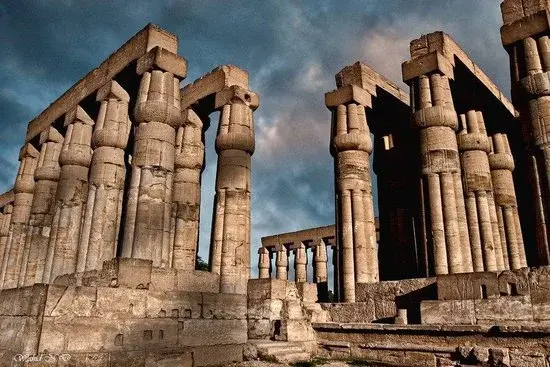
The Karnak Temple is distinguished by its unique architecture, consisting of temples and architectural elements. Here are some architectural Facts about The Temple of Karnak:
The Temple of Amun is a long series of buildings divided by 6 large walls and pylons (huge gates). Large halls and courtyards are between these walls, some of which contain obelisks. "Southern Propylaea.
Visitors can see the Avenue of Sphinxes, which consists of a corridor lined with parallel rows of sphinxes with rams' heads. Under the ram's head is a small statue of Ramesses II. The Avenue of Sphinxes leads to the first and largest pylons. Built-in the Greco-Roman-Ptolemaic period, the avenue is 113 meters wide and 15 meters thick.
At one time, Karnak and Luxor were connected by side passages and roads lined with sphinxes—long stone “dromes.” The royal procession route linking the Karnak and Luxor temple complexes was once lined with more than 1.7 million statues along its 700-mile length.
What is the architecture of the Karnak Temple?
The Abyssinian Court (the first court after the Karnak entrance) dates back to the 9th Dynasty. To the north of it is a wall surrounded by columns with closed papyrus capitals. In front of it is a sphinx commissioned by Ramesses II. The massive columns with open papyrus capitals are all that remain of the great pavilion of King Taharka of Ethiopia. The pavilion is 21 meters high, has a wooden roof, and was built to accommodate the sacred boat.
In front of the column on the right is the temple of Ramesses III, and on the three sides inside the temple is a statue of Ramesses III in the foreground, his arms crossed holding crooks like the god Orisis. On the left is the temple of Sethi I.
The opet festival In Karnak temple
The opet festival In Karnak temple is an ancient Egyptian celebration that was held in Thebes (Luxor) every year, during the New Kingdom and after. It is considered one of the most important festivals of the calendar in ancient Egypt, and in ancient Egyptian, it means “Love Nefer En Opet” which means the beautiful Opet.
In a grand ceremonial procession. The statues of the Theban triad of gods (Amun, Mut, Khonsu) were escorted and hidden from view in their sacred boats, so that Amun-Ra from Karnak would meet Amun of Luxor, in what is known as the "rebirth" ritual.
During the initial festivities of the Opet or "Ipet" festival, statues were carried down the Avenue of Sphinxes, which linked the two temples, with stops at smaller shrines laden with offerings. At the conclusion of the celebrations at Luxor Temple, the sacred boats would journey back to Karnak.
In later celebrations in Egyptian history, the statues were transported to and from Karnak-Luxor by boats on the river rather than by the Avenue of Sphinxes. A royal boat also sailed with the sacred boats.
- Learn about the antiquities of Pharaonic Egypt during and visit Grand Egyptian Museum Tour
The Importance of the Karnak Temple
Because of the great historical Facts about The Temple of Karnak, its importance is due to:
- Its religious role. The Karnak Temple Complex was the center of ancient faith during the New Kingdom, while power was concentrated in Thebes (modern Luxor). Its importance lies in its large size.
- It served as the administrative center, treasury, and palace for the New Kingdom pharaohs.
- Karnak is the largest temple complex ever built anywhere in the world.
- It resulted in a collection of temples, sanctuaries, towers, and other decorations that are unparalleled throughout the Arab Republic of Egypt.
- Its importance lay during the New Kingdom and during the reigns of famous pharaohs such as Hatshepsut, Thutmose III, Seti I, and Ramses II, all of whom contributed important additions to the complex.
- Construction continued in the Greco-Roman era with the Ptolemies, Romans, and early Christians leaving their mark there.
Karnak Temple today
Karnak Temple today is different than before, as the damaged parts inside the temple have been restored by the Antiquities Authority, new developments have been made in the temple and the facade of the building has been updated to preserve the general appearance of the temple, which is the face of tourism in Egypt.
They also adjusted the lighting and sound inside the temple and put many rest areas to receive visitors. The temple is divided into three areas, which are
- The southern area: It contains the group of Queen Mut, wife of Amun.
- The northern area: It contains the group of King Amun-Ra Montu.
- The central area: It contains a group dedicated to King Amun-Ra.
To see the greatness of Egyptian history you can take 5 Days Cairo to Luxor Tour Packages
Best sites inside the Karnak temple
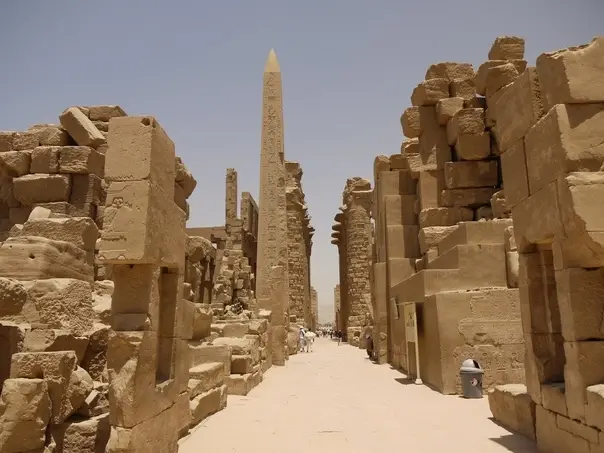
The following are the Best sites inside the Karnak temple :
- Temple entrance: The entrance to the temple is not an ordinary entrance, but an archaeological masterpiece, as there are two large obelisks on both sides.
- Temple of Ramses III: The temple contains images of Ramses III, and at the entrance, there are two statues of red stone, each six meters long.
- The Great Hypostyle Hall: It contains 134 huge columns made of sandstone, in addition to 12 other columns in the middle of the hall, each 20 meters high.
- The Great Festival Temple of Thutmose III: The temple is located to the east of the Karnak Temple has a magnificent width of 44 meters and contains 22 columns to support the structure of the building. The temple includes about 50 halls and rooms, a few of which can be visited.
- The Sacred Lake: It is a huge lake with religious symbolism, as the priests used to come to it to purify themselves and perform their religious rituals.
Karnak Temple obelisk
Hatshepsut's Permanent Obelisk: This obelisk is made of pink granite and is one of the most beautiful landmarks of Karnak Temple. It is also one of the two tallest obelisks in the world, with a height of 29.5 meters and a weight of 330 tons. It is believed that it was built in the sixteenth year of her reign.
Getting to Karnak Temple
Since Karnak Temple is open and very large, it takes at least two and a half hours to visit. It is essential to be comfortable and protect yourself from the Egyptian sun. The best way to get to Karnak Temple is to book and enjoy Egypt Online Tour | Egypt Tour Packages.
Visiting the Karnak Temple Complex
A visit to Karnak Temple is definitely a must-do for any tourist visiting Egypt. The Karnak Temple complex occupies a huge area with temple complexes built by many Egyptian rulers.
The Karnak Open Air Museum will amaze everyone who comes here on a Karnak Temple tour. Participants in the Karnak Temple tour will feel the power of ancient civilizations that existed here at a time when people lived in forests and caves on other continents.
The Karnak Temple is divided into three main complexes: the Sanctuary of Amun, the Sanctuary of Mut, and the Sanctuary of Montu. However, the Sanctuary of Amun is the most famous and important of these complexes.
The Sanctuary of Amun contains many famous sections, including the Great Hypostyle Hall with 134 massive columns, which is one of the most prominent landmarks in Egypt. Karnak also offers a fascinating sound and light show in several languages, which is held three times a night.
If you want to visit the temple on a sightseeing tour, you can enjoy this tour 8 Days Cairo, Luxor, Aswan Classic Tours: What Wonders Await
Summary
By learning the Facts about The Temple of Karnak, we find that it is one of the most famous tourist attractions in Egypt and contains many great historical monuments. You can enjoy a wonderful tour in Karnak to see the great Pharaonic history of Egypt.
FAQ
Why is the Karnak Temple so famous?
Karnak is famous for being a group of multiple temples that were built starting from the 11th Dynasty around 2134 BC, when Thebes was the center of Egyptian religion. The temples are surrounded by mud brick walls, connected to each other by corridors guarded by statues arranged in two rows of sphinxes, known as the Avenue of Sphinxes.
What secrets does the Temple of Karnak hold?
A secret of the ancient Egyptian civilization for thousands of years, it is the "Sacred Lake" which is 80 meters long and 40 meters wide, in the heart of the Karnak Temples in Luxor, a short distance from the Nile River. It is the lake whose water has not dried up throughout the year since its establishment during the reign of King Thutmose III, and to this day, this lake remains a secret of the Pharaonic civilization with water that has not dried up throughout history.