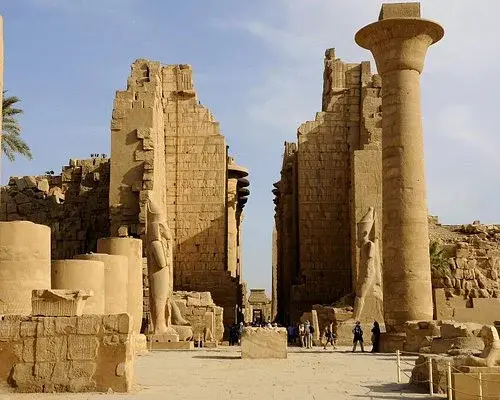

King Amenhotep III was the ninth pharaoh of the 18th Dynasty and ruled Egypt for about 38 years, around 1390 to 1352 BC, when the country was at the height of its wealth and international power. He is the builder of Luxor Temple and the Colossi of Memnon, the husband of Queen Tiye and the father of Akhenaten, and more statues of him survive than of any other pharaoh: over 250.
Our guides meet Amenhotep III at almost every stop in Luxor, and his mummy is one of the royal mummies in Cairo. This article tells his story in short and shows where you can still see his work.
Amenhotep III at a glance
| Reign | About 1390 to 1352 BC (about 38 years); dates vary by a few years between chronologies |
|---|---|
| Dynasty | 18th Dynasty, New Kingdom |
| Parents | Thutmose IV and Queen Mutemwiya |
| Great royal wife | Tiye |
| Children | Crown prince Thutmose (died young), Amenhotep IV (Akhenaten), daughters including Sitamun, Henuttaneb, Iset and Nebetah |
| Throne name | Nebmaatre, "Lord of truth is Re" |
| Tomb | WV22, in the Western Valley of the Valley of the Kings |
| Mummy | National Museum of Egyptian Civilization, Cairo |
Who was Amenhotep III?
He came to the throne young, perhaps around the age of 12, after his father Thutmose IV. He inherited an empire that reached from Nubia in the south to Syria in the north, built by the warrior kings before him. Amenhotep III fought little; one campaign in Nubia is recorded early in his reign. Instead he ruled through diplomacy, trade and display, and Egypt grew rich on gold from Nubia and tribute from Asia.
Queen Tiye
Early in his reign he married Tiye, the daughter of a provincial official, Yuya, and his wife Tuya, not a royal princess. Tiye became one of the most powerful queens in Egyptian history: her name appears beside the king's on official monuments, foreign kings wrote to her directly, and she remained influential under her son. Her mummy, identified in 2010, is also in Cairo.
A king who announced his news on scarabs
Amenhotep III issued large stone scarabs inscribed with announcements, sent around the country like royal press releases. They record his marriage to Tiye, a wild bull hunt, the arrival of a foreign princess from Mitanni with her retinue, the digging of a lake for the queen, and the 102 lions he said he killed in the first ten years of his reign.
Egypt's golden age: diplomacy and wealth
We know his foreign policy from the Amarna letters, clay tablets in Akkadian found at Amarna, which preserve letters between Egypt and the great kings of Babylon, Mitanni, Assyria and the Hittites, as well as vassal rulers in Canaan. The other kings call Amenhotep "brother", ask for gold ("in your land gold is like dust", one wrote) and offer their daughters in marriage. He married several foreign princesses, but famously refused to send an Egyptian princess abroad.
At home he celebrated three jubilee (Sed) festivals, in years 30, 34 and 37 of his reign, at his palace of Malkata on the West Bank of Thebes. In his last years he was ill, and statues show him heavier and older. He died around 1352 BC and was succeeded by his son, who became Akhenaten.
The monuments of Amenhotep III
Luxor Temple
The core of Luxor Temple is his: the elegant sun court, the hypostyle hall, the sanctuary and the colonnade, as well as the "birth room" with scenes that show the god Amun as his father. Cruise passengers who board in Luxor see it at the start: the 4-night program of the luxury-class Steigenberger Regency opens with Karnak and Luxor Temple on Day 1. Read when the Luxor Temple was built for who added what.
The Colossi of Memnon and his mortuary temple
The two seated giants on the West Bank, about 18 metres tall, once guarded the entrance of his mortuary temple at Kom el-Hettan, the largest temple ever built in Thebes. The temple stood close to the Nile flood and was later used as a quarry, so little remains above ground; excavators have been raising its fallen statues for years. See our Colossi of Memnon guide.
Karnak and the Temple of Mut
He built the Third Pylon at Karnak and started work in the precinct of the goddess Mut, where he set up hundreds of statues of the lion-headed goddess Sekhmet. Several still sit in rows in the Precinct of Mut.
Malkata palace
His palace city on the West Bank, with painted halls and a vast harbour basin, is mostly mudbrick ruins today. Our article on Malkata, the palace city of the sun king describes what has been found.
In Nubia
He built temples at Soleb in Sudan and the first temple at Wadi es-Sebua in Lower Nubia, which Ramesses II later rebuilt. See our page on Wadi es-Sebua.
His tomb
Amenhotep III was buried in tomb WV22 in the Western Valley, a branch of the Valley of the Kings. It was robbed in antiquity and is not part of the normal visitor route.
Amenhotep III and Akhenaten
Amenhotep III's reign already shows growing worship of the Aten, the sun disc: his palace was called "the Dazzling Aten". His son took this further, raised the Aten above all gods, changed his name to Akhenaten and left Thebes for a new capital at Amarna. Some scholars think father and son ruled together for some years; others reject such a co-regency. Our article on Akhenaten continues the story, which leads on to his grandson Tutankhamun.
Where to see Amenhotep III today
- Luxor East Bank: Luxor Temple, Karnak's Third Pylon, the Sekhmet statues in the Mut precinct.
- Luxor West Bank: the Colossi of Memnon, the Kom el-Hettan excavations (from the road) and Malkata.
- Luxor Museum: statues from the 1989 cache found in his court at Luxor Temple, including a fine quartzite statue of the king.
- Cairo: his mummy in the Royal Mummies Hall of the National Museum of Egyptian Civilization (see our royal mummies guide), and the colossal family group of Amenhotep III and Tiye from Medinet Habu in the Egyptian Museum in Tahrir.
- Abroad: the British Museum, the Louvre and the Metropolitan Museum all hold major statues of him.
Our tip: in Luxor, stop at the Colossi at sunrise on your way to the Valley of the Kings, before the tour buses, and see Luxor Temple in the evening; you will have seen the beginning and the heart of his work in one day. The budget-class Princess Sarah gives you a similar day at the end of its 3-night program from Aswan, when Day 3 covers the West Bank, Karnak and Luxor Temple.
Plan it with us
Our Luxor West Bank private day trip includes the Colossi of Memnon, and the East Bank private tour covers Luxor Temple and Karnak. More options are in our Luxor day tours.
Amenhotep III: quick answers
What is Amenhotep III famous for?
For ruling Egypt at the height of its wealth, building Luxor Temple and the Colossi of Memnon, his diplomacy recorded in the Amarna letters, and being the father of Akhenaten.
How long did Amenhotep III rule?
About 38 years, roughly 1390 to 1352 BC.
Where is the mummy of Amenhotep III?
In the Royal Mummies Hall of the National Museum of Egyptian Civilization in Cairo, moved there in April 2021. It was found in 1898 in the tomb of Amenhotep II (KV35).
Was Amenhotep III related to Tutankhamun?
Yes. DNA studies published in 2010 indicate that Amenhotep III and Tiye were the grandparents of Tutankhamun; his father is the KV55 mummy, usually identified as Akhenaten.
Ahmed Samir writes and updates the Egypt travel guides of Egypt Online Tour, a licensed tour company based in Cairo (ETAA licence 1466). Our travel advisors review each guide before it is published.
All guides by Ahmed Samir