Standard
ComfortComfortable ship, good value
$785per person
- Nile cruise 3 nights

Three nights on a Nile cruise ship sailing from Aswan to Luxor, with guided visits to Philae, Edfu, the Valley of the Kings and Karnak. Full board, an Egyptologist guide, entrance fees, the motorboat to Philae, the horse carriage at Edfu and transfers in Aswan and Luxor are included.
This is the short Nile cruise: three nights downstream from Aswan to Luxor, the direction that needs the least time on the water because the ship sails with the current. You see the main temples of Upper Egypt with an Egyptologist guide: Philae and the High Dam in Aswan, the double temple of Kom Ombo, the Temple of Horus at Edfu, the Valley of the Kings and the temple of Hatshepsut on the West Bank of Luxor, and Luxor Temple and Karnak on the last morning. All meals on board, the visits, the entrance fees and the transfers are included.
The cruise starts in Aswan, so it fits after a flight or the sleeper train from Cairo, or a few days in Aswan, and it ends in Luxor with a transfer to your hotel, the airport or the station.
It is a weaker fit if you want more time sailing or more sites: the four-night cruise from Luxor to Aswan spends longer on the river, and a dahabiya stops at smaller sites. Our guide Luxor to Aswan or Aswan to Luxor compares the two directions, and our Nile cruise itineraries list the other routes.
It also suits you less if you want time in Aswan itself: the cruise leaves Aswan on the first afternoon, so the Nubian villages, the botanical gardens on Kitchener's Island and a felucca sail are not part of it. If those matter, add a night in Aswan before you board. And Abu Simbel is not included; it is a separate early-morning trip from Aswan, best done the day before the cruise.
The pace is moderate. Each day has one or two visits, timed around the ship's sailing schedule, with free time on the sun deck in between. The West Bank morning starts earliest, to avoid the heat. Expect walking on uneven ground and sloping corridors in the tombs. Sailing times and the order of visits can change with the river traffic and the lock at Esna; every visit in the programme still takes place.
A typical day looks like this: breakfast from about 6 or 7 am, a guided visit of two to three hours, lunch on board, an afternoon of sailing with tea on deck, and dinner at around 7:30 pm. The longest day on foot is Day 3, with three to four hours of walking on the West Bank. Day 1 is the busiest in terms of logistics, as you meet your guide, see two sites in Aswan and board the ship on the same day.
Monday from Aswan, Wednesday from Aswan, Friday from Aswan
Your guide meets you at Aswan airport, the railway station or your hotel, with a sign bearing your name. Aswan airport is about 25 minutes from the city, and the station is in the centre. If you arrive early, your luggage can go to the ship, which is moored on the Corniche, while you start the visits; if you arrive later, the order of the morning changes so that you still see both sites.
The dam visit is short, about 30 minutes on the crest, with Lake Nasser stretching south on one side and the river on the other. Philae takes longer: the boat ride itself is about ten minutes each way, and the island is small enough to walk around in an hour. Worship of Isis continued here long after it ended elsewhere in Egypt, and some of the latest hieroglyphic inscriptions known are carved on its walls. Look also for the crosses carved by early Christians, who later used part of the temple as a church.
You board the ship for lunch and check in to your cabin; the reception holds your passport for registration and returns it during the cruise. In the afternoon the ship sails north, with tea on the sun deck, to Kom Ombo, about 45 km downstream. This is one of the most attractive stretches of the river, with granite outcrops, sand dunes close to the west bank and fields and palm groves along the water.
Kom Ombo is a double temple of the Ptolemaic period, with two entrances and two sanctuaries side by side: one for Sobek, the crocodile god, and one for Haroeris, Horus the Elder. Your guide shows you the relief often read as a set of medical instruments, and the Crocodile Museum next door. Dinner is on board as the ship sails towards Edfu.
The temple stands on a low hill right on the river, so the walk from the mooring is only a few minutes. It is especially good in the late afternoon and after dark, when the columns are lit. Next door, the Crocodile Museum displays mummified crocodiles from a nearby cemetery, sacred to Sobek. Overnight on board.
After breakfast on board, a horse carriage takes you from the river to the Temple of Horus. Built between 237 and 57 BC, it is the most complete temple in Egypt: the pylon, the roofed halls and the granite shrine still stand much as they were built. The walls tell the battle between Horus and Seth, and the inscriptions record how the temple was planned and used.
The carriage ride from the mooring takes about 15 minutes through the town; the driver waits for you during the visit, and a small tip is customary. Inside, your guide walks you from the great pylon through the courtyard, the hypostyle halls and the dark inner rooms to the sanctuary, where a granite shrine once held the statue of Horus. The visit takes about 90 minutes, and you are back on board before the ship sails.
Lunch is on board while the ship sails north through farmland and villages. At Esna the ship passes through the lock that lifts and lowers boats past the barrage; ships often wait their turn here, which is why times on this stretch vary.
The afternoon has no visits, so it is the quietest time of the cruise: watch the river from the sun deck, swim in the pool if the ship has one, or rest in your cabin. At the lock, local traders sometimes row out to the ships to sell cloth and galabeyas, throwing them up to the deck to bargain; it is part of the scene, and there is no obligation to buy.
Many ships hold a galabeya evening after dinner, when guests are invited to wear the traditional Egyptian robe, with music and dancing. The ship reaches Luxor late in the evening or overnight. Ask the reception tonight about the time of tomorrow's early breakfast, and keep a hat, water and closed shoes ready. Overnight on board.
After an early breakfast you cross to the West Bank. The Valley of the Kings holds more than 60 tombs cut for the pharaohs of the New Kingdom. The standard ticket opens three tombs among those open on the day; the tomb of Tutankhamun needs a separate ticket bought at the site. Inside, the painted corridors show the king's journey through the underworld.
The ship is moored on the East Bank, so you cross by road over the Luxor bridge, about 30 to 40 minutes to the valley. A small electric train takes you from the visitor centre to the tombs. Which tombs are open changes on a rotation to protect the paintings, so your guide chooses the best three on the day. Tombs are cooler than the valley outside, but the air is still, and the descent into some of them is long; bags and large cameras may need to stay outside.
At Deir el-Bahari, the temple of Queen Hatshepsut rises in three terraces against the cliffs. She ruled as pharaoh for about two decades, and the reliefs record her trading expedition to the land of Punt. The ramps and terraces are open to the sun, and the reliefs on the middle terrace show the ships, the incense trees and the people of Punt in fine detail. After her death, many of her images were cut away, which your guide points out on the walls.
On the way back you stop at the Colossi of Memnon, two seated statues of Amenhotep III, each about 18 metres tall, that once stood at the entrance of his mortuary temple.
You are back on the ship by around 1 pm. Lunch and afternoon tea are on board, and the afternoon is free. Many guests rest after the early start; others take a taxi or a horse carriage to walk along the Luxor Corniche or visit the souk near Luxor Temple. The Luxor Museum, a small museum on the Corniche with fine statues, is an optional extra. Dinner is on board, with the ship moored in Luxor. Pack tonight, as check-out is tomorrow morning. Overnight on board.
If you wish, start the day with a hot-air balloon flight over the West Bank, at extra cost. The flight lasts 30 to 45 minutes, depending on the weather, and passes over the temples, the Valley of the Kings and the fields. Our guide is a balloon ride in Luxor worth it helps you decide. Pick-up is before dawn, usually around 5 am, and you are back on the ship in time for breakfast. Flights can be cancelled at short notice in strong wind.
After breakfast you check out. Luxor Temple, built mainly by Amenhotep III and Ramses II, has colossal statues of Ramses at its entrance and one remaining obelisk; the other has stood in the Place de la Concorde in Paris since 1836. The Avenue of Sphinxes, about 2.7 km long, links it to Karnak, the temple of Amun, enlarged over some 2,000 years. The Great Hypostyle Hall has 134 columns, and the obelisks of Thutmose I and Hatshepsut and the sacred lake are at the heart of the temple.
Both temples are on the East Bank, close to the mooring. Karnak covers a huge area, so your guide follows a route through the main axis: the avenue of ram-headed sphinxes at the entrance, the first courtyard, the Hypostyle Hall with its carved columns, the obelisks and the sacred lake. Allow about two hours there and about an hour at Luxor Temple. Luggage stays with the ship or in the vehicle while you visit.
After the visits, your guide takes you to your hotel in Luxor, the airport or the railway station. Luxor airport is about 20 minutes from the town centre. Lunch is not included today; if your onward journey is in the afternoon, your guide can suggest a restaurant near Luxor Temple. This is the end of the cruise.
Comfortable ship, good value
More space and better service
Our highest level
Children pay less, see the children policy below. Christmas, New Year and Easter dates add 25%. Prices are per person in US dollars.
October to April is the most comfortable time, with days around 23 to 26 °C in Aswan and Luxor from December to February and cool evenings on deck. From May to September temperatures often pass 40 °C; visits are then planned for the early morning and the ship's pool and shaded decks matter more. Christmas, New Year and Easter are the busiest weeks, when ships fill first.
Our Nile cruise packing list has more detail.
Cabins on Nile cruise ships are usually all outside cabins with a window or a small balcony facing the river, an en-suite bathroom and air conditioning. Meals are served as buffets in the restaurant, often with a set dinner on one evening; tea and cakes are served on the sun deck in the afternoon. Water at meals is usually bottled and paid separately unless the ship includes it, and drinks from the bar are charged to your cabin. Ships moor side by side in Aswan, Edfu and Luxor, so you may walk through the lobbies of one or two other ships to reach the riverbank; the crew help with this.
Drink bottled water and avoid ice from unknown sources off the ship. The sun on the open deck is stronger than it feels with the breeze, so use shade and sunscreen between visits. If anyone in your group has limited mobility, tell us when you book: the gangways between ships and the steps at some temples can be awkward, and the guide can plan around them.
Many nationalities can buy a tourist visa on arrival or apply for an e-visa in advance on Egypt's official portal, visa2egypt.gov.eg; the rules and the fee depend on your passport. Your passport should be valid for at least six months from the day you arrive. The ship holds passports at check-in for registration and returns them during the cruise.
The currency is the Egyptian pound. Drinks on board are paid at the end of the cruise, usually by card or cash. Aswan and Luxor both have ATMs in town; draw cash before the visits, as you cannot count on a machine at the temples. Keep small notes for the horse carriage drivers at Edfu, toilets at some sites and the markets. Tips are not included; the tipping guide in the travel policies below gives the usual amounts for the guide and the cruise staff.
All prices are per person in US dollars. The price changes with the season (winter 1 September to 30 April, summer 1 May to 31 August), the accommodation level and the size of the group. Christmas, New Year and Easter dates add 25%. Your quote lists the final price and everything it covers. After the deposit, changes to your itinerary cost US$25 per request, plus any third-party fees.
A deposit of 30% of the total tour cost confirms your booking. We send you a secure payment link for the deposit; the balance is paid in cash or by card on arrival in Egypt, unless your written offer gives another date. We never ask for card details by email, chat or WhatsApp. We confirm every booking by email.
No-show travelers are charged 100%. During peak events in Egypt, hotels and Nile cruises do not refund deposits. Groups of more than 10 people may have different terms.
Add each child and their age in the enquiry form so the quote is exact.
Optional visits, such as a hot air balloon ride in Luxor, a Sound and Light show or a felucca ride, are not in the price. Tell us which ones you want and we add them to your quote with their cost.
Not included in the price: Egypt entry visa and international flights; Personal expenses and souvenirs; Optional tours and activities not in the itinerary, such as the balloon flight; Drinks with meals and on board; Extra tickets at the sites, such as the tomb of Tutankhamun; Tips for the guide and cruise staff.
Tipping is customary in Egypt and is not included in the price. A usual amount for a private tour is US$8 to 10 per person per day for your guide, US$4 to 5 for your driver and US$5 to 8 per person per day for the crew on a Nile cruise. Your guide can advise you on the day.
The Nile flows north, so from Aswan the ship sails with the current and needs three nights to reach Luxor. Going south against the current takes four nights for the same stops.
By a domestic flight from Cairo (about 1 hour 20 minutes) or by the overnight sleeper train, which reaches Aswan in the morning. Neither is included in the cruise price; we can book them for you.
No. Abu Simbel is about 280 km south of Aswan. It can be added the day before the cruise, as a day trip by road or by air from Aswan, at extra cost.
The guide is arranged by us for your booking. The ship, its meals and its evening programme are shared with the other guests, as on any cruise.
Independent reviews on the platforms travelers already trust.
Amazing Egyptian vacation! We did an 11 day private tour of Cairo, cruise on the Nile between Aswan and Luxor and a 4 day stay in Hurghada. The guided tours were very interesting, with extremely knowledgeable guides, attentive and helpful.
Egypt package to the Pyramids of Giza and Saqqara was a fascinating journey through Egypt's ancient past ,guide knowledge, the majesty of the pyramids, and the historical depth of Saqqara made this tour truly enriching!
our honeymoon to Egypt ,Giza and Saqqara was a magical escape into history The pyramids looming in the distance, the quiet serenity of the desert, and the ancient wonders of Saqqara created moments that will be with me forever!
Answers to the questions travelers ask before they book.

The Temple of Horus at Edfu is the best-preserved temple in Egypt, built by the Ptolemies between 237 and 57 BC halfway between Luxor and Aswan. A foreign adult ticket costs EGP 550. Here is its history, what to see inside, how to get there and how long to stay.
Read the guide
The best months for a Nile river cruise between Luxor and Aswan are October to April, when daytime highs are about 23 to 30 degrees. November, February and March balance weather and crowds best; December and January are busiest; summer is hot but cheaper. A month-by-month guide with holidays and booking tips.
Read the guide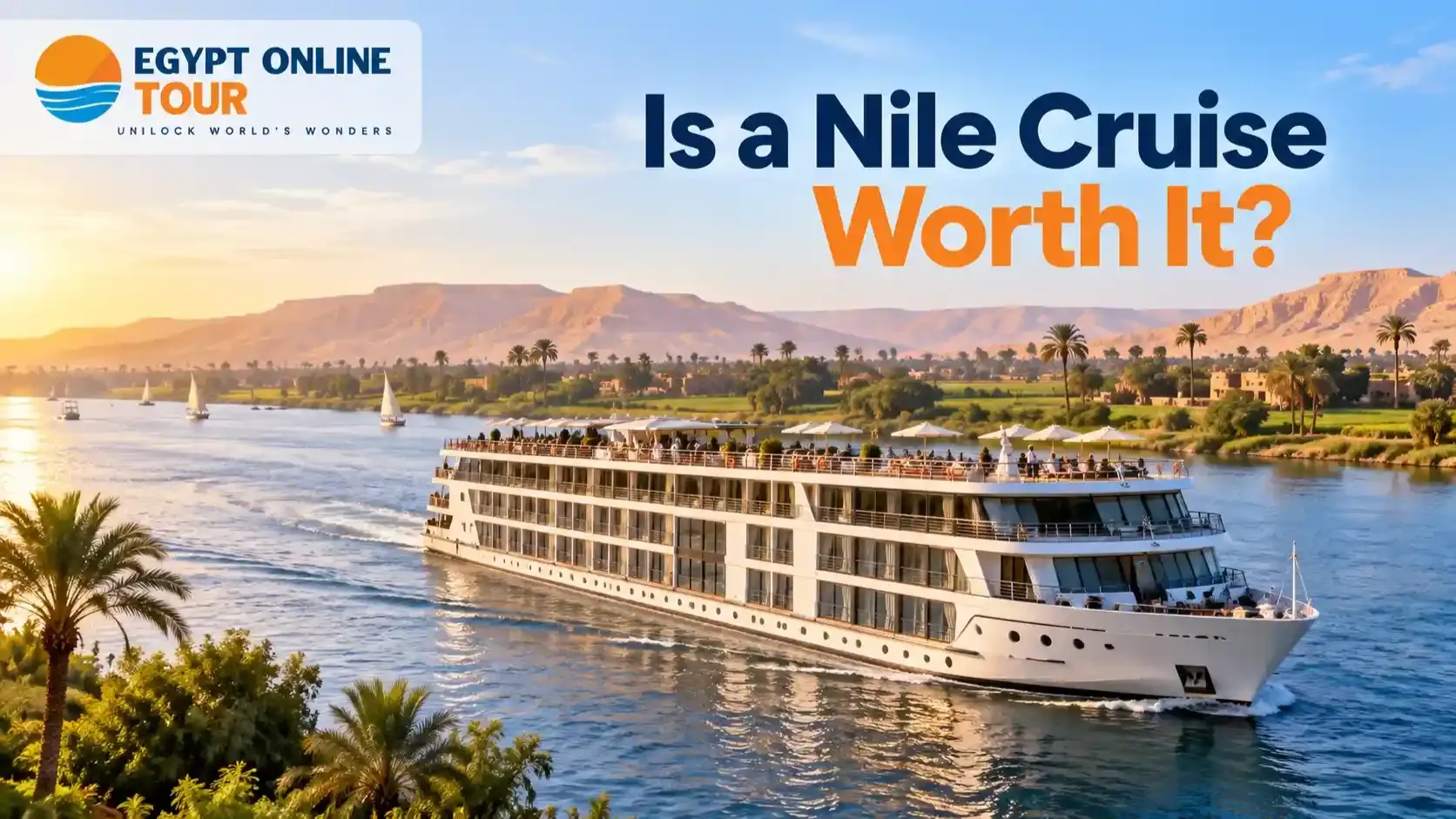
Is a Nile Cruise Worth It? Yes. Enjoy easy sightseeing, relaxing travel, and iconic temples between Luxor and Aswan. Compare cruises and book today.
Read the guideWe always use the cookies this site needs to work. With your permission we also use the optional ones listed under Settings. You can change your choice at any time. Privacy policy