Standard
Standard hotelsComfortable, well located
$1,430per person
- Cairo 4 nightsBarceló Cairo Pyramids or Jaz Pyramid Cairo, or similar

5 days, 4 nights based in Cairo: the Pyramids of Giza, Memphis and Saqqara, the Egyptian Museum, the Citadel and Coptic Cairo, then a day trip by private car to Alexandria. Includes a hotel with breakfast, three lunches, an Egyptologist and entrance fees.
This private five-day tour covers Egypt's two great cities in one stay, from a single hotel in Cairo. Two days go to Cairo and Giza: the pyramids of the Fourth Dynasty at Giza, Memphis and the Step Pyramid at Saqqara, then the Egyptian Museum, the Citadel of Saladin, the churches and synagogue of Coptic Cairo and the market of Khan el-Khalili. A third day takes you up the Desert Road to Alexandria, the city of Alexander the Great and the Ptolemies, for its Roman monuments, the Qaitbay Citadel and the new library.
A certified Egyptologist guides every sightseeing day and the vehicle is private for your group, so the order of visits can follow your pace. Breakfast is included every day and lunch on the three touring days. You keep the same Cairo hotel for all four nights, with no packing between stops.
It is a weaker fit if you want to see Luxor or Aswan, or the Grand Egyptian Museum's Tutankhamun galleries, which are not in this program. For those, see our Egypt classic tours, or ask for a tailor-made plan. If you are weighing the two cities, our article on Cairo or Alexandria may help.
It is also less suited to travelers who want a beach holiday: Alexandria is a city on the sea rather than a resort, and this program spends the day on its monuments, not on the sand. And if a long day in a car is hard for anyone in your group, consider that the Alexandria day includes five to six hours on the road in total.
The pace is moderate: three full sightseeing days with a lunch break, and two light days for arrival and departure. Touring days run from about 8 am to 5 pm, with three to four sites a day and four to five hours on foot, on sand at Giza, uneven paving at Saqqara, stairs at the Citadel and a spiral staircase in the catacombs. The Alexandria day is the longest:
Our representative meets you in the arrival hall of Cairo International Airport, helps with the formalities and walks you to your private air-conditioned vehicle. The drive to your hotel takes 45 to 75 minutes, depending on traffic and on where the hotel is.
Your guide goes through the plan for the coming days with you: the pick-up times, what to wear for the churches and the mosque on Day 3, and the early start for Alexandria on Day 4.
No meals are included today. After a long flight the hotel restaurant is the easiest choice; keep the evening light, as Day 2 starts after an early breakfast.
If you need a visa on arrival, it is bought at the bank counters in the arrivals hall before passport control. An ATM or exchange counter at the airport is the easiest place to get your first Egyptian pounds, and local SIM cards are sold in the arrivals hall with your passport. If you land in the morning, the afternoon is free: a walk along the Nile Corniche near the hotel or a rest by the pool both work well before the touring starts. Overnight in Cairo.
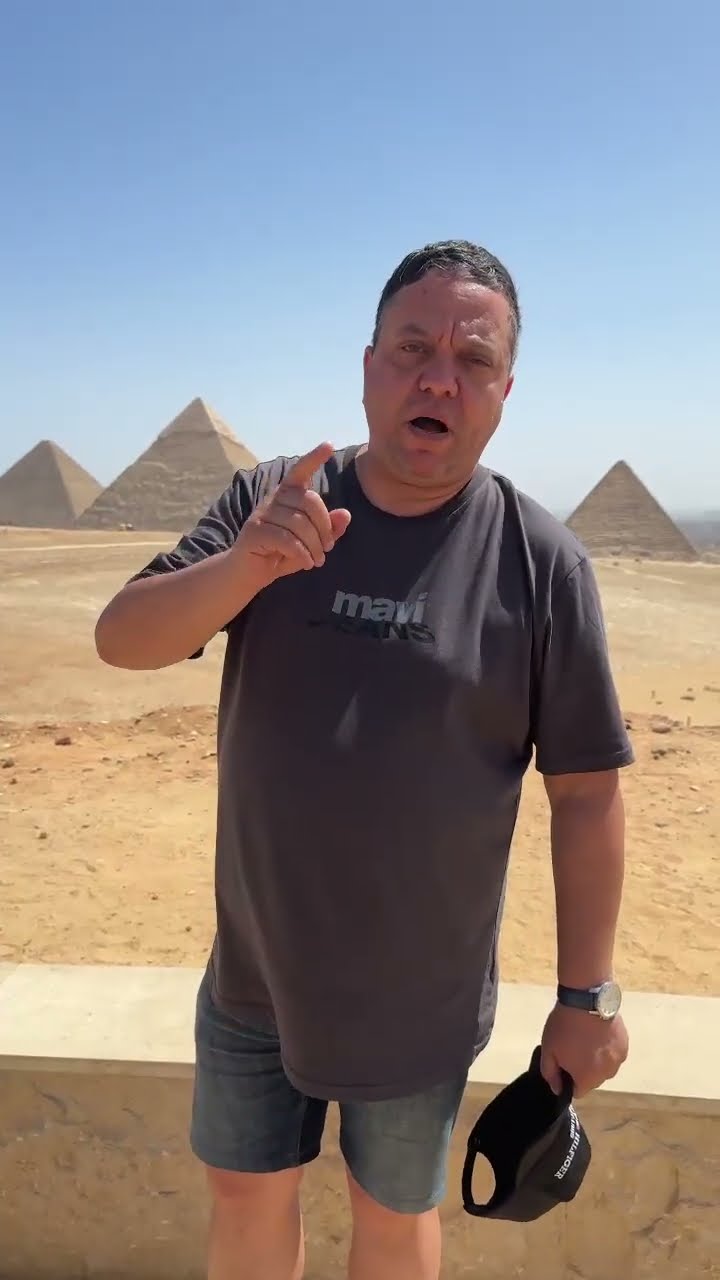
After breakfast your Egyptologist meets you at the hotel. The three main pyramids of Giza were built for the Fourth Dynasty kings Khufu, Khafre and Menkaure about 4,500 years ago; the Great Pyramid of Khufu is the only one of the Seven Wonders of the Ancient World still standing. Going inside the Great Pyramid needs a separate ticket. From the panoramic viewpoint you see the three pyramids in one view.
The morning at Giza is about two to three hours. Your guide explains how the plateau was laid out as a royal cemetery, with temples, causeways and the tombs of officials around each pyramid, and how the blocks were quarried and moved. The passage inside the Great Pyramid is narrow, steep and hot, so it is not recommended for anyone who dislikes tight spaces. Camel and horse rides near the viewpoint are optional; agree the price and the route first, or ask your guide to arrange it.
Below them is the Great Sphinx, about 73 metres long, carved from the bedrock of the plateau and usually linked to Khafre. Next to it, the Valley Temple of Khafre, built of huge granite blocks, is where the king's funeral rites began.
A drive of about 35 to 45 minutes south brings you to Memphis, capital of Egypt for much of the Old Kingdom and, by tradition, founded by King Menes. Little of the city remains, but its open-air museum keeps a colossal limestone statue of Ramses II lying on its back and the Alabaster Sphinx. The colossus lies in a covered hall with a gallery above it, so you look down along its length and see the fine carving of the face and the royal names on the belt and shoulder. The visit takes about 45 minutes.
Lunch is at a local restaurant near Saqqara, the burial ground of Memphis. The Step Pyramid of Djoser, designed by the architect Imhotep around 2650 BC, is the earliest large stone building in Egypt. You also visit one or two of the mastaba tombs of officials, when open, whose walls are carved with scenes of farming, fishing and daily life.
Djoser's pyramid stands at the centre of a large walled complex, entered through a colonnade of stone columns carved to imitate bundled reeds: one of the first times builders translated wood and reed architecture into stone. Saqqara is quieter than Giza, and walking across the open site gives you a sense of how large the necropolis of Memphis was. The site is exposed, so a hat and water matter here more than anywhere else today.
You are back at the hotel in the late afternoon, around 4 to 5 pm. Dinner is not included. The Sound and Light show at the pyramids is an optional extra in the evening, and a warm layer is useful for it in winter. Overnight in Cairo.
The Egyptian Museum on Tahrir Square, opened in 1902, still holds tens of thousands of objects from 5,000 years of history: the Narmer Palette, Old Kingdom statues, painted coffins, jewellery and papyri. Tutankhamun's treasures have moved to the Grand Egyptian Museum and the royal mummies to the National Museum of Egyptian Civilization, so your guide plans a route through the highlights that remain here.
The building itself is part of the visit: a pink neoclassical hall where the displays still have the feel of an early 20th-century museum. Your guide usually starts on the ground floor with the Narmer Palette, which records the unification of Upper and Lower Egypt, and the Old Kingdom statues of kings and officials, then moves upstairs to the coffins, jewellery and papyri. Allow about two hours.
Saladin began the Citadel in 1176 to defend Cairo, and it was the seat of Egypt's rulers for some 700 years. Inside stands the Mosque of Mohamed Ali, built in the Ottoman style between 1830 and 1848 and clad in alabaster, with its domes and pencil minarets visible across the city. From the terrace you see Cairo spread out below, and on a clear day the pyramids of Giza on the horizon. Inside the mosque you take off your shoes; the domes are hung with lamps, and in the courtyard stands a clock tower given by King Louis-Philippe of France, in exchange for the Luxor obelisk now in the Place de la Concorde in Paris.
After lunch at a local restaurant you drive to Old Cairo, built around the Roman fortress of Babylon. The Hanging Church takes its name from its position above the fortress gate. The Church of Saints Sergius and Bacchus, Abu Serga, stands over the crypt where, by tradition, the Holy Family rested during their flight into Egypt. The Ben Ezra Synagogue nearby, linked by local tradition to the place where the infant Moses was found, is where the Cairo Geniza manuscripts came to light in the 19th century.
The day ends at Khan el-Khalili, a market since the late 14th century, with lanes of lamps, spices, silver and fabric. Your guide shows you the main lanes and the medieval gates and mosques around the market, then leaves you free time to browse or sit for a mint tea at one of the old coffeehouses. Brass lanterns, spices, cotton and silver are the usual buys.
You are back at the hotel around 6 pm. Dinner is not included. Tomorrow starts early for Alexandria, so ask the hotel tonight for an early breakfast or a breakfast box if the restaurant opens late. Overnight in Cairo.
After an early breakfast you drive north on the Desert Road, about two and a half to three hours with a rest stop. On the way your guide tells the story of the city Alexander the Great founded in 331 BC, which became the capital of the Ptolemies and the centre of learning of the ancient world. For almost three centuries it was the seat of the Greek dynasty that ended with Cleopatra VII, and its library and Museion drew scholars from across the Mediterranean.
Pompey's Pillar, a red granite column about 27 metres high, was raised around AD 297 in honour of the Roman emperor Diocletian; it stood in the precinct of the Serapeum, and the name comes from a medieval mistake. A short drive away, the Catacombs of Kom el-Shoqafa, a burial complex of the 2nd century AD found by chance in 1900, go down three levels by a spiral staircase. Their carvings mix Egyptian gods with Roman dress and Greek decoration. In the main tomb, Anubis stands guard in the armour of a Roman legionary, and a banquet hall where relatives once shared funeral meals opens off the stairs. The steps are steep and can be damp, so closed shoes help.
You drive along the Corniche to the Qaitbay Citadel, built in 1477 on the site of the Pharos, the lighthouse that was one of the Seven Wonders of the Ancient World. Lunch is fresh fish or seafood at a local restaurant near the harbour.
The fort stands at the end of a narrow spit at the entrance to the Eastern Harbour, and stones from the fallen Pharos are thought to have been reused in its walls. You walk through the courtyard and the inner keep and look out over the sea and the curve of the Corniche back towards the city. At the restaurant, fish is often chosen from the counter by weight and then grilled or fried, served with rice, salads and tahini; if you prefer meat or a vegetarian meal, your guide orders for you.
The new library, opened in 2002 near the site of the ancient Library of Alexandria, is a tilted disc of glass whose granite wall is carved with letters from scripts around the world. You see the great reading room and, when open, its small museums.
You drive back to Cairo on the Desert Road, with a rest stop on the way, and reach your hotel between 7 and 9 pm, depending on traffic. Dinner is not included. Overnight in Cairo.
Alexandria's sites are spread across a long city, so the order of visits can change with traffic and opening hours. If the library is closed on your date, your guide replaces it with another Alexandria site, such as the Roman Amphitheatre at Kom el-Dikka or the Montazah gardens.
After breakfast you have free time until your transfer. Check-out is usually at noon; if your flight is later, the hotel can store your luggage, and a late check-out can be requested for a fee, subject to availability. Our representative helps with check-out and drives you to Cairo International Airport in time for your flight; airlines usually ask you to be there three hours before departure. This is the end of the tour.
If your flight leaves late in the day, ask us about an extra visit, such as the Grand Egyptian Museum or the National Museum of Egyptian Civilization, as an optional extra. Because the tour is private, extra days or a Nile cruise can also be added.
Comfortable, well located
More space and better ships
Our highest level
Children pay less, see the children policy below. Christmas, New Year and Easter dates add 25%. Prices are per person in US dollars.
October to April is the most pleasant time, with Cairo around 18 to 25 °C by day. Alexandria is cooler and can be windy and rainy from December to February, so bring a light waterproof for that day. In summer, Cairo passes 35 °C, while Alexandria stays around 30 °C with a sea breeze; visits start early and indoor sites are kept for the afternoon. Christmas, New Year and Easter are the busiest weeks.
Many nationalities can buy a tourist visa on arrival at Cairo airport or apply in advance for an e-visa on Egypt's official portal, visa2egypt.gov.eg. Rules and fees depend on your passport, so check before you book your flights. Your passport should be valid for at least six months from arrival. The visa is not included in the tour price.
The currency is the Egyptian pound. Cards are accepted in hotels and larger shops; keep small notes for markets, toilets at some sites and camera tickets. ATMs are common in both cities. Bargaining is normal in Khan el-Khalili, where prices are rarely marked; fixed-price shops and hotel boutiques cost more but save the haggling. Tips are not included. The tipping guide in the travel policies below gives the usual amounts for guides and drivers.
Cairo is a city of more than 20 million people, and traffic shapes every plan. Your guide orders the visits to avoid the worst of it, which is why the times in this program are approximate. Friday mornings are the quietest time on the roads; weekday late afternoons are the busiest. On Fridays some mosques close to visitors during the midday prayer, and on Sunday mornings the Coptic churches hold services; your guide adjusts the order of Day 3 if your dates fall on either.
Lunch on the touring days is at local restaurants your guide knows: Egyptian grills, rice, salads and bread in Cairo, and fresh fish chosen by weight and grilled or fried in Alexandria. Tell us about any allergies or a vegetarian diet when you book, and we pass it on. Tap water is not recommended for drinking; bottled water is included during the tours.
All prices are per person in US dollars. The price changes with the season (winter 1 October to 30 April, summer 1 May to 30 September), the accommodation level and the size of the group. Christmas, New Year and Easter dates add 25%. Your quote lists the final price and everything it covers. After the deposit, changes to your itinerary cost US$25 per request, plus any third-party fees.
A deposit of 30% of the total tour cost confirms your booking. We send you a secure payment link for the deposit; the balance is paid in cash or by card on arrival in Egypt, unless your written offer gives another date. We never ask for card details by email, chat or WhatsApp. We confirm every booking by email.
No-show travelers are charged 100%. During peak events in Egypt, hotels and Nile cruises do not refund deposits. Groups of more than 10 people may have different terms.
Add each child and their age in the enquiry form so the quote is exact.
Optional visits, such as a hot air balloon ride in Luxor, a Sound and Light show or a felucca ride, are not in the price. Tell us which ones you want and we add them to your quote with their cost.
Not included in the price: Egypt entry visa; Interior visits to the Pyramids or drinks during meals; Gratuities for guides and drivers.
Tipping is customary in Egypt and is not included in the price. A usual amount for a private tour is US$8 to 10 per person per day for your guide, US$4 to 5 for your driver and US$5 to 8 per person per day for the crew on a Nile cruise. Your guide can advise you on the day.
No. Alexandria is a full day trip from your Cairo hotel, about two and a half to three hours each way by the Desert Road. If you would rather sleep by the sea, we can change one Cairo night to Alexandria; ask when you enquire.
No. Day 3 visits the Egyptian Museum on Tahrir Square. The Tutankhamun galleries are now at the Grand Egyptian Museum near Giza, which we can add on Day 5 or in place of the Tahrir museum; tell us when you book.
No. The guide and vehicle are private for your group, and the times of each day can follow your pace.
Yes. The tour works well as the first part of a longer trip: a Nile cruise between Luxor and Aswan, a few days on the Red Sea, or both. We arrange the domestic flights and adjust the price.
Independent reviews on the platforms travelers already trust.
Amazing Egyptian vacation! We did an 11 day private tour of Cairo, cruise on the Nile between Aswan and Luxor and a 4 day stay in Hurghada. The guided tours were very interesting, with extremely knowledgeable guides, attentive and helpful.
Egypt package to the Pyramids of Giza and Saqqara was a fascinating journey through Egypt's ancient past ,guide knowledge, the majesty of the pyramids, and the historical depth of Saqqara made this tour truly enriching!
our honeymoon to Egypt ,Giza and Saqqara was a magical escape into history The pyramids looming in the distance, the quiet serenity of the desert, and the ancient wonders of Saqqara created moments that will be with me forever!
From the same category, with the same private service.

We always use the cookies this site needs to work. With your permission we also use the optional ones listed under Settings. You can change your choice at any time. Privacy policy