Standard
Standard hotelsComfortable, well located
- Cairo 3 nightsBarceló Cairo Pyramids or Jaz Pyramid Cairo, or similar
- Nile cruise 3 nightsPrincess Sarah or M/S Nile Dolphin, or similar
- Hurghada 5 nightsArabia Azur Hurghada or similar
Three nights in Cairo, a three-night Nile cruise from Aswan to Luxor and five nights on the Red Sea in Hurghada, with three boat days for diving or snorkelling and both domestic flights included.
This 12-day tour splits Egypt into two halves. The first week covers the sites: two full days around Cairo and Giza, a flight south to Aswan and a three-night Nile cruise downriver to Luxor, ending with both banks of Luxor in one day. The second half is spent on the Red Sea in Hurghada, five nights in all, with three days out on a boat over the coral reefs and two days to rest. On the last morning you fly from Hurghada to Cairo to connect with your flight home.
Along the way you see the Pyramids of Giza and the Sphinx, Memphis and the Step Pyramid at Saqqara, the Tutankhamun galleries of the Grand Egyptian Museum, the Citadel of Saladin, Coptic Cairo and Khan el-Khalili, then the High Dam and Philae in Aswan, the temples of Kom Ombo and Edfu, Karnak, Luxor Temple, the Valley of the Kings and the temple of Hatshepsut. In Cairo your Egyptologist guide and vehicle are private; on the cruise the sightseeing is led by the ship's Egyptologist. The domestic flights, the Luxor to Hurghada drive and the three boat days with lunch on board are included in the price.
It is a weaker fit if you do not swim or have no interest in the sea, if you want Abu Simbel (it is not on this route), or if you would rather have your own guide on the cruise as well as in Cairo. For a route with more temples and fewer beach days, see our Egypt classic tours; for other high-comfort trips, our luxury Egypt tours. Any part of this one can be changed in a tailor-made trip.
The first seven days are busy, with early starts and two to five sites a day. Day 3 is the fullest in Cairo, and Day 7 combines the East and West Banks of Luxor with the drive to the coast. From Day 8 the pace drops: one free day, then three boat days that start around 8:30 and return to the hotel by mid-afternoon. Three days include a longer transfer:
Our representative meets you in the arrival hall of Cairo International Airport, helps with the visa counter and your bags if needed, and walks you to your private air-conditioned car. The drive to the hotel takes 30 to 60 minutes, depending on the traffic and on where you stay.
Check-in is arranged for you, with a welcome drink on arrival. Your tour leader goes through the coming days: the pick-up time for Day 2, the dress code for the mosque and churches on Day 3, and the flight to Aswan on Day 4.
No sightseeing and no meals are planned today, so you can rest after the flight. Day 2 starts after an early breakfast.
Your Egyptologist meets you after breakfast and you drive about an hour south of Cairo to Memphis, the capital of Egypt for much of the Old Kingdom. Little of the city stands today, but its open-air museum holds a colossal limestone statue of Ramses II, lying on its back, and the Alabaster Sphinx.
A few minutes away is Saqqara, the cemetery of Memphis. The Step Pyramid of Djoser, built around 2650 BC to a design by the architect Imhotep, is the oldest large stone structure in Egypt: six stacked steps that show how the smooth-sided pyramids began. Depending on which tombs are open on the day, you may also see the Pyramid Texts carved inside the Pyramid of Teti or the daily-life reliefs of a noble's tomb.
Lunch is at a local restaurant between Saqqara and Giza, with Egyptian dishes such as grilled meats, rice, salads and fresh bread.
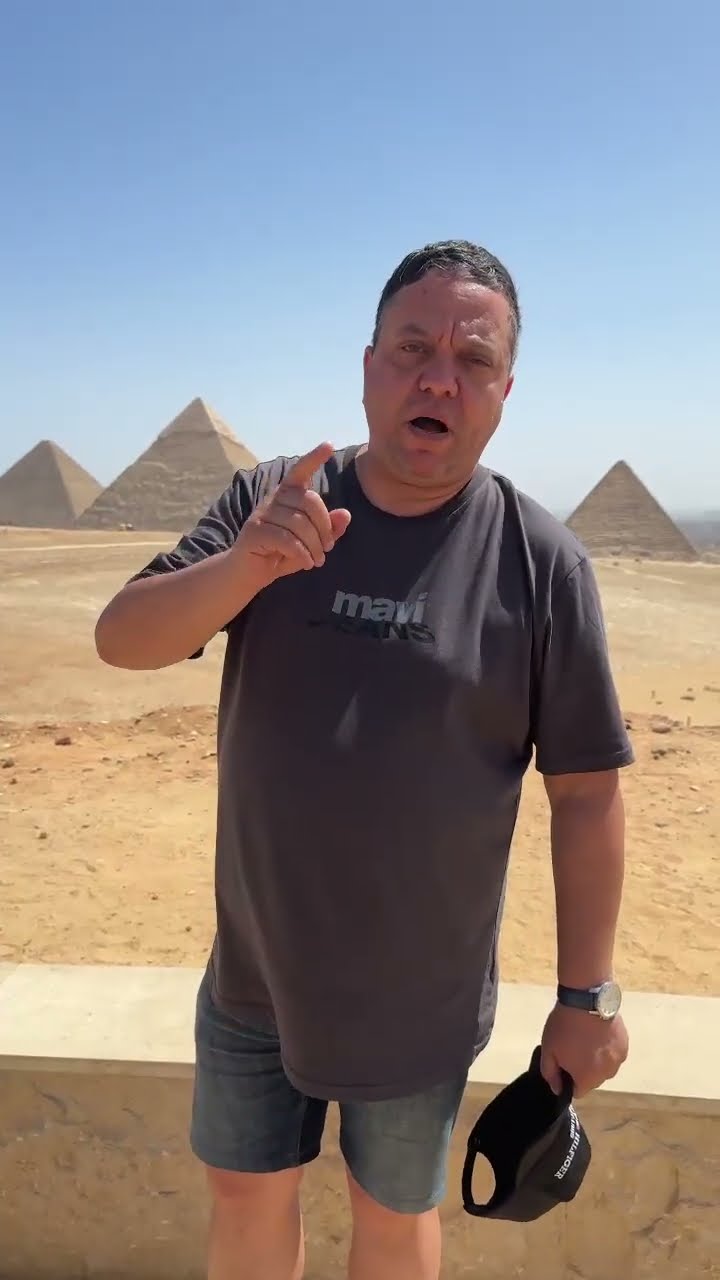
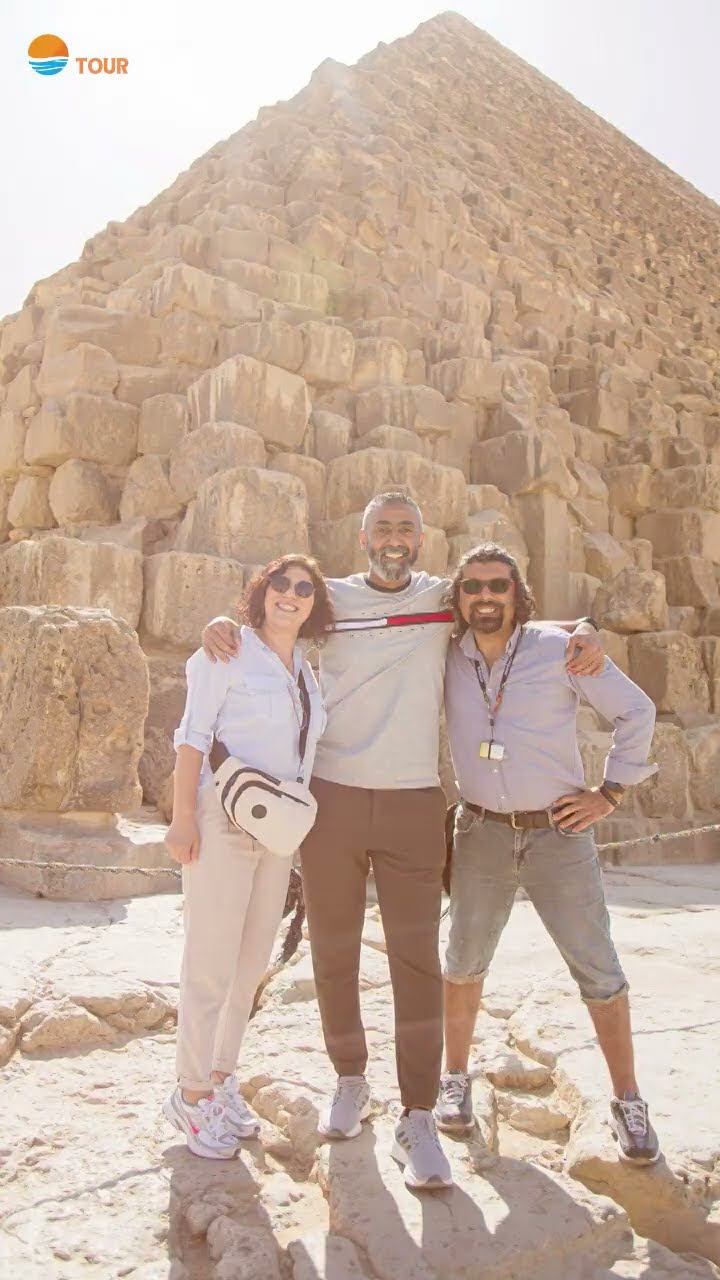
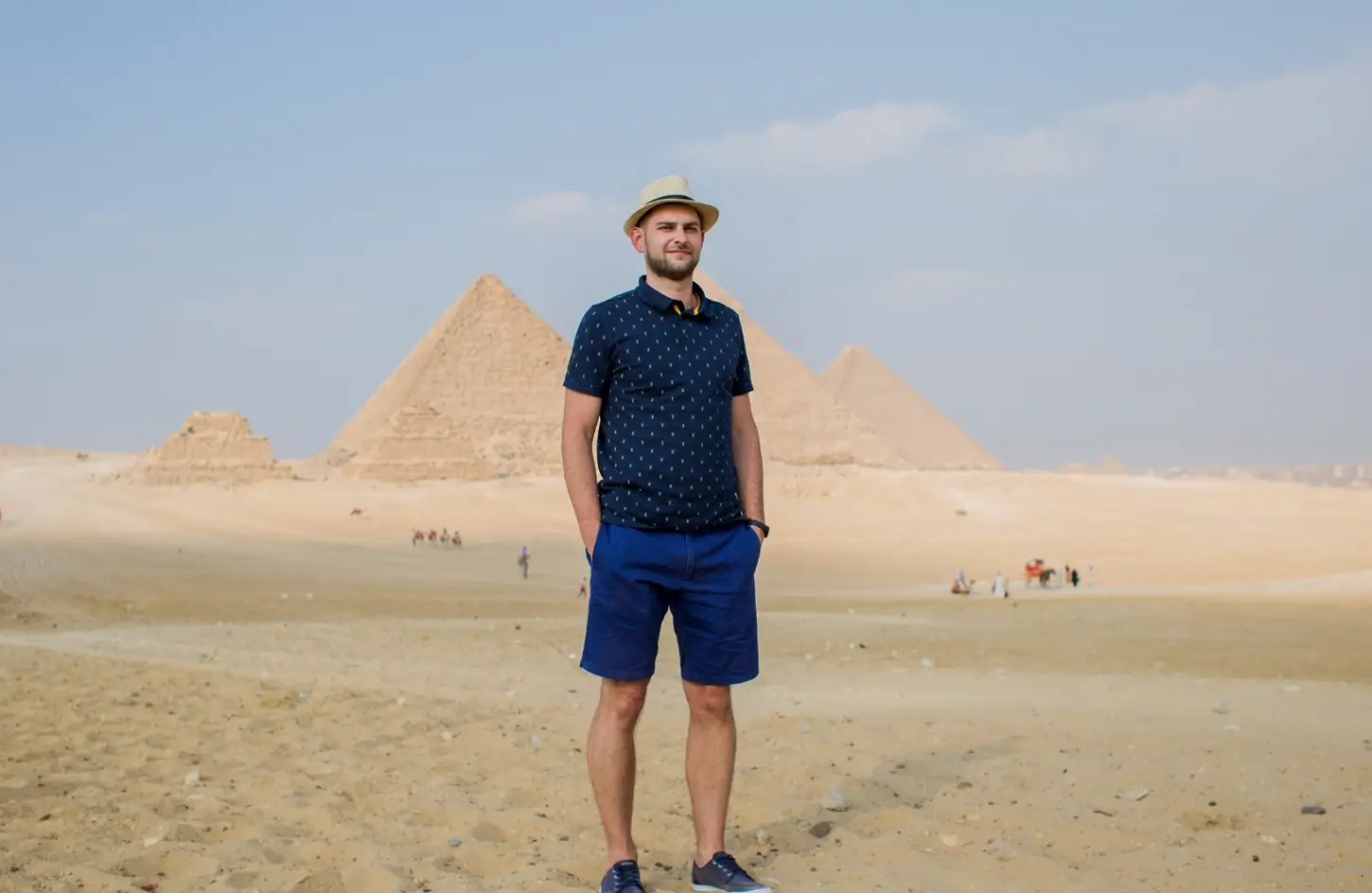
The afternoon is on the Giza Plateau. The three main pyramids belong to the Fourth Dynasty kings Khufu (Cheops), Khafre (Chephren) and Menkaure (Mycerinus) and are about 4,500 years old; the Great Pyramid of Khufu is the only one of the Seven Wonders of the Ancient World still standing. Going inside the Great Pyramid needs a separate ticket bought at the site. Below the pyramids you see the Great Sphinx and the Valley Temple of Khafre, built of granite blocks, where the rites of the king's burial began.
You are back at the hotel in the late afternoon. Overnight in Cairo.
The Grand Egyptian Museum stands about 2 km from the Giza pyramids. You pass the colossal statue of Ramses II in the Grand Hall and climb the Grand Staircase lined with royal statues to the Tutankhamun galleries, where the objects from the young king's tomb are shown together for the first time. The museum is very large, so your guide picks a route through the key pieces in two to three hours.
Next is the Citadel, the fortress Saladin began in the 1170s on a spur of the Muqattam hills, seat of Egypt's rulers for some 700 years. Its best-known building is the Mosque of Muhammad Ali, finished in the 1840s in the Ottoman style and called the Alabaster Mosque for the stone that lines its walls. From the terrace there is a wide view over the minarets of historic Cairo. Lunch follows at a local restaurant.
In Old Cairo you walk into the Coptic quarter, built around the Roman fortress of Babylon. The Hanging Church takes its name from its position over the fortress gatehouse, and the Ben Ezra Synagogue nearby is where the Cairo Geniza, a store of medieval Jewish manuscripts, was found in the 19th century. Shoulders and knees should be covered in the churches, the synagogue and the mosque.
The day ends at Khan el-Khalili, a market since the late 14th century, with its lanes of lamps, spices, silver and fabrics. There is time to walk, shop or sit for a mint tea before the drive back to your hotel. Overnight in Cairo.
After breakfast you check out and transfer to Cairo airport for the domestic flight to Aswan, about 1 hour 20 minutes. Our representative meets you on arrival and drives you to the river, where you board your Nile cruise ship. Lunch is the first meal on board.
In the late afternoon a felucca, the traditional sailing boat of the Nile, takes you around the islands of Aswan. You pass Kitchener's Island with its botanical garden and see the Mausoleum of the Aga Khan on the west bank hill, the tomb of the leader of the Ismaili Muslims, who died in 1957 and chose Aswan as his resting place. The granite boulders in the river here mark the start of the First Cataract, the old southern border of Egypt.
Afternoon tea is served on the sun deck, and dinner on board. Many ships hold a Nubian folk show in the evening. The ship stays moored in Aswan tonight.
After breakfast the ship's Egyptologist takes you to the High Dam, completed in 1970, which ended the yearly Nile flood and created Lake Nasser, more than 500 km long. Then a short motorboat ride brings you to Philae, the temple of the goddess Isis. When the old Aswan Dam left it half under water for much of the year, it was moved stone by stone to Agilkia Island in the 1970s in a UNESCO campaign, and its courts and reliefs are now dry and complete.
Back on board, lunch is served as the ship leaves Aswan and sails north, about four hours, past palm groves, villages and the sandstone hills of the desert edge.
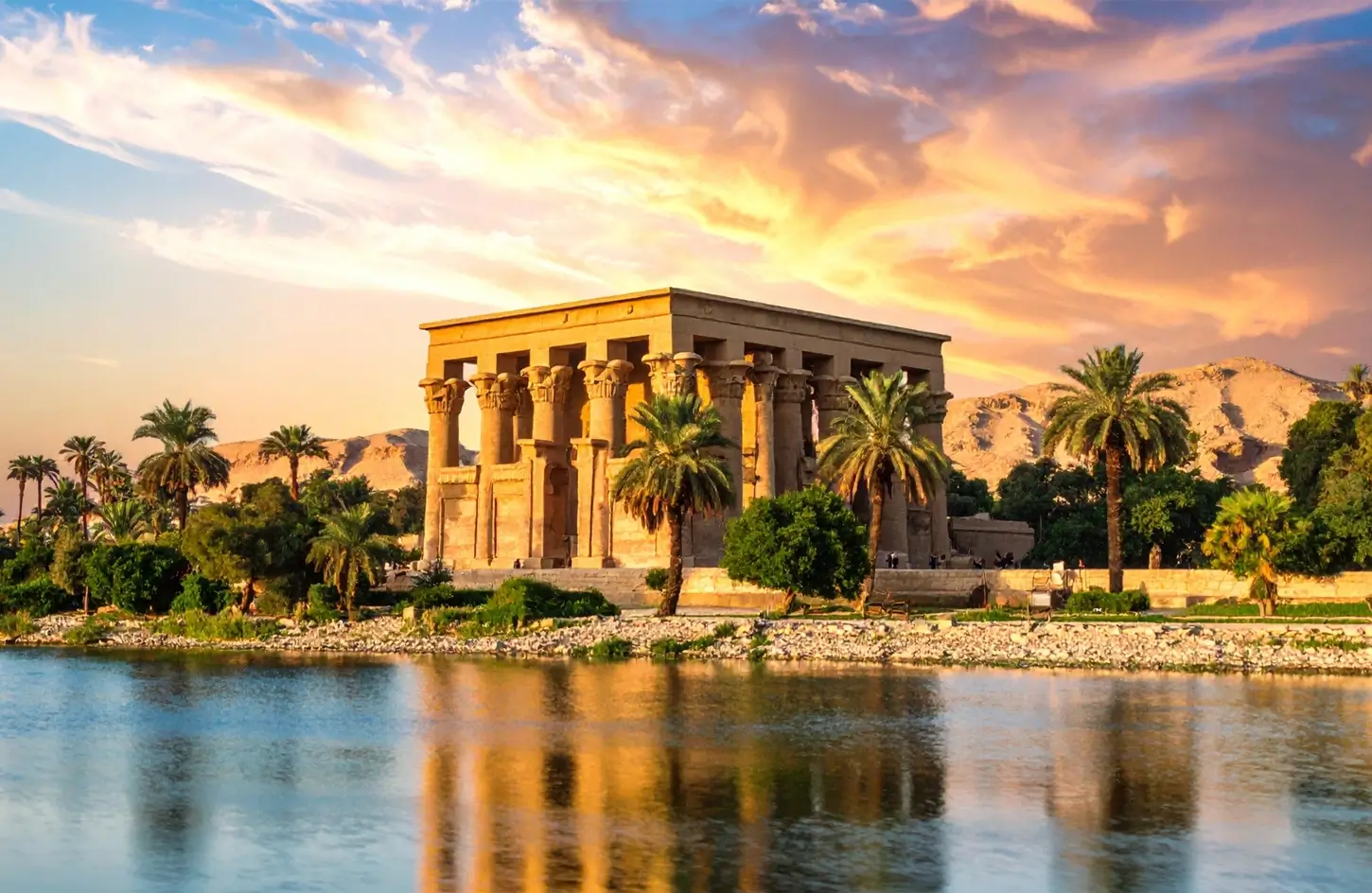
The ship moors next to Kom Ombo, a double temple from the Ptolemaic period with two entrances and two sanctuaries: one for Sobek, the crocodile god, and one for Haroeris, Horus the Elder. Your guide shows you a relief often read as a set of medical instruments and the Nilometer that measured the river. The small Crocodile Museum next door displays mummified crocodiles from a nearby cemetery. The temple is lit after dark, which makes this a good time to see it.
Afternoon tea, dinner on board and, on many ships, an evening show. The ship sails on to Edfu overnight.
After an early breakfast a horse carriage takes you from the quay through the town to the Temple of Horus. Built between 237 and 57 BC, it is the most complete temple in Egypt: the pylon, the roofed halls and the granite shrine of the falcon god still stand much as they were built. Its walls tell the story of the battle between Horus and his uncle Seth, and list the rituals and festivals held there, which is why scholars use it to understand how earlier temples worked.
Lunch is on board as the ship sails north. Near Esna it passes through the lock that lifts and lowers boats around the barrage, a slow and interesting stretch to watch from the deck. Afternoon tea is served while the fields, palm trees and villages slide past.
Dinner is on board, often with a galabeya party, when guests are invited to wear the long traditional robe. The ship moors in Luxor for the night.
After breakfast you leave the ship with your luggage and cross to the West Bank, ahead of the heat. The Valley of the Kings holds more than 60 tombs cut for the pharaohs of the New Kingdom; the standard ticket opens three of the tombs open on the day, and the tombs of Tutankhamun, Seti I and Ramses VI need a separate ticket bought at the site. Inside, the painted corridors show the king's journey through the underworld.
At Deir el-Bahari, the temple of Queen Hatshepsut rises in three terraces against the cliffs; she ruled as pharaoh for about two decades, and the reliefs record her trading expedition to the land of Punt. On the way back you stop at the Colossi of Memnon, two seated statues of Amenhotep III, each about 18 metres tall.
On the East Bank, Karnak was the great temple of Amun, enlarged by pharaoh after pharaoh over some 2,000 years. Its Great Hypostyle Hall has 134 columns, and the obelisks of Thutmose I and Hatshepsut still stand inside. Luxor Temple, built mainly by Amenhotep III and Ramses II, stands in the centre of town; one of its two obelisks has stood in the Place de la Concorde in Paris since 1836.
Your private vehicle takes you north to Qena, then east across the mountains of the Eastern Desert to the coast at Safaga and on to Hurghada, about four hours with a short stop. You check in to your beach hotel in the evening. Overnight in Hurghada.
After a week of early starts, today is yours. Most travelers spend it on the beach or by the pool, or at the hotel spa. Hurghada stretches for about 40 km along the coast, and most resort hotels have their own beach and a jetty out over the reef, so you can snorkel straight from the hotel.
In the evening, the promenade of Hurghada Marina has cafés and restaurants by the water, and El Dahar, the older part of town, has a local market. A desert trip by jeep or quad bike, often ending with dinner at a Bedouin camp, is an optional extra if you would like a change from the sea. More ideas are in our guide to things to do in Hurghada.
Breakfast is included; lunch and dinner are your choice. Check your mask and fins, or ask at the hotel dive centre, before the three boat days that follow.
You are collected from the hotel after breakfast, usually around 8:00, for the marina. The boat heads out to the reefs off Hurghada, often around the Giftun Islands, a protected area, or the reefs to the north towards the Strait of Gubal. The crew chooses the sites on the day by the wind and the sea.
Certified divers make two guided dives with a dive guide, with tanks, weights and weight belts provided. If you have never dived, an introductory dive with an instructor in shallow water is the usual first step; you fill in a short medical form before it. If you prefer to stay at the surface, you snorkel over the same reefs. Expect hard and soft corals, reef fish such as anthias, butterflyfish and parrotfish, and, with luck, a turtle or a ray.
Lunch is cooked on board between the two stops, with soft drinks and water. The boat is back at the marina in the mid-afternoon, and the rest of the day is free at the hotel.
A second boat day, usually to different sites from yesterday, so you see more of the reefs around Hurghada. The pattern is the same: pick-up after breakfast, two dives or snorkelling stops, lunch with soft drinks on board, and back at the hotel by the mid-afternoon.
Do not stand on or touch the coral, and do not feed the fish. If you feel tired after yesterday, you can skip a dive and snorkel or rest on the sun deck instead. The evening is free; the marina is the easiest place for dinner out.
The last of the three boat days, with two more dives or snorkelling stops, lunch and soft drinks on board, and the return to the hotel in the mid-afternoon.
Tomorrow you fly from Hurghada to Cairo. Diving agencies advise at least 18 hours between your last dive and a flight, and 24 hours after several days of repeated dives. If your flight is early in the day, tell the dive guide in the morning: you can snorkel instead, or keep the second dive short and shallow.
The evening is free for a last dinner by the sea. Pack tonight, and check the baggage allowance printed on your domestic flight ticket: diving gear can push you over it.
After breakfast you check out, and our representative drives you to Hurghada airport for the domestic flight to Cairo, about one hour. The flight is timed to your international flight home, and in Cairo our team meets you and helps you to the departure terminal. Airlines usually ask you to be at the airport three hours before an international flight, so allow for that when you book.
If your international flight leaves from Hurghada instead, tell us when you book and we will replace the domestic flight with a transfer to Hurghada airport. This is the end of the tour.
Comfortable, well located
More space and better ships
Our highest level
Children pay less, see the children policy below. Christmas, New Year and Easter dates add 25%. Prices are per person in US dollars.
For this route, the best balance is October to May. In winter, December to February, Cairo is around 18 to 22 °C by day, Aswan and Luxor are pleasantly warm, and nights on deck are cool. The sea in Hurghada is then around 21 to 23 °C, fine for diving in a 5 mm wetsuit, but some swimmers find it fresh. In April, May, October and November the water is 24 to 27 °C and the air still comfortable for the temples. From June to September the Red Sea is at its best, about 28 °C with calm, clear water, but Luxor and Aswan often pass 40 °C, so the cruise days start very early. Christmas, New Year and Easter are the busiest and most expensive weeks.
Many nationalities can get a tourist visa on arrival at Cairo airport or apply for an e-visa beforehand on the official portal, visa2egypt.gov.eg; the rules and the fee depend on your passport. Your passport should be valid for at least six months from the day you arrive. The visa is not included in the price, but we can help you with it on arrival if you ask when you book. Divers should also note that you should not fly for at least 18 to 24 hours after your last dive: the last boat day is Day 11 and the flight is on Day 12, so plan a shorter or shallower last dive if your flight leaves early.
The currency is the Egyptian pound. Cards work in the hotels, on the ship and in larger shops; carry small notes for the markets, toilets at some sites and the crew on the boat days. Tips are not included in the price. The tipping guide in the travel policies below gives the usual amounts for guides, drivers, cruise staff and dive crews; how much you give is your choice.
All prices are per person in US dollars. The price changes with the season (winter 1 October to 30 April, summer 1 May to 30 September), the accommodation level and the size of the group. Christmas, New Year and Easter dates add 25%. Your quote lists the final price and everything it covers. After the deposit, changes to your itinerary cost US$25 per request, plus any third-party fees.
A deposit of 30% of the total tour cost is required at the time of booking. The final payment is due 30 days before departure, and bookings made within 30 days of departure are paid in full. We accept Visa or Master Card by secure online payment, Visa or Master Card by email, and wire transfer. We confirm every booking by email.
No-show travelers are charged 100%. During peak events in Egypt, hotels and Nile cruises do not refund deposits. Groups of more than 10 people may have different terms.
Add each child and their age in the enquiry form so the quote is exact.
Optional visits, such as a hot air balloon ride in Luxor, a Sound and Light show or a felucca ride, are not in the price. Tell us which ones you want and we add them to your quote with their cost.
Not included in the price: Egypt entry visa (we can help you get it on arrival); International flights to and from Egypt; Personal expenses; Extra tickets at the sites: inside the Great Pyramid, and the tombs of Tutankhamun, Seti I and Ramses VI; Tips for guides, drivers, cruise staff and boat crews; Drinks with meals in the hotels and on the ship; Optional activities, such as a balloon flight in Luxor, a desert trip from Hurghada or a diving course.
Tipping is customary in Egypt and is not included in the price. A usual amount for a private tour is US$8 to 10 per person per day for your guide, US$4 to 5 for your driver and US$5 to 8 per person per day for the crew on a Nile cruise. Your guide can advise you on the day.
No. Certified divers make guided dives; if you have never dived, you can try an introductory dive with an instructor in shallow water, or snorkel over the same reefs from the surface. Bring your certification card and logbook if you have them, and tell us your level when you book so the dive centre can plan for you.
You fly from Cairo to Aswan (about 1 hour 20 minutes), sail from Aswan to Luxor on the cruise ship, drive from Luxor to Hurghada in a private vehicle (about four hours) and fly from Hurghada to Cairo on the last day (about one hour). Both domestic flights are included; book your international flights to and from Cairo.
Your Cairo sightseeing, your vehicle and all transfers are private. On the Nile cruise, the visits in Aswan, Kom Ombo, Edfu and Luxor are made with the ship's Egyptologist and other guests, and the boat days in Hurghada are shared with other divers and snorkellers. A private guide for the cruise days can be added at extra cost.
Yes. If you prefer, one or more boat days can be replaced with a free day or another trip from Hurghada, such as a desert safari or a day in El Gouna. Tell us when you book, as the price may change.
No. Abu Simbel is about 280 km south of Aswan and is not on this route. It can be added from Aswan by road or by air on Day 5 morning, which shortens the Aswan visits, or with an extra night; ask us when you enquire.
Independent reviews on the platforms travelers already trust.
Amazing Egyptian vacation! We did an 11 day private tour of Cairo, cruise on the Nile between Aswan and Luxor and a 4 day stay in Hurghada. The guided tours were very interesting, with extremely knowledgeable guides, attentive and helpful.
Egypt package to the Pyramids of Giza and Saqqara was a fascinating journey through Egypt's ancient past ,guide knowledge, the majesty of the pyramids, and the historical depth of Saqqara made this tour truly enriching!
our honeymoon to Egypt ,Giza and Saqqara was a magical escape into history The pyramids looming in the distance, the quiet serenity of the desert, and the ancient wonders of Saqqara created moments that will be with me forever!
We always use the cookies this site needs to work. With your permission we also use the optional ones listed under Settings. You can change your choice at any time. Privacy policy