
The Citadel of Qaitbay is a 15th-century sea fortress at the entrance of Alexandria's Eastern Harbour, built by the Mamluk sultan al-Ashraf Qaitbay between 1477 and 1479 on the foundations of the ancient Lighthouse of Alexandria. It is open every day from 9:00 to 20:00, and a ticket for a foreign adult costs EGP 200 (EGP 100 for students), according to the Ministry of Tourism and Antiquities when we last checked on 4 November 2026.
It is the picture on every Alexandria postcard and the stop our guests ask for first on a day in the city. This guide covers its history, what you see inside, the practical details of the visit and how to fit it into a day with the Library, the catacombs and the Corniche.
Citadel of Qaitbay tickets and opening hours
| Visitor | Adult | Student |
|---|---|---|
| Foreign visitor | EGP 200 | EGP 100 |
| Egyptian citizen | EGP 60 | EGP 30 |
- Hours: daily 9:00 to 20:00, according to the ministry's page. Hours can be shorter during Ramadan and on some holidays.
- Tickets: sold at the gate. Many Egyptian sites now take cards only, so carry a card as well as some small cash for tips and the walk along the Corniche.
- Students: bring a valid student card with a photo.
- Photos: phones and cameras are fine; drones are not allowed anywhere in Egypt without a permit.
Prices for Egyptian sites change, usually once a year, and some 2025 price lists showed a different figure, so check again shortly before your trip. If you visit with us, the tickets are included.
History of the Citadel of Qaitbay
Built on the Lighthouse of Alexandria
The Pharos lighthouse, one of the Seven Wonders of the Ancient World, stood at the eastern tip of Pharos island from the 3rd century BC. Earthquakes in the 14th century, in 1303 and 1323, brought down what was left of it. A century and a half later, the Ottoman fleet was a growing threat to Egypt's coast, and Sultan Qaitbay chose the lighthouse's site, the natural guard post at the mouth of the harbour, for a new fort. Work ran from 1477 to 1479 (882 to 884 in the Islamic calendar), and stone from the ruined lighthouse was reused in the walls. The sultan is said to have spent more than 100,000 gold dinars on it.
What was the Lighthouse of Alexandria?
The Pharos was commissioned by Ptolemy I and finished under his son Ptolemy II, between about 284 and 246 BC; Pliny names the architect as Sostratus of Cnidus. Modern estimates put its height at 100 metres or more, in three tiers: a square base, an octagonal middle and a round top where a fire burned at night. For centuries it was one of the tallest buildings on earth, and its name became the word for "lighthouse" in Greek, French (phare), Italian and Spanish (faro). Earthquakes damaged it from the 8th century on; the traveller Ibn Battuta found it too ruined to enter in 1349. When Qaitbay built his fort, the last remains were cleared and reused.
Who was Sultan Qaitbay?
Al-Ashraf Sayf al-Din Qaitbay ruled Egypt and Syria from 1468 to 1496, one of the longest reigns of the Mamluk period. He came to Egypt as a slave soldier, rose through the army and became one of the great builders of medieval Cairo. His funerary complex in the Northern Cemetery is pictured on the Egyptian one-pound note, and he also built a fort at Rosetta, where French soldiers found the Rosetta Stone in 1799 while rebuilding it. The Alexandria citadel was part of the same plan to defend the Mediterranean coast.
Five centuries of use
| Date | Event |
|---|---|
| 1477 to 1479 | Built by Sultan Qaitbay; a mosque is included inside |
| Early 1500s | Sultan Qansuh al-Ghuri strengthens the garrison |
| 1517 onwards | The Ottomans keep it as a garrison fort |
| 1798 | Taken by the French at the start of Bonaparte's expedition |
| 19th century | Muhammad Ali restores the ramparts and installs coastal guns |
| 11 July 1882 | Badly damaged when the British fleet bombards Alexandria |
| 1904 | Upper floors restored |
| After 1952 | The navy turns it into a maritime museum |
| 1984 | The largest restoration, by the Egyptian Antiquities Organization |
| 2003 | Further conservation and enlargement works, according to the ministry |
The lighthouse under the sea
In the 1990s French archaeologists working with the Egyptian antiquities service mapped thousands of large blocks, statues and column pieces on the seabed just off the fort, many of them thought to come from the lighthouse and the royal quarter. Some of the finds are now in Alexandria's museums. You can see the area of the excavations from the citadel's northern walls.
What to see inside the citadel
The fort covers about 17,550 square metres. Its plan is simple once you know it: an outer wall with towers, an inner wall around a courtyard, and a massive keep in the north-west corner of the courtyard.
The outer and inner walls
The outer wall, with its defensive towers, runs along the sea. Walk the path on the sea side for the classic views of the waves breaking on the rocks. The inner wall holds rooms that served as barracks and stores; their narrow slits show how the soldiers fired on ships.
The keep
The main tower is a three-storey square building with half-round towers at its four corners, which carry projecting balconies for defence. Inside, look for Qaitbay's mosque on the first floor, with its mihrab and the remains of its decoration, and climb the stairs for the view across the harbour to the city skyline and the Bibliotheca Alexandrina.
The cistern and the courtyard
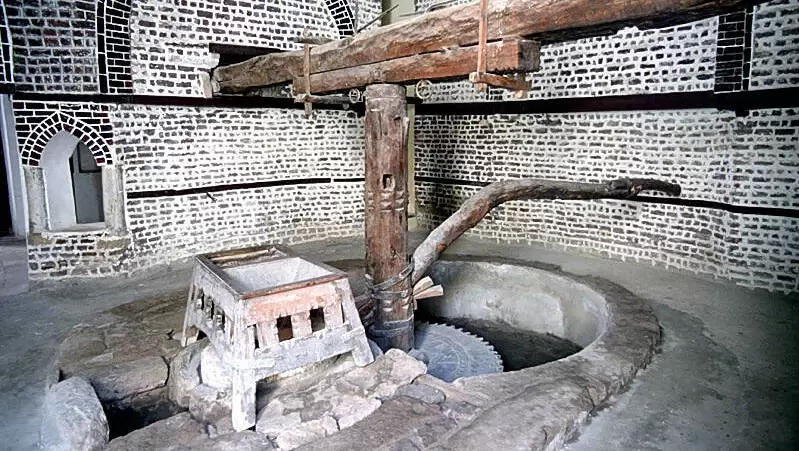
A water tank near the keep supplied the garrison and its horses during a siege. The open courtyard around the keep is where you get the best photos of the whole tower.
Details our guides point out
- Reused stone: look for granite pieces and column fragments set into the lower walls; they come from older buildings, probably including the lighthouse.
- Repairs in a different stone: the western side, wrecked in the 1882 bombardment, was rebuilt, and you can see where newer masonry meets the old.
The views
On a clear day you see the whole curve of the Eastern Harbour from the walls. In the late afternoon the light falls on the sea side of the fort; that is the hour our guides choose when the timing of the day allows it.
How to get to the Citadel of Qaitbay
The citadel stands at the end of a short causeway in the Anfoushi and Bahary district, at the western end of the Corniche.
- Taxi or Uber/Careem: 10 to 20 minutes from the city centre (Raml station or Mansheya), depending on traffic. Ask for "Qalaat Qaitbay".
- Walking: from Raml station along the Corniche it is about 3 km, a pleasant walk in winter with the sea on your right.
- From Cairo: Alexandria is about 220 km away, around 3 hours by road or 2.5 to 3 hours by train to Misr station, then a taxi. A day trip from Cairo is possible with an early start. Our 7-day Cairo, Luxor and Alexandria tour sets aside day 6 for that trip.
How long to spend and the best time to go
- Time: 45 minutes to 1 hour for the walls and the keep; add 30 minutes if you want to sit by the sea or walk the full outer wall.
- Time of day: morning is quiet on weekdays. Friday and Saturday afternoons bring local families and school groups. The late afternoon light is the best for photos.
- Season: Alexandria is milder than Cairo. Spring and autumn are ideal; in winter the wind and waves can be strong, so bring a jacket; in July and August it is humid but cooler than Cairo.
- Shoes: there are uneven stone floors and steep stairs in the keep.
What to wear, families and safety
- What to wear: light, modest clothes (shoulders and knees covered suit the mosque in the keep and the conservative Bahary district), flat shoes for the stairs, a hat in summer and a windproof jacket from December to February, when the sea wind is cold.
- Children: children enjoy the towers, the walls and the sea, but the ramparts have low parapets in places and the keep stairs are steep and dark, so keep small children by the hand. Strollers are hard to use inside.
- Safety: the citadel is a busy, guarded tourist site and feels safe. Mind your step on wet stone near the sea wall in winter, when waves break over the rocks.
- Toilets and water: there are basic facilities; cafes and kiosks are just outside on the Corniche.
Is the Citadel of Qaitbay worth visiting?
Yes, if you spend any time in Alexandria. It is a short visit, inexpensive, and it combines three things in one stop: the site of one of the Seven Wonders, a well-kept Mamluk fort, and the best sea views in the city. Do not expect a museum full of objects; the fort itself and its setting are the reason to come. If you want ancient Alexandria in objects, add the Alexandria National Museum on the same day.
Near the citadel: building a day in Alexandria
- The fish market and seafood restaurants: next to the citadel in Anfoushi; choose your fish at the counter and it is grilled for you. Our guide to the best fish restaurants in Alexandria has addresses.
- Abu al-Abbas al-Mursi Mosque: 10 minutes' walk, the city's best-known mosque; dress modestly.
- The Corniche: walk or drive east along the Alexandria Corniche to the Library.
- Bibliotheca Alexandrina: about 10 minutes by car; see our Library of Alexandria guide.
- Catacombs of Kom el Shoqafa: about 15 to 20 minutes across town; read our catacombs guide.
A typical day with our guides: the catacombs and the Serapeum hill in the morning, the National Museum or the Library at midday, a fish lunch in Anfoushi, then the citadel in the afternoon light.
Plan it with us
The citadel is included on our Alexandria archaeological day tour from Cairo and on the shorter Alexandria half day tour. To stay longer, the 5 days Cairo and Alexandria tour gives the city a full day.
Citadel of Qaitbay: quick answers
How much is the ticket to the Citadel of Qaitbay?
EGP 200 for a foreign adult and EGP 100 for a foreign student, according to the Ministry of Tourism and Antiquities (checked 4 November 2026).
What are the opening hours of the Citadel of Qaitbay?
Daily from 9:00 to 20:00 according to the ministry. Hours may be shorter in Ramadan.
Who built the Citadel of Qaitbay and when?
The Mamluk sultan al-Ashraf Qaitbay, between 1477 and 1479, on the site of the Lighthouse of Alexandria.
Is the Lighthouse of Alexandria under the citadel?
The citadel stands on the lighthouse's site and reuses some of its stone. Many large blocks thought to come from the lighthouse lie on the seabed just off the fort.
How long do you need at the Citadel of Qaitbay?
About 45 minutes to 1.5 hours, depending on how much of the outer wall you walk.
Ahmed Samir writes and updates the Egypt travel guides of Egypt Online Tour, a licensed tour company based in Cairo (ETAA licence 1466). Our travel advisors review each guide before it is published.
All guides by Ahmed Samir