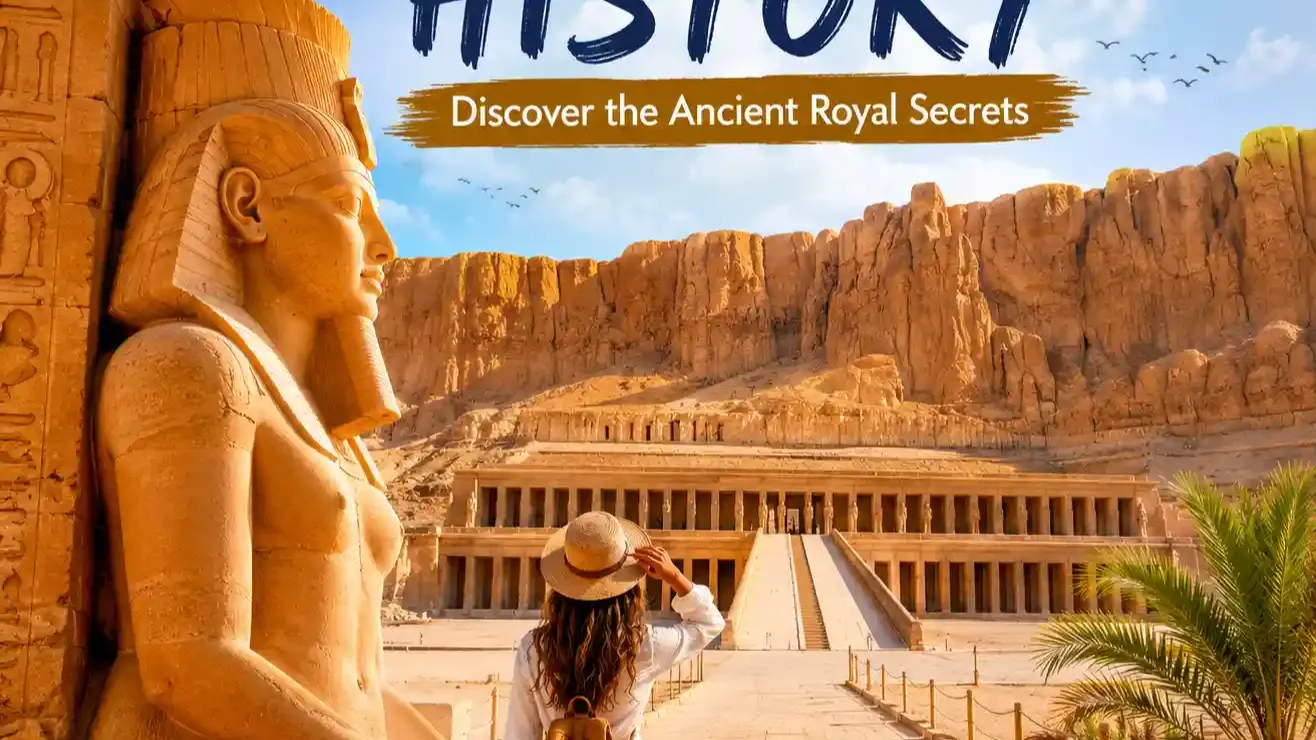
Ancient Egyptian history has always been replete with achievements that are hard for the mind to believe and comprehend. Among these is Deir el Bahri History, a temple where every inscription and detail tells a story of a rich history and true innovation. In this article, let’s embark on an extraordinary journey to discover the temple’s features, the details of its construction, information about Queen Hatshepsut’s temple, the secrets of its inscriptions, and some important tips before visiting it.
Deir el Bahri History in Luxor
Deir el-Bahari is considered one of the most distinctive places, brimming with examples of Egypt’s glorious history
What is Deir el Bahri?
Deir el-Bahari is one of the most famous archaeological sites in ancient Egypt; it is a funerary complex comprising a number of important monuments and funerary temples, the most famous of which is the Temple of Queen Hatshepsut. Deir el Bahri History served as an important religious centre for over 2,000 years.
Where is Deir el Bahri located?
Deir el-Bahari is situated on the west bank of the Nile, next to the modern-day city of Luxor; the site lies at the foot of towering mountain slopes near the Valley of the Kings.
Why is Deir el Bahri famous?
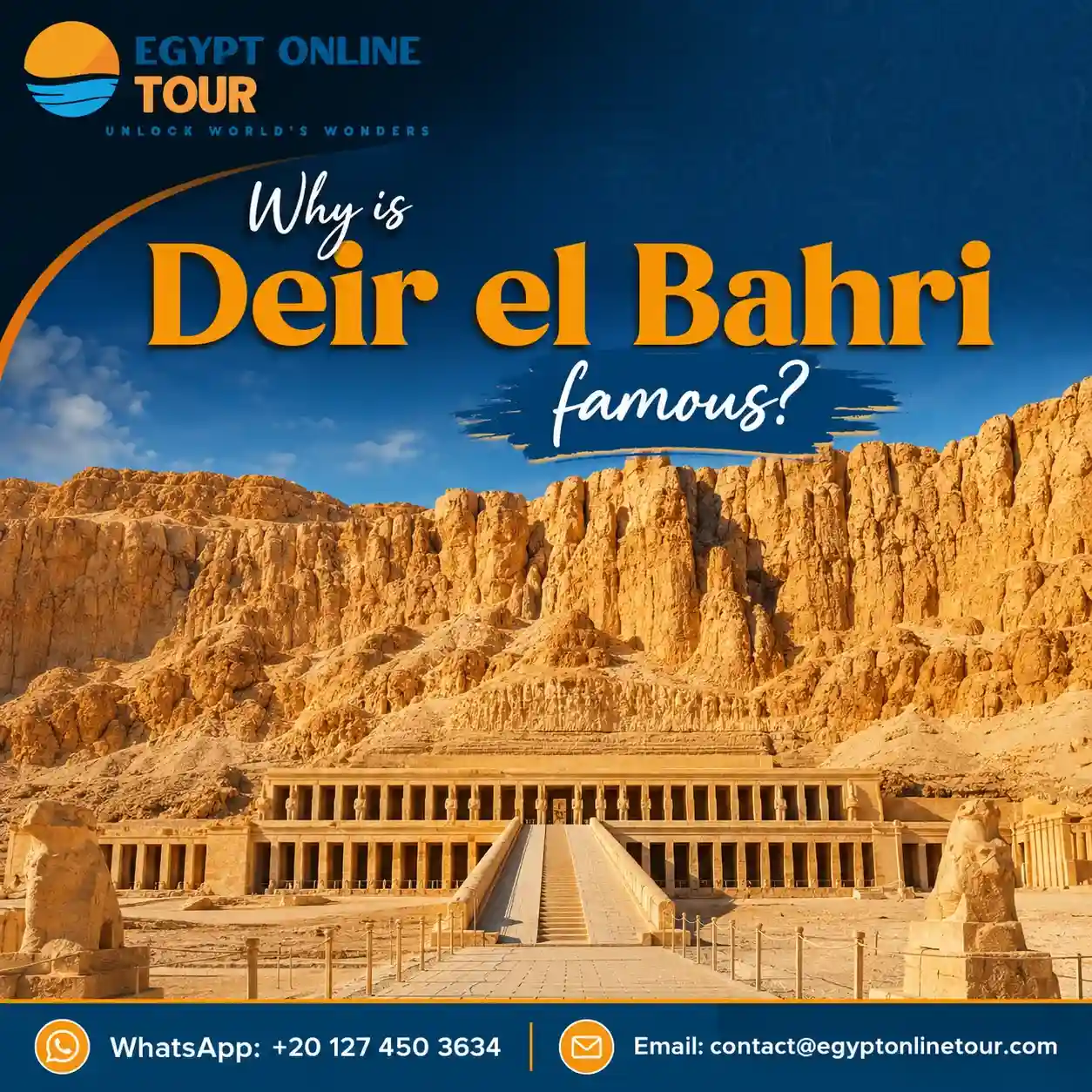
Deir el Bahri History is considered one of the most important and famous Egyptian archaeological sites, and this is because:
- It comprises a group of funerary temples, the most famous of which is Mortuary Temple of Hatshepsut, which was built for religious rituals and to immortalise their memory.
- The Royal Cache, considered one of the most famous discoveries, is a vast tomb containing dozens of royal mummies, some of which belong to famous pharaohs and were moved there to protect them from tomb robbers.
- The site contains a number of inscriptions and statues that reflect the religious life and cultural achievements of the ancient Egyptians.
The History of Deir el Bahri
Deir el Bahri History is steeped in secrets and stories in every corner, particularly its famous funerary temples
Mentuhotep II Temple
After King Amenhotep II had reunified Ancient Egypt, he built his great temple, which represented a major shift in terms of its differences from the temples of the Old Kingdom and the nature of worship practised there.
As new rituals for the worship of the god Osiris were introduced, to be performed by the kings themselves. This had a significant impact on the nature of royal temples in later periods.
Hatshepsut Temple
Following the death of King Thutmose II, Queen Hatshepsut became regent for Thutmose III, given his young age, and subsequently proclaimed herself pharaoh of the land. To consolidate her authority and immortalise her achievements, what did Hatshepsut do? She ordered the construction of her mortuary temple, which stands today at Deir el-Bahari.
Thutmose III Temple
King Thutmose III built his famous mortuary temple at Deir el-Bahari towards the end of his reign, which spanned the years 1435 to 1425 BC, and it was known as Geser-Akht.
This temple was renowned for housing the sacred barque of the god Amun and played a key role during the Festival of the Beautiful Valley.
The temple was damaged by a powerful earthquake, but the inscriptions and artefacts it contains still bear witness to its great significance.
Hatshepsut Temple at Deir el Bahri
The Temple of Hatshepsut is the most distinctive of the temples of Deir el Bahri History, to the extent that some people believe they are one and the same temple
Queen Hatshepsut
Queen Hatshepsut is one of the enduring symbols of ancient Egyptian women. A member of the Eighteenth Dynasty, she assumed the throne following the death of her husband and half-brother, King Thutmose II, acting as regent for Thutmose III. She was renowned for her political and economic achievements, particularly the expedition she sent to the land of Punt, which she immortalised on the walls of her temple at Deir el-Bahari.
Senenmut the architect
He was the brilliant engineer who designed Queen Hatshepsut’s temple and oversaw its construction, leaving us with a historical masterpiece: a columned structure characterised by its striking symmetry. The temple was built near the Valley of the Kings, and its design was clearly influenced by the temple of Mentuhotep II, which had stood on the very same site.
Djeser-Djeseru
- It is the ancient name of Queen Hatshepsut’s funerary temple, known as the ‘Holy of Holies’.
- This name reflects the religious significance of the temple, which served as a centre for worship and the performance of Queen Hatshepsut’s funerary rites.
- It also contained chambers dedicated to the worship of the gods Amun, Hathor and Anubis.
- The temple featured distinctive inscriptions documenting the most significant events undertaken by the queen, from her divine coronation to her journey to Punt.
Don’t miss out 8 Days Cairo, Luxor, Aswan Classic Tours For an exceptional experience that immerses you in the civilisation from Qahua to Luxor.
Look at: How many days in Luxor
Deir el Bahri Architecture
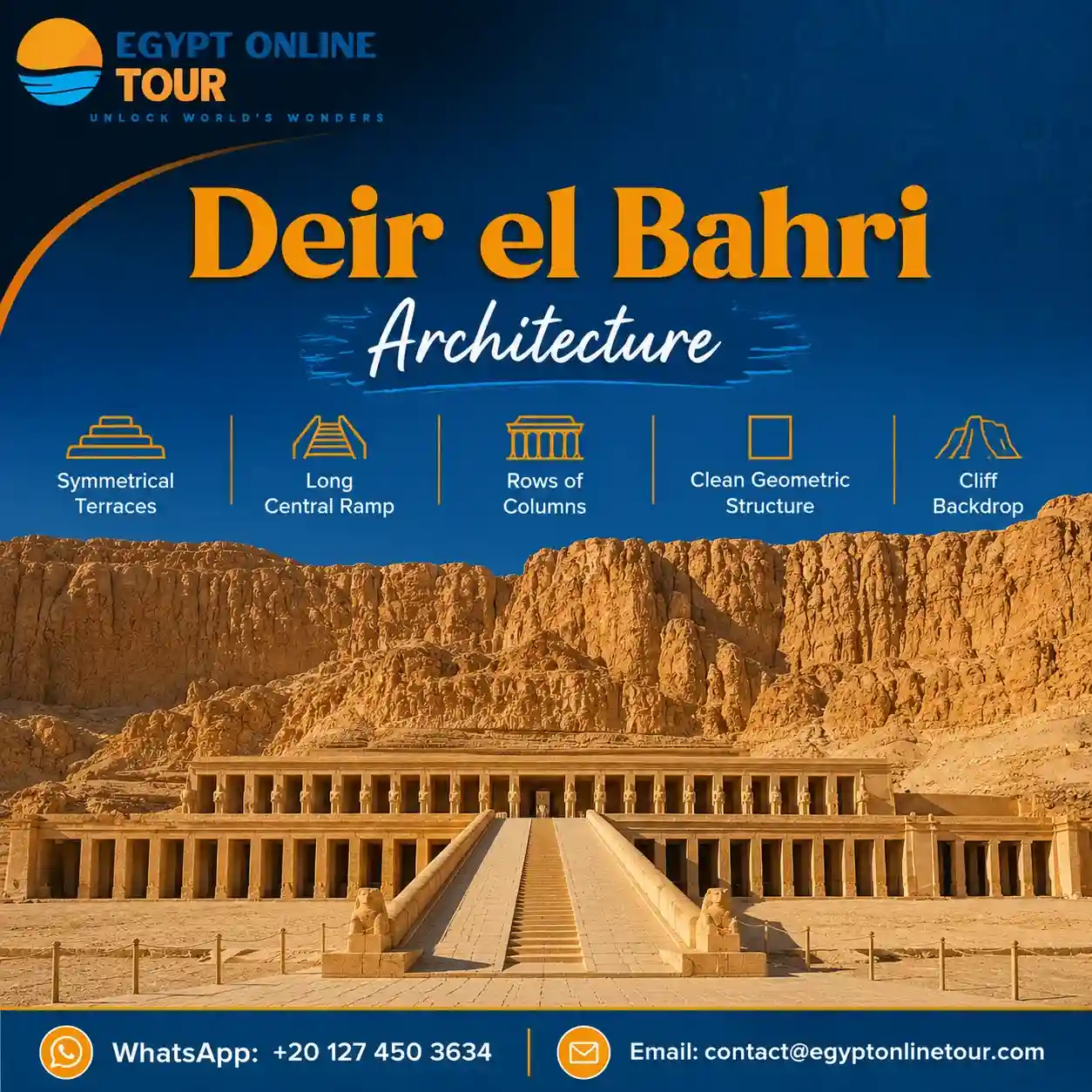
The architecture of the Temple of Hatshepsut has always stood out and remains to this day a testament to the grandeur of the ancient civilisation and its remarkable ability to blend with nature
Terraces and ramps
- The first, or lower, terrace, which overlooked a vast courtyard filled with gardens and sphinx statues.
- The second, or middle, terrace comprises the Ponto and Nativity Galleries, which feature a combination of reliefs depicting Hatshepsut’s journey to the Land of Pumet, as well as reliefs depicting Hatshepsut’s divine birth.
- The third or upper terrace: this is the most sacred area of the temple, consisting of a colonnade with massive columns opening onto the Royal Chapel, the Sun Cult complex and the sanctuary of Amun-Re.
- Ramps: were used to connect the three terraces, and processions would also pass along them during religious ceremonies and various other occasions.
This unique architectural design is one of the reasons why Hatshepsut’s Temple is considered one of the most magnificent examples of architecture in Deir el Bahri History and the whole world.
- We recommend you try 10 Days Round Trip Nile Cruise and Pyramids For a wonderful experience combining the beauty of the desert with the tranquillity of the Nile.
Cliffs and landscape
The temple has a distinctive natural form that blends in with its surroundings for the following reasons:
- The temple’s location at the foot of the limestone cliffs provides it with a majestic yet tranquil natural backdrop.
- The design of the terraces and slopes, which follows the natural contours of the mountains, gives the temple a sense of harmony with its natural surroundings.
- The limestone cliffs reflect the sunlight, which highlights the temple complex and lends it an exceptional artistic appearance.
- In ancient times, the temple was connected to a ceremonial avenue flanked by gardens and extending all the way to the Nile Valley, creating a magnificent blend of natural greenery and the mountainous desert landscape.
- The mountain is crowned by a pyramid-shaped rocky peak, which in ancient belief was associated with the concepts of creation and renewal.
Columns and chapels
The columns and hypostyle halls are among the most prominent architectural features that characterise the Temple of Hatshepsut at Deir el-Bahari, and include:
- The columns: which run along the facades of the three terraces and lend the temple a majestic and harmonious appearance.
- The Amun Chapel: one of the most important parts of the temple, dedicated exclusively to the worship of the god Amun, where religious rituals were performed.
- The Hathor Chapel: dedicated to the worship of the goddess Hathor, it is distinguished by its columns adorned with the face of Hathor and the ears of a cow, making it one of the temple’s most significant aesthetic features.
- The Anubis Chapel: Designed for the worship of the god Anubis, it features coloured reliefs, many of which are still preserved today.
- The Holy of Holies: Located in the innermost part of the temple, this was the most sacred place and was used for performing religious rites and offering sacrifices to the gods.
Reliefs and Stories at Deir el Bahri
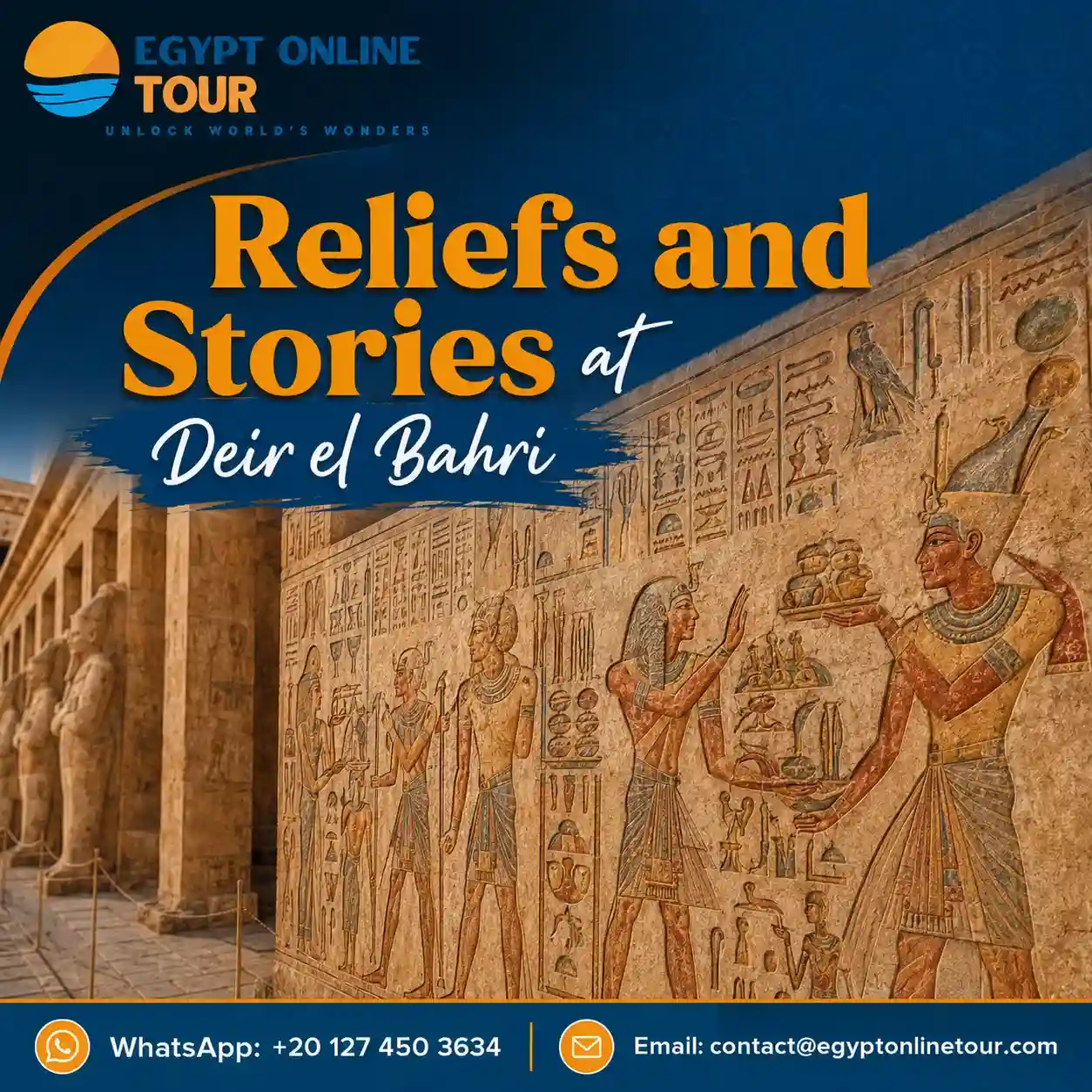
The inscriptions at Deir el Bahri History, particularly those at Hatshepsut’s temple, are not merely passing inscriptions; they are a true testament to a civilisation that remained at the forefront for thousands of years
The Punt expedition
The walls of Hatshepsut’s mortuary temple tell Interesting Facts About Ancient Egyptian Art and the story of Punt expedition, who was more than just a trading partner.
When Hatshepsut became Queen of Egypt in 1470 BC, she told her subjects that the gods had inspired her to find a route to the land of Punt - which corresponds to present-day Ethiopia and Somalia - by sending a trading expedition there. The voyage unfolded as follows:
- The expedition began in the ninth year of her reign, during which she dispatched five ships, each 21 metres long.
- The expedition comprised 210 men, including sailors and oarsmen.
- They sailed up the Nile until they reached the wilderness, where they dismantled their boats and then reassembled them, aided by their lightweight design.
- They covered approximately 50 kilometres a day, travelling close to the Red Sea coast.
The people of Punt were impressed by the courage of the ancient Egyptians, as well as their equipment and jewellery, and they engaged in barter; so the Egyptians returned with their boats laden with:
- ivory.
- ebony.
- gold.
- wild animals.
- 31 live myrrh trees, which were planted in the courtyard of Hatshepsut’s mortuary temple; this was the first time that trees had been transported, received alive and replanted.
Divine birth scenes
The divine scenes depicting Queen Hatshepsut are among the most distinctive and eye-catching reliefs at the Temple of Deir el-Bahari. These reliefs tell a narrative that illustrates the stages of the queen’s birth, in which:
- The god Amun, appearing in the form of Hatshepsut’s father, visits her mother and then proclaims that the child has been chosen by the will of the gods to rule the land.
- The scenes also depict the queen’s pregnancy and the birth of Hatshepsut with the assistance of the gods, followed by her presentation to Amun so that he may bless her and grant her the legitimacy to rule.
- These reliefs are characterised by their artistic detail, the precise depiction of events and the carving of the figures, as well as their distinctive hieroglyphic inscriptions.
Amun and Hathor reliefs
The reliefs depicting the gods Amun and Hathor are among the most beautiful in the temple. They highlight the deep connection between the queen and the gods.
- Amun reliefs: These depict the god Amun bestowing blessings and divine authority upon Hatshepsut, which strengthened her reign as it was carried out with the god’s approval. They also depict scenes of the offering of sacrifices and the performance of religious rituals.
- Hathor reliefs: These carvings depict her in the form of a woman or a sacred cow, symbolising the goddess of love and beauty; the columns in the sanctuary are also distinguished by capitals carved in the shape of a cow’s face.
The Royal Cache at Deir el Bahri
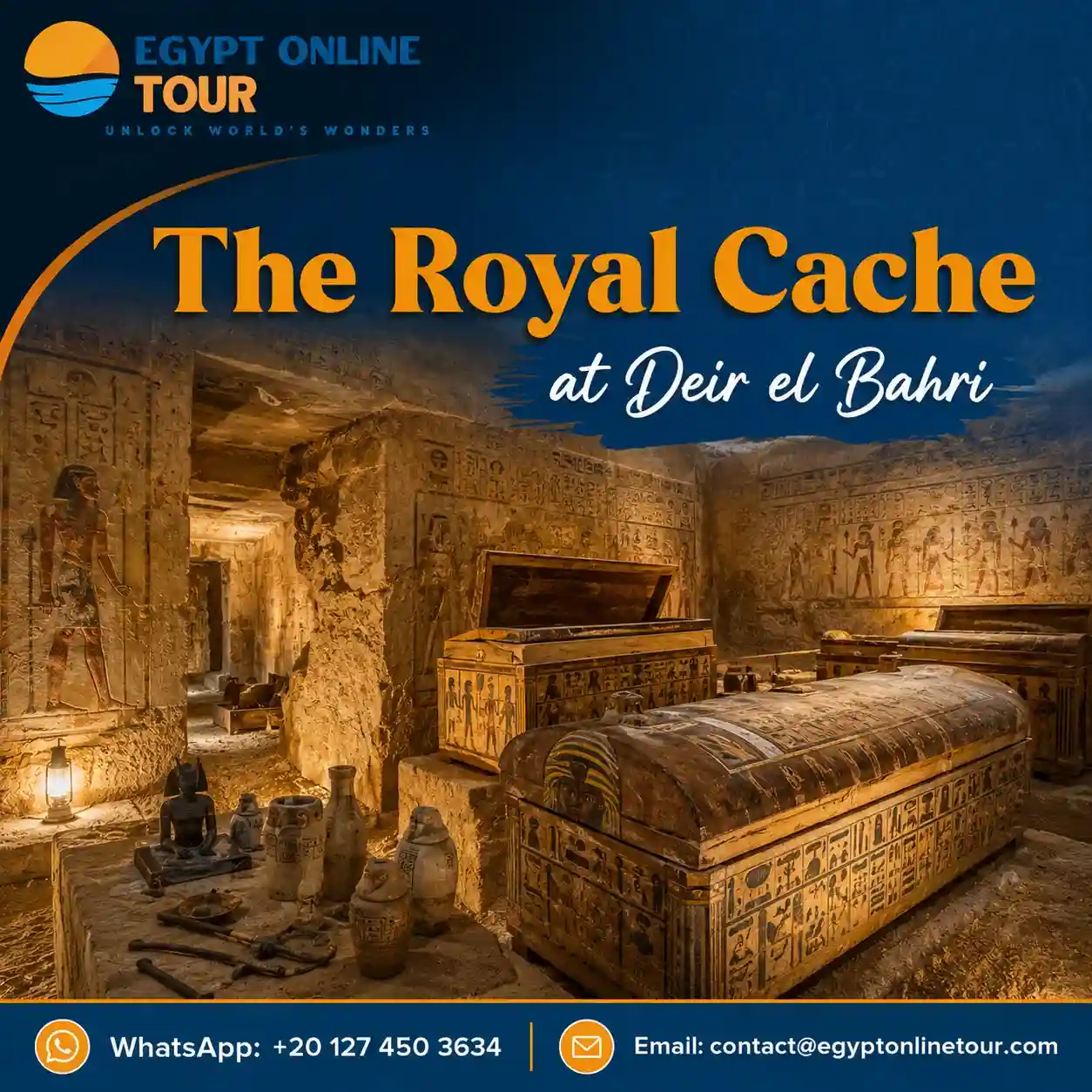
This discovery of Deir el Bahri History is a revolution that has significantly changed archaeologists’ understanding of ancient Egyptian civilisation.
Discovery of the royal mummies
This discovery was made quite by chance when a local resident, whilst searching for his lost goat, heard its bleating coming from underground.
When he went down to rescue it, he found himself inside a tomb containing coffins and inscriptions dating back to ancient Egyptian civilisation.
Kings found in the cache
The tomb contained a large collection of royal mummies dating from the 17th and 18th Dynasties, including:
- Seknenre.
- Ahmose I.
- Ahmose Nefertari.
- Amenhotep I.
- Thutmose I.
- Thutmose II.
- Thutmose III.
- Seti I.
- Ramses II.
- Ramses III .
- Pinejem II, High Priest of Amun in the 21st Dynasty.
Why the cache is important
This cache has marked a major breakthrough in our understanding of ancient Egyptian civilisation, enabling archaeologists to link a large number of faces to names previously known only from artefacts, statues and texts.
With recent advances in technology, a clearer picture is beginning to emerge of the lives and achievements of these kings.
What to See at Deir el Bahri
Deir el Bahri History is a funerary complex comprising three exceptional temples
Hatshepsut Temple
Queen Hatshepsut’s mortuary temple is considered one of the greatest architectural masterpieces, renowned for its magnificent terraced architecture, columns with intricate capitals, and superbly preserved wall reliefs that offer a rich insight into Egyptian civilisation dating back thousands of years.
Hathor Chapel
Hathor Chapel belongs to King Thutmose III, discovered to the south of the Temple of Hatshepsut. The shrine contained statues of the goddess Hathor in the form of a cow. Hathor was renowned as the goddess of music, joy and happiness, and also as the protector of the dead in Thebes.
Anubis Chapel
This part of Queen Hatshepsut’s temple was dedicated to the worship of Anubis, the god of mummification and protector of the dead, who is responsible for protecting the deceased, overseeing the mummification process and guiding them on their journey to the afterlife.
It also features inscriptions and religious scenes depicting the queen offering sacrifices to Anubis.
Sanctuary of Amun
Sanctuary of Amun is situated within Queen Hatshepsut’s temple at Deir el-Bahari. The temple was dedicated to the worship of Amun, the chief god of the New Kingdom.
Religious rituals were also held there and offerings were made during festivals.
The statue of Amun would be brought to the temple during festivals to symbolise the close bond between the queen and Amun.
Read more about: What Is There to Do in Luxor
Deir el Bahri Restoration
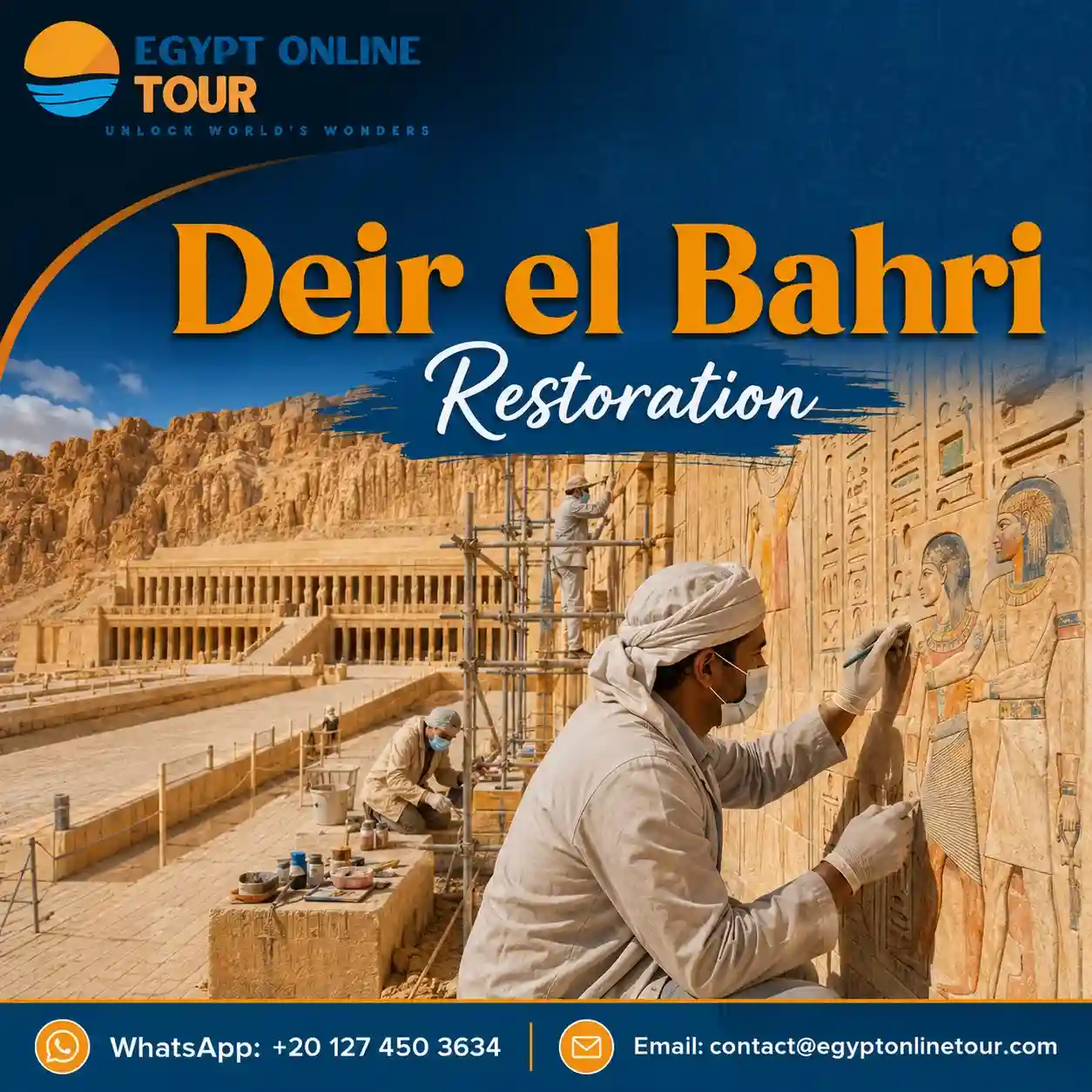
The Deir el-Bahari Temple has been subjected to a number of factors that have significantly affected its structure; some of these were natural, whilst others were man-made. However, thanks to restoration work, the temple remains standing tall to this day.
Damage through history
Many statues and artefacts were destroyed in ancient times on the orders of King Thutmose III.
Modern restoration work
The statues currently on display at the Temple of Hatshepsut are the result of a major effort by Polish archaeologists and conservators, who have restored more than twenty statues, including:
- Statues of the Sphinx.
- Statues of Osiris.
- Two colossal statues of Queen Hatshepsut.
And other statues that were restored entirely by hand, without the use of any heavy machinery.
What visitors see today
When visiting the temple today, visitors can see Queen Hatshepsut’s temple following restoration work, which includes:
- The three terraces, the ramps and the columns.
- Hathor Chapel.
- Anubis Chapel.
- The reliefs depicting important events such as the expedition to Punt and the Queen’s divine birth.
Is Deir el Bahri Worth Visiting?
Yes, the Temple of Deir el-Bahari is considered one of the most important archaeological sites and distinctive tourist destinations in Ancient Egypt, and Deir el Bahri History is a must-see for lovers of ancient civilisation.
Best for history lovers
It is an ideal destination for lovers of ancient Egyptian history, as it features:
- Queen Hatshepsut’s temple, which reflects the grandeur of the New Kingdom.
- Distinctive inscriptions recounting important historical expeditions, such as the expedition to Punt and the scene of Queen Hatshepsut’s divine birth.
- It contains chapels dedicated to the worship of the gods.
The combination of all these elements creates a unique experience that gives visitors a deep understanding of history and religion.
Best for architecture lovers
The Bahari Temple is a magnificent example of the architectural design that demonstrated the architectural and engineering advances of Ancient Egypt.
The temple consists of three terraced levels connected by straight ramps, and is surrounded by rows of columns. The temple’s overall form blends beautifully with the surrounding mountains.
Best for Luxor West Bank tours
Deir el-Bahari is one of the most prominent stops on any tour of Luxor.
Given its proximity to the Valley of the Kings and Queens and the Colossi of Memnon, most visitors are keen to include it in their itinerary so they can explore the region’s most important archaeological sites.
Visiting Deir el Bahri
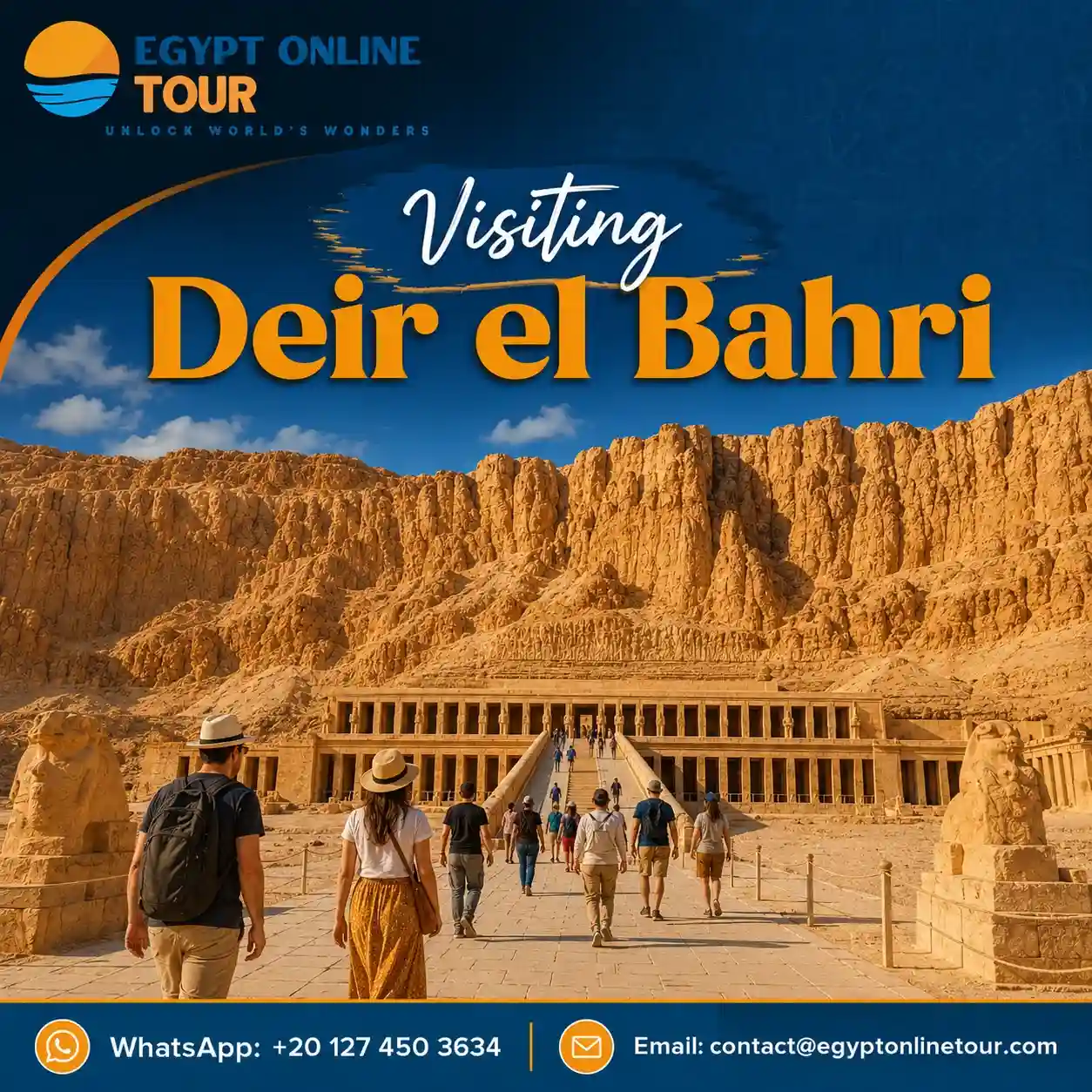
Some things to bear in mind before visiting the Deir el-Bahari Temple today
Tickets
The entrance ticket to the Deir el-Bahari Temple is 360 pounds for adults.
Tickets can be purchased at the entrance gate from 6.00 am to 5.00 pm.
Best time to visit
The best time to visit the Deir el-Bahari Temple is during the cooler months from April to October, as the temperatures are milder and you can avoid the intense summer heat.
Visiting in the early morning or just before sunset also makes for a better experience, and the photographs taken at these times are more beautiful and of higher quality, thanks to the scenery.
Know more about: Best Months to Visit Egypt
How long to spend
If you are planning an in-depth visit to the Temple of Deir el-Bahari with a tour guide, it may take around 4 hours.
It is advisable to visit early in the morning to avoid the sun’s rays, as the temple is open to the elements, and to avoid the crowds as well.
Plan Your Deir el Bahri Tour With Egypt Online Tour
Start your journey of discovery to the Temple of Deir el-Bahari now with Egypt Tour packages for an exceptional trip that combines the richness of history with enjoyment.
Book a Luxor West Bank tour
Explore the most famous tourist attractions and find out How Many tombs in the Valley of the Kings in West Bank of Luxor on a comprehensive tour taking in the most renowned archaeological sites, offering a deeper insight into the region’s cultural heritage stretching back thousands of years.
Visit Hatshepsut Temple with a guide
Hiring a specialist tour guide who can share the details and secrets of the magnificent history behind the construction of Queen Hatshepsut’s temple makes the experience a hundred per cent more enjoyable.
They will help you discover the story of one of the greatest queens of Ancient Egypt, ensuring an experience rich in information and historical facts.
Customize your Luxor itinerary
Customize your own tailor-made itinerary to suit your interests, schedule and budget. Whether you’d like to visit specific attractions or enjoy a personalized experience with your family or friends, this is the perfect choice for you to know When Was the Luxor Temple Built.
Conclusion
Ultimately, Deir el Bahri History lies not merely in its status as an archaeological site, but in its standing as a testament to the religious, social and political genius embodied in a masterful architectural achievement that has stood the test of time for thousands of years. From the majestic Temple of Queen Hatshepsut and its inscriptions recounting the journey to Punt, to the cache of mummies that was discovered, all these factors marked a turning point in the annals of ancient Egyptian history.