
The Christian monasteries and historic sites of Egypt fall into five areas: Coptic Cairo (the Hanging Church, Abu Serga, the Coptic Museum and the Ben Ezra Synagogue), the four monasteries of Wadi El Natrun, the Red Sea monasteries of St Anthony and St Paul, St Catherine's Monastery in Sinai, and the Holy Family stations along the Nile in Middle Egypt. Coptic Cairo fits into half a day; each of the others is a full day or more from Cairo.
Egypt is where Christian monasticism began, and the Coptic Church is one of the oldest churches in the world, so these places are living communities as well as monuments. Below we explain what each site is, how far it is, how long you need and the practical rules our guides follow with pilgrims and travellers.
The main Christian sites in Egypt at a glance
| Site | Where | Dates from | From central Cairo | Time needed |
|---|---|---|---|---|
| Coptic Cairo: Hanging Church, Abu Serga, St George, Ben Ezra, Coptic Museum | Old Cairo | Late antiquity to the 19th century (buildings rebuilt many times) | 20 to 30 minutes | Half a day |
| Cave Church of St Simon | Mokattam, Cairo | Late 20th century | 30 to 45 minutes | 1 to 2 hours |
| Wadi El Natrun (4 monasteries) | Desert road to Alexandria | 4th century monastic settlement | About 1.5 to 2 hours | Full day |
| Monasteries of St Anthony and St Paul | Red Sea mountains, Eastern Desert | 4th to 5th century | About 5 to 6 hours (334 km to St Anthony) | Full day or overnight |
| St Catherine's Monastery | South Sinai, at the foot of Mount Sinai | 548 to 565 | Flight to Sharm El Sheikh, then about 3 hours by road | 1 to 2 days with Mount Sinai |
| Holy Family stations: Gabal al-Tair, Deir al-Muharraq | Minya and Assiut | Tradition from the 4th century; churches of many dates | 4 to 6 hours | 2 to 3 days |
| White and Red Monasteries | Sohag, Upper Egypt | 5th century | Best combined with Luxor or Abydos | Half a day |
Why Egypt matters for Christian history
Coptic tradition holds that St Mark the Evangelist brought Christianity to Alexandria in the 1st century, and the Coptic Orthodox Church counts its popes from him. Alexandria became one of the great centres of early Christian thought. Egypt also gave the Church its first monks: St Anthony the Great left for the Eastern Desert in the late 3rd century and became known as the "father of monks", and St Pachomius organised the first communal monasteries in Upper Egypt in the 4th century. The model spread from Egypt to Palestine, Syria and Europe.
For Egyptian Christians the country is also blessed by the visit of the Holy Family, who fled from Herod according to the Gospel of Matthew. Coptic tradition lists the places where they stayed, from Sinai to Assiut, and many churches and monasteries stand on those stations. We tell that story in full in how long Mary and Joseph stayed in Egypt.
Coptic Cairo: churches, a synagogue and a museum in one walk
Coptic Cairo, inside and around the Roman fortress of Babylon in Old Cairo, is the easiest place to start. Everything is within a few minutes' walk, and the churches are free.
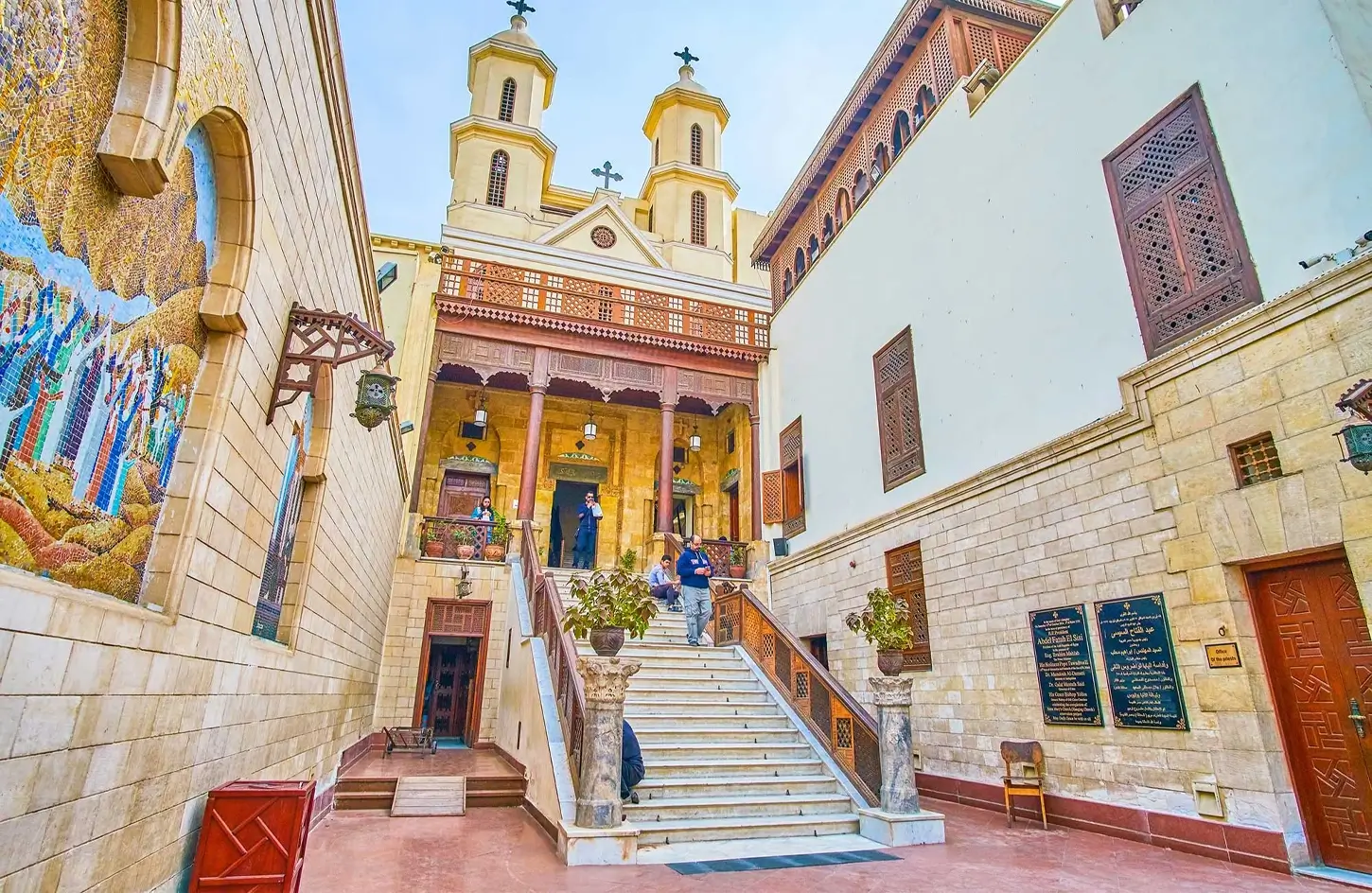
The Hanging Church (St Mary)
The church is built over the ruins of the Roman fort, which is why it is called al-Muallaqa, "the suspended". From the late 11th century, under Pope Cyril II, it served as the seat of the Coptic patriarch and the place where new popes were consecrated. Look for the marble pulpit on slender columns (11th century), the icon screens and the wooden ceiling shaped like Noah's Ark. Open daily from 9:00 to 16:00. Our guide to the Hanging Church covers it room by room.
Abu Serga (Saints Sergius and Bacchus)
Tradition says the Holy Family sheltered in a cave on this spot, now the crypt under the sanctuary. The church is usually dated to the late 7th or early 8th century and has been rebuilt several times. Read more about the Church of St Sergius and St Bacchus.
The Church of St George and the other churches
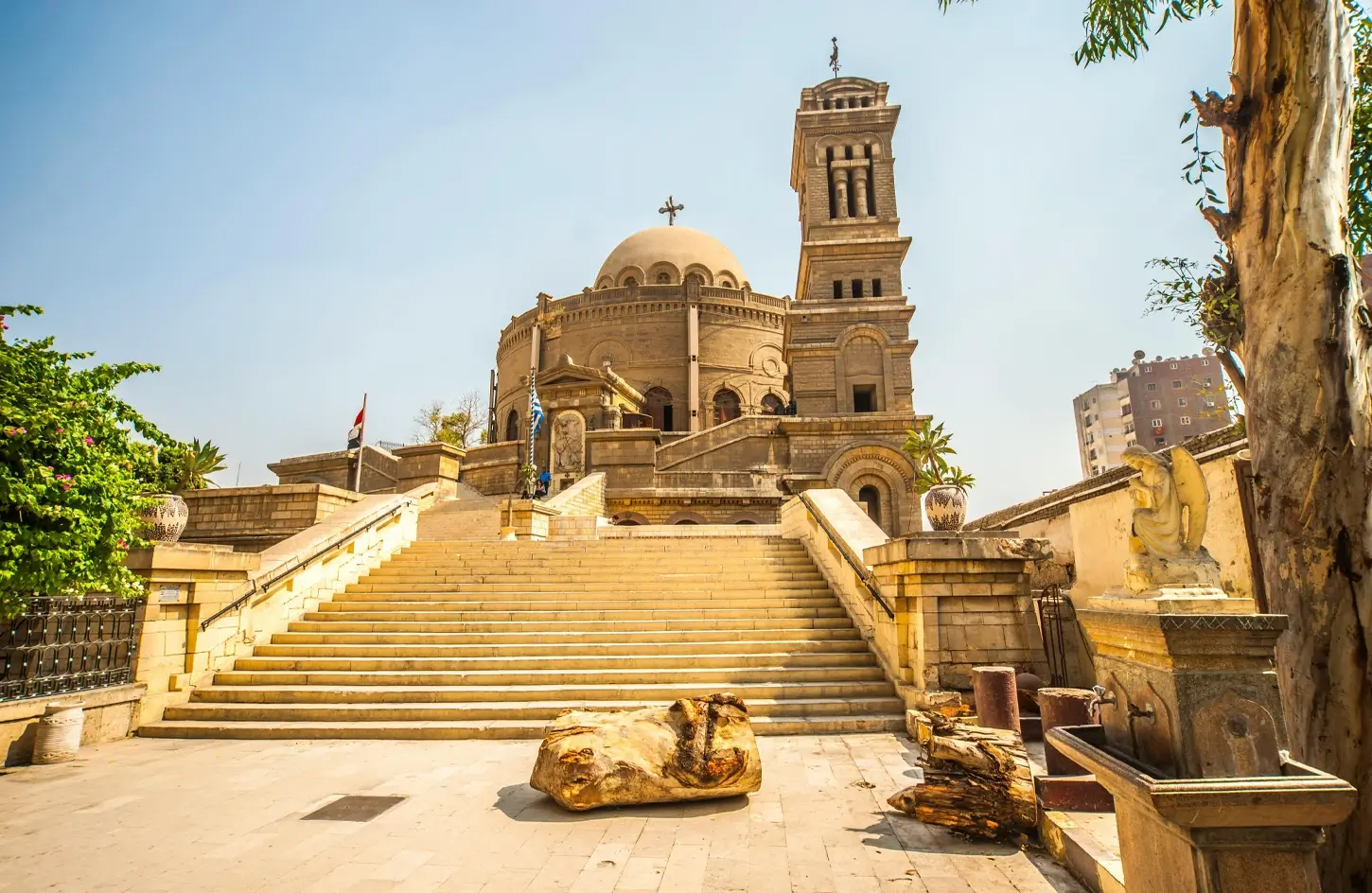
The round Greek Orthodox Church of St George stands on one of the fort's towers next to Mar Girgis metro station. Behind it, the lanes of the old quarter lead to the churches of St Barbara and of the Virgin (Qasriet al-Rihan). See our guide to the Church of Saint George in Cairo.
The Ben Ezra Synagogue
The Ben Ezra Synagogue, a few steps from Abu Serga, is the oldest synagogue in Egypt and part of every Coptic Cairo walk. It is named after the scholar Abraham ibn Ezra and is no longer used for worship; it is kept as a historic site and reopened in August 2023 after a restoration of about ten years.
- History: a traditional account says it was a church that the Coptic patriarch sold to the Jewish community in 882 to pay a tax to Ahmad ibn Tulun; historians do not take the story at face value. Documents show a Jewish community here from early on. The present building is a reconstruction of 1889 to 1892.
- The Cairo Geniza: Jewish custom forbids destroying texts that may contain the name of God, so the community stored worn papers in a room called a geniza for about 850 years. Scholars became aware of it in the 19th century, and from 1896 Solomon Schechter moved a large part to Cambridge. The Cairo Geniza holds about 400,000 items, letters, contracts and religious texts, and is one of the richest sources on medieval Mediterranean life. The documents are now in libraries abroad, not in the synagogue.
- Tradition: local stories place the finding of the infant Moses near a well behind the synagogue, and the same spot is linked to the Virgin Mary drawing water for the child Jesus.
- Inside: a central bimah, and a hekhal (the cabinet for the Torah scrolls) decorated in the Islamic style and inlaid with mother-of-pearl.
- Visiting: open daily from 9:00 to 16:00. Photography inside has often been forbidden, so ask at the door; there is a security check at the entrance.
The Coptic Museum
Founded by Marcus Simaika in 1908 and opened in 1910, the Coptic Museum holds the largest collection of Coptic art in the world, about 16,000 objects, including the Nag Hammadi codices. It is the best introduction to everything else in this article; a foreign adult ticket costs EGP 280 at the time of writing.
The Cave Church of St Simon, Mokattam
On the Mokattam cliffs above the neighbourhood of the Zabbaleen, Cairo's traditional rubbish collectors, the Monastery of St Simon the Tanner was carved into the rock from the 1970s on. Its main church is an amphitheatre in the cliff that holds thousands of worshippers, and the rock walls are carved with Bible scenes. Coptic tradition links St Simon to the miracle of the moving of the Mokattam mountain in the Fatimid period. See our guide to the Cave Church.
Alexandria: St Mark's Coptic Orthodox Cathedral
St Mark's Cathedral in the Mahatet el-Raml district of central Alexandria is the historic seat of the Coptic Pope. Tradition places it on the site of the church founded by St Mark the Evangelist in the 1st century, and the Coptic Church holds that his head is kept here, while most of his body was taken to Venice in 828. The church has been destroyed and rebuilt many times; the present building replaced the old one in 1950 to 1952, keeping its two bell towers, and was enlarged in 1985 to 1990. Expect a security check at the gate, dress as for any church, and visit outside the main services unless you want to attend one. It fits easily into a day in Alexandria, and Wadi El Natrun lies on the desert road between Cairo and Alexandria, so the two combine well.
Wadi El Natrun: four living monasteries
Wadi El Natrun is a desert depression off the Cairo to Alexandria desert road, about 100 km from Cairo. St Macarius the Great came here around 330, and the valley, known to early Christians as Scetis, became one of the cradles of monasticism: at its height it had hundreds of monastic dwellings. Four monasteries survive and are active today:
- St Macarius (Deir Abu Makar): the largest community; it often limits access for visitors, so arrange it in advance.
- St Bishoy (Deir Anba Bishoy): the most visited, with the relics of St Bishoy and a historic keep.
- The Syrians (Deir al-Suryan): named after the Syrian monks who lived here; famous for its medieval wall paintings and carved wooden screens.
- Baramous (Deir al-Baramus): held by tradition to be the oldest of the four.
A day trip usually covers two or three monasteries. Monks or guides show visitors the old churches, the keeps where monks took refuge from raids, and the refectories. For directions and timing, read where Wadi El Natrun is and how to get there.
The Red Sea monasteries: St Anthony and St Paul
Hidden in the Red Sea mountains of the Eastern Desert, these are the oldest monasteries in Egypt still in use.
Monastery of St Anthony
Built by the followers of St Anthony near the spring where he lived, it is 334 km south-east of Cairo, about five to six hours by road, and closer from the Red Sea coast at Zafarana or Hurghada. Its Church of St Anthony is covered with wall paintings from the 7th to the 13th century, restored in a joint project of the Egyptian antiquities authorities and the American Research Center in Egypt. St Anthony's cave lies about 2 km above the monastery: allow an hour of climbing on a stairway, and go early, before the heat.
Monastery of St Paul the Anchorite
On the other side of the same mountain block, the Monastery of St Paul grew around the cave of St Paul of Thebes, traditionally the first hermit, whom St Anthony is said to have visited before Paul's death. It is smaller and quieter, with a cave church and a defensive tower. Most visitors combine both monasteries in one long day from Hurghada, or with a night on the Red Sea coast.
St Catherine's Monastery, Sinai
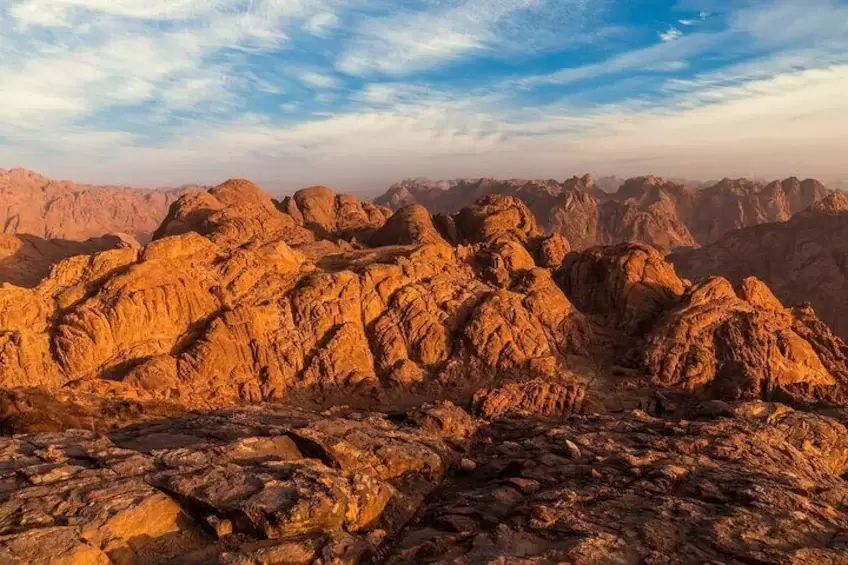
At the foot of Mount Sinai, St Catherine's Monastery was built between 548 and 565 by order of the Byzantine emperor Justinian, around the place where tradition locates the Burning Bush of Moses. It belongs to the Greek Orthodox Church of Sinai and is one of the oldest continuously inhabited monasteries in the world. Inside the walls are the 6th-century basilica, the Chapel of the Burning Bush, a small mosque created in the Fatimid period with a minaret of 1106, and a library whose collection of early manuscripts is second only to the Vatican's. The monastery and Mount Sinai form the UNESCO World Heritage site of the Saint Catherine Area, inscribed in 2002.
The monastery opens to visitors only for a few hours in the morning and closes on some days of the week and on Orthodox feasts; days and hours have changed over the years, so we confirm them for each group. Most travellers climb Mount Sinai at night for the sunrise and visit the monastery afterwards. It is about 3 hours by road from Sharm El Sheikh. For the rest of the peninsula, see things to do in the Sinai Peninsula.
Upper Egypt: Holy Family stations and the Sohag monasteries
- Gabal al-Tair (Minya): a church on a cliff above the Nile, linked by tradition to Empress Helena, with a large feast at the end of May.
- Deir al-Muharraq (Assiut): the monastery where, according to Coptic tradition, the Holy Family stayed longest, about six months.
- Dronka (Assiut): a monastery around a cave in the mountain, crowded during the August fast of the Virgin.
- The White Monastery and the Red Monastery (Sohag): the White Monastery is dedicated to St Shenoute, one of the great abbots of the 5th century; the Red Monastery, about 4 km away, has one of the best-preserved painted church interiors of late antiquity.
- St Simeon (Aswan): the ruins of a large monastery on the west bank, reached by boat and a short desert walk or camel ride.
Travel in Minya and Assiut is coordinated with the local authorities, so plan it with an operator and check the current arrangements before you book.
Practical tips for visiting churches and monasteries
Dress and behaviour
- Cover shoulders and knees. Women may be asked to cover their hair in some monasteries, so carry a scarf.
- Remove shoes where you see others do so, especially near altars and relics.
- Keep voices low, and do not enter the sanctuary behind the icon screen.
- Ask before taking photos; some monasteries forbid photography inside churches.
Opening times, fasts and feasts
- Churches in Coptic Cairo are generally open daily from about 9:00 to 16:00 and are free; the Coptic Museum has a ticket.
- Desert monasteries receive visitors at set times and may close to visitors during the great fasts, especially Lent before Coptic Easter. Always check the week before.
- Coptic Christmas is on 7 January; the feast of the entry of the Holy Family into Egypt is on 1 June; the fast of the Virgin runs in the first half of August. These are moving times to visit and also the most crowded.
- Friday and Sunday mornings are for the liturgy, so sightseeing inside churches is easier on weekday mornings.
When to go
October to April is the most comfortable season for desert monasteries and Sinai. In summer, visit Coptic Cairo early in the morning and plan desert visits for the first hours of the day.
How to combine the sites
- One day in Cairo: Coptic Cairo in the morning and the Cave Church in the afternoon.
- Three days: add Wadi El Natrun, and the Virgin Mary's Tree at Matariya.
- A week: add St Catherine and Mount Sinai, or the Red Sea monasteries from Hurghada.
- Ten days or more: the full Holy Family route with Minya and Assiut, combined with a Nile cruise between Luxor and Aswan.
Plan it with us
Our Holy Family tour in Egypt visits Coptic Cairo, Wadi El Natrun and the main stations with a guide who knows the tradition, and the Christian Holy Land tour package adds the Nile Valley. If you are staying in Sharm El Sheikh, the St Catherine Monastery day tour covers the monastery and the area around it.
Christian sites in Egypt: quick answers
What is the oldest monastery in Egypt?
The Monastery of St Anthony in the Red Sea mountains, founded by the followers of St Anthony in the 4th century, is generally counted as the oldest monastery still in use; St Catherine's in Sinai (548 to 565) is one of the oldest continuously inhabited monasteries in the world.
Are monasteries in Egypt open to tourists?
Most are, at set visiting hours. Some limit visits during the great fasts or on feast days, and St Macarius in Wadi El Natrun often needs prior arrangement.
Can you visit the Ben Ezra Synagogue?
Yes. It is in Coptic Cairo, open daily from 9:00 to 16:00, and is kept as a historic site rather than a place of worship.
How long do I need for Coptic Cairo?
Half a day covers the Hanging Church, Abu Serga, St George, the Ben Ezra Synagogue and the Coptic Museum.
How far is Wadi El Natrun from Cairo?
About 100 km on the Cairo to Alexandria desert road, roughly 1.5 to 2 hours by car.
What should I wear to visit churches and monasteries?
Clothes that cover shoulders and knees; women should carry a scarf in case they are asked to cover their hair.
Ahmed Samir writes and updates the Egypt travel guides of Egypt Online Tour, a licensed tour company based in Cairo (ETAA licence 1466). Our travel advisors review each guide before it is published.
All guides by Ahmed Samir