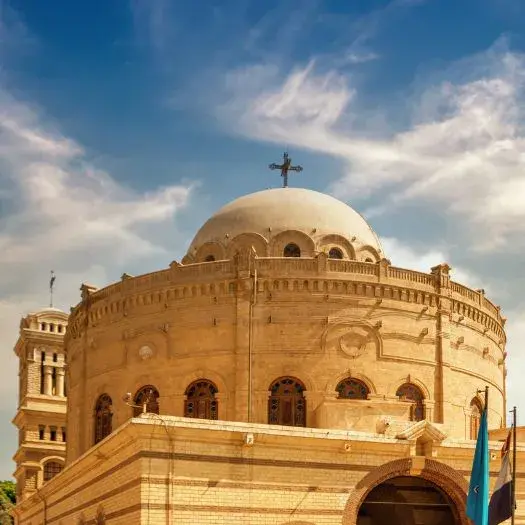
The Hanging Church is the Coptic Orthodox Church of the Virgin Mary in Old (Coptic) Cairo, called al-Muallaqa, "the suspended one", because it is built on top of the southern gatehouse of the Roman Babylon Fortress, so its nave hangs over a passage below. A church has stood on the site since at least the 9th century, and Coptic tradition places the first one much earlier; from 1047 it was the official residence of the Coptic Pope. Entry is free.
It is the first stop on almost every Old Cairo walk our guides lead, and it rewards a slow look: 29 steps up from the street, a ceiling shaped like the hull of a ship, a marble pulpit on slender columns and 110 icons. Below are its history, what to see inside, opening times and how to visit with the other sites of Coptic Cairo.
Why is it called the Hanging Church?
Around 300 AD the Roman emperor Diocletian rebuilt a fortress called Babylon at the point where the Nile valley meets the Delta, beside the canal that linked the river to the Red Sea. Its southern gate was flanked by two massive round towers. The church was built on top of that gate, resting on the towers, with its nave spanning the passage between them. When the Nile was higher than today, the church seemed to hang over the water.
The Roman masonry is still visible. Before you climb the steps, walk to the right of the entrance and look down into the excavated area: you see the base of the fortress walls several metres below today's street level. Our article on Fort Babylon in Cairo explains the fortress in detail.
History of the Hanging Church
| Date | Event |
|---|---|
| About 300 AD | The Babylon Fortress is rebuilt by Diocletian |
| 3rd-7th century | Coptic tradition dates the first church on the site to the 3rd century; the main church is usually dated between the 5th and 7th centuries |
| 831-849 | First written mention, in the life of Patriarch Joseph I |
| 975-978 | Pope Abraham largely rebuilds the church |
| 1047 | Pope Christodoulos moves the patriarchal residence from Alexandria to Cairo, at the Hanging Church |
| 11th-14th century | Patriarchs are chosen and enthroned here; several are buried here in the 11th and 12th centuries |
| 19th century | The present façade with its two bell towers is added |
| 1983, 1992 | Part of the ceiling collapses after a column is removed; the Cairo earthquake damages the walls |
| 1998-2011 | A major restoration; the church reopens in 2011 |
The Mokattam tradition
The church is linked with one of the best-known Coptic traditions. According to it, in the 970s the Fatimid caliph al-Muizz challenged Pope Abraham to prove the Gospel saying that faith can move mountains. The Pope prayed for three days in the Hanging Church, where the Virgin Mary is said to have appeared to him and sent him to a humble tanner named Simon. With Simon's prayers, the Mokattam hill moved. The story is commemorated by the great Cave Church of St Simon on the Mokattam hill today.
What to see inside
The steps and the courtyard
From Mari Girgis Street you pass through an iron gate under a stone arch into a narrow courtyard decorated with modern mosaics of biblical scenes. Then come the 29 steps up to the 19th-century façade with its twin bell towers, and a small inner porch.
The nave and the wooden ceiling
The church is a basilica with a central nave, aisles and three sanctuaries at the east end. The pointed wooden roof is shaped like an upturned ship's hull, a reference to Noah's Ark, a common symbol of the Church as the vessel of salvation. In a few places glass panels in the floor let you look down into the gate passage of the Roman fortress below.
The marble pulpit
The ambon (pulpit) stands on 15 slender marble columns on a white marble base. Guides traditionally explain them as Christ, the twelve apostles and two evangelists, with one darker column for Judas and one greyish for "doubting" Thomas. Look closely at the different stones and carvings: the columns were reused from older buildings.
The icons and the screens
The church holds 110 icons. The oldest is dated to the 8th century; most are from the 18th century, many painted by the Armenian-Egyptian artist Yuhanna al-Armani and his circle. The sanctuary screens of dark wood are inlaid with ivory and ebony in geometric crosses, some of the finest of their kind in Egypt. Do not miss the icon of the Virgin known in tradition as the "Coptic Mona Lisa" for her gaze, which seems to follow you.
The side chapels
Beside the main sanctuary of the Virgin are sanctuaries of Saint John the Baptist and Saint George, and a small side chapel usually described as dedicated to the Ethiopian saint Takla Haymanot. They are often quieter than the main nave.
Opening hours and tickets
- Entry: free. Donations in the boxes are welcome and support the church.
- Hours: the church is open daily from 9:00 to 16:00, the hours given by the Ministry of Tourism and Antiquities (checked 5 November 2026). It is an active church: on Friday and Sunday mornings the liturgy is held, visitors are welcome but should stay at the back and keep silent.
- Photography: usually allowed without flash. Do not photograph people at prayer, and stop if the staff ask you to.
- The Coptic Museum next door has its own ticket, EGP 280 for a foreign adult and EGP 140 for a student on the ministry's page. See our Coptic Museum guide.
Hours can change on feast days and during restoration work, so check locally before a special trip.
Dress code and etiquette
- Cover shoulders and knees; women do not need to cover their hair in the Hanging Church, though a scarf is useful for mosques nearby.
- Speak quietly and do not walk in front of people praying.
- Do not touch the icons; many visitors kiss them as a sign of devotion, which is part of the church's life.
- Do not enter the sanctuaries behind the screens.
How to get there
- Metro: Line 1 to Mar Girgis station. The church is directly across the road from the station exit, a two-minute walk. This is the easiest way from downtown (Sadat / Tahrir station), about 10 minutes.
- Taxi or ride-hailing: ask for "el-Kenisa el-Muallaqa, Masr el-Adima". About 15 to 30 minutes from downtown or Zamalek, 45 to 60 minutes from Giza.
- With a guide: most Old Cairo tours start here.
Best time to visit
Come in the morning, between 9:00 and 11:00, before the groups. From October to April the weather is mild all day. In summer the inside of the church stays fairly cool, but the walk between the churches is hot at midday. Weekdays other than Friday and Sunday mornings are the quietest. Around Coptic Christmas (7 January) and Easter the church is crowded with worshippers, which is a moving sight but makes sightseeing difficult.
How long do you need, and what else to see nearby?
Allow 30 to 45 minutes for the Hanging Church alone. Most visitors combine it with the rest of Coptic Cairo, all within a few minutes' walk:
- The Coptic Museum, the largest collection of Coptic art in the world (1 to 1.5 hours).
- The Church of Saints Sergius and Bacchus (Abu Serga), built over the crypt where, by tradition, the Holy Family rested. See our Abu Serga guide.
- The Ben Ezra Synagogue, where the Cairo Geniza documents were found.
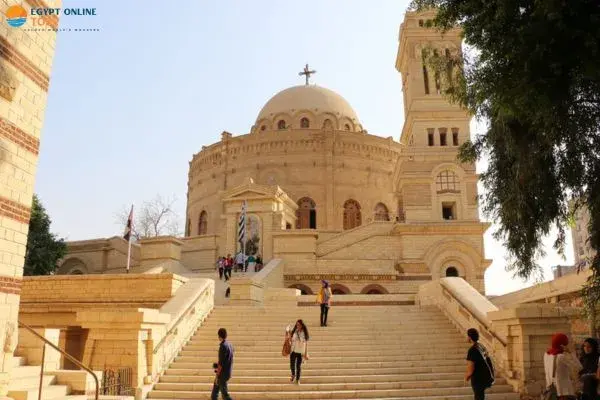
- The Church of St George and the Greek Orthodox monastery of St George. See Church of Saint George.
- The Mosque of Amr ibn al-As, the first mosque in Egypt, about 10 minutes on foot. See our Amr ibn al-As Mosque article.
A half day covers all of these comfortably. For the Holy Family route through Egypt, read how long Mary and Joseph stayed in Egypt.
Plan it with us
Our Old Cairo tour covers the Hanging Church, Abu Serga, Ben Ezra and the Coptic Museum with an Egyptologist, and the Old Cairo day tour adds Islamic Cairo. For pilgrims, the Holy Family tour in Egypt follows the route of the Holy Family from Cairo to Upper Egypt.
The Hanging Church: quick answers
Why is it called the Hanging Church?
Because it is built on top of the southern gatehouse of the Roman Babylon Fortress, so its nave is suspended over the gate passage.
Is there an entrance fee for the Hanging Church?
No. Entry is free; donations are welcome.
How old is the Hanging Church?
Coptic tradition dates the first church on the site to the 3rd century. The first written mention is from the 9th century, and the church was largely rebuilt in the 970s.
What is the nearest metro station?
Mar Girgis on Metro Line 1, directly opposite the entrance to Coptic Cairo.
Ahmed Samir writes and updates the Egypt travel guides of Egypt Online Tour, a licensed tour company based in Cairo (ETAA licence 1466). Our travel advisors review each guide before it is published.
All guides by Ahmed Samir