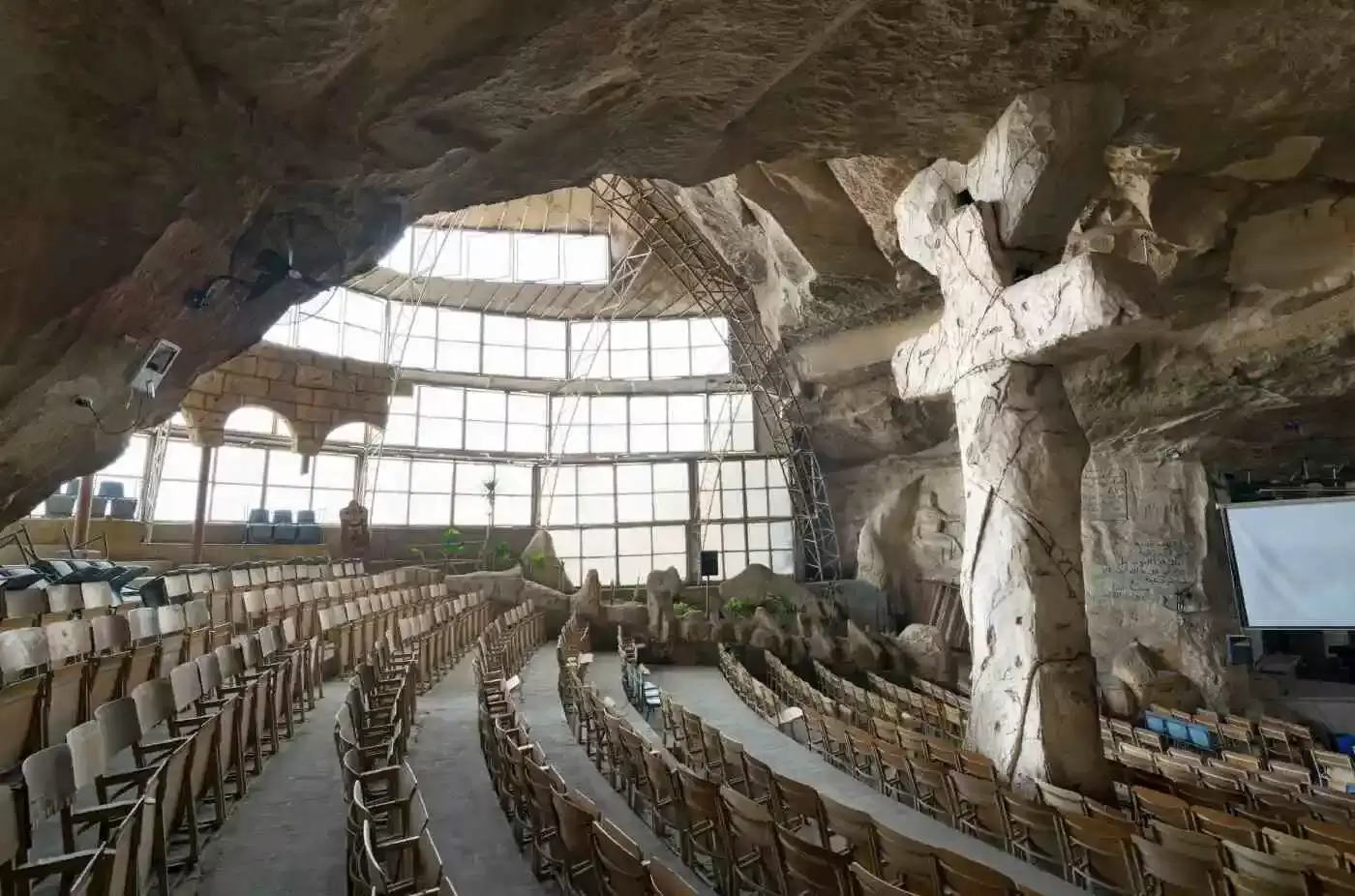
The Cave Church is the popular name of the Monastery of St. Simon the Tanner (Deir Samaan el-Kharraz), a complex of churches carved into the limestone cliffs of the Mokattam hills on the eastern edge of Cairo. It stands above Manshiyat Naser, the quarter of the Zabbaleen, the Coptic community that collects and recycles much of Cairo's rubbish. The main church is a vast open-air amphitheatre in the rock, and the cliffs around it are covered with large carved scenes from the Bible.
The churches were built from the 1970s onwards, but they honour a much older Coptic tradition: the miracle of the moving of the Mokattam mountain in the 10th century. Entry is free. Our guides add it to Old Cairo days for travellers who want to see the living Coptic church as well as its ancient monuments; this guide explains the story, what you see and how to visit respectfully.
The story of St. Simon and the Mokattam mountain
Coptic tradition tells that during the reign of the Fatimid caliph al-Mu'izz li-Din Allah, in the 970s, the caliph challenged the Coptic Pope Abraham to prove the words of the Gospel: "If you have faith as a grain of mustard seed, you shall say to this mountain, move" (Matthew 17:20). If the Christians could not move the Mokattam, the community would suffer.
According to the tradition, the pope prayed and fasted for three days, and the Virgin Mary appeared to him in a dream and sent him to a humble one-eyed tanner and water carrier named Simon. Simon told the pope to gather the clergy and the people at the mountain and pray; when they cried "Kyrie eleison" the mountain moved. Coptic sources date the event to 27 November 979. After it, Simon disappeared from the crowd.
Historians note that the story is first recorded in later Coptic writings and debate its origins; for the Coptic Church it is a cherished account of faith, and the Copts still keep three days of fasting before Advent in its memory. In 1991, during restoration work, remains believed to be those of St. Simon were found in the Church of the Virgin at Babylon el-Darag in Old Cairo. Part of the relics is now kept at the Mokattam monastery.
How the Cave Church was built
The Zabbaleen moved to the foot of the Mokattam cliffs in the late 1960s and 1970s. In the mid-1970s a young priest, Father Samaan (Simon) Ibrahim, began to serve the community there, and the first church was made in a cave in the cliff. Over the following decades the community and the church cleared and enlarged the caves into a whole monastery, with the large amphitheatre church added later.
Sources count six or seven churches and chapels in the complex today, among them:
- The Church of St. Simon the Tanner: the great amphitheatre under an overhanging cliff, with tiered stone seats for thousands of worshippers. It is often described as the largest church in the Middle East.
- St. Mark's Church, in the cave first used for worship, and several smaller churches and chapels cut into the rock.
The rock carvings
The cliffs and walls of the monastery are covered with large relief carvings of biblical scenes: the Nativity, the raising of Lazarus, Samson, Joseph and the wife of Potiphar, Christ's resurrection and many more, often with Arabic verses beside them. They are the work of a Polish artist from Krakow, Mariusz Dybich, known in Cairo as "Mario", who met Father Samaan in the early 1990s and spent more than two decades carving here, about 70 works by 2019.
Look out for a carving of Simon himself: tradition says that the tanner, ashamed after glancing at a customer's legs, put out his own eye with an awl, following the Gospel saying "if your eye causes you to sin, pluck it out".
The Zabbaleen and Manshiyat Naser
To reach the monastery you drive through Manshiyat Naser, often called "Garbage City". The Zabbaleen collect household waste from across Cairo, sort it by hand in their homes and workshops and recycle plastic, paper, metal and cloth. The streets are crowded with sacks and trucks, and the smell can be strong. Most visitors find the contrast with the peaceful churches above one of the most memorable parts of the visit. Please be respectful: this is where families live and work, so ask before you photograph people.
Visiting the Cave Church: practical tips
- Entry: free; a donation box is at the church.
- Getting there: by car or taxi from downtown Cairo, about 30 to 45 minutes depending on traffic. Drivers who do not know the route often get lost in the narrow lanes of Manshiyat Naser, so give them the monastery's name in Arabic, Deir Samaan el-Kharraz, or go with a driver who knows it.
- When: any day. Sunday is the main day of worship and the amphitheatre is full; visit on a weekday if you want to look around quietly, or on a Sunday if you want to see a Coptic service.
- How long: 1 to 1.5 hours for the churches and the carvings.
- Dress: shoulders and knees covered for everyone; women do not need a headscarf, but carrying one is respectful.
- Photography: allowed in the churches; be discreet during prayers.
- Combine with: the Citadel of Salah el-Din, about 15 minutes away, or the churches of Old Cairo.
Read our guides to the Hanging Church and to Islamic and Coptic Cairo to build a full day, and our article on how long Mary and Joseph stayed in Egypt for the Holy Family sites of Cairo.
Plan it with us
Our Old Cairo day tour can include the Cave Church with the Hanging Church and the Coptic quarter, with a guide and a driver. For a longer journey through Christian Egypt, see the Holy Family tour in Egypt.
The Cave Church: quick answers
Is the Cave Church in Cairo free to visit?
Yes. There is no ticket; visitors may leave a donation.
Is it safe to visit the Cave Church?
Yes. The drive through Manshiyat Naser is busy and unfamiliar, but the community is used to visitors. Go with a driver who knows the route and be respectful when taking photos.
Who carved the Cave Church?
The churches were cut into the cliffs by the community from the 1970s. The biblical reliefs are the work of the Polish artist Mariusz Dybich, known as Mario, from the 1990s onwards.
Ahmed Samir writes and updates the Egypt travel guides of Egypt Online Tour, a licensed tour company based in Cairo (ETAA licence 1466). Our travel advisors review each guide before it is published.
All guides by Ahmed Samir