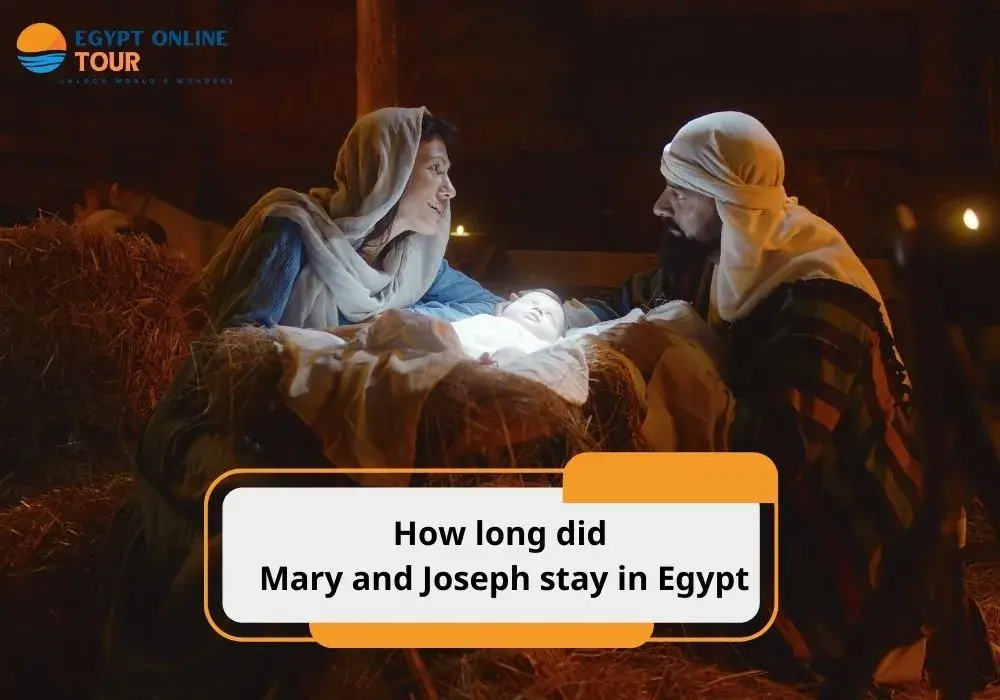
How long did Mary and Joseph stay in Egypt? The Bible does not say. The Gospel of Matthew only tells us that the Holy Family stayed in Egypt "until the death of Herod". The Coptic Church holds that the stay lasted about three and a half years (often given as three years, six months and ten days), while many historians, who date Herod's death to 4 BC, think it was closer to one or two years.
Below we explain where each figure comes from, follow the route of the Holy Family through Egypt station by station, and show which of the sites you can visit today. We run Holy Family tours in Cairo and Upper Egypt, so the last part of the article is practical: what is open, how far it is and how to plan it.
How long did the Holy Family stay in Egypt? Three answers
| Source | Duration | Based on |
|---|---|---|
| The Bible (Matthew 2:13-23) | Not stated | The family stays "until the death of Herod" and returns when an angel tells Joseph that Herod has died. |
| Coptic Orthodox tradition | About 3.5 years (some texts give 3 years and 11 months) | Church tradition and the vision attributed to Pope Theophilus of Alexandria (late 4th century), which lists the places the family stayed. |
| Historians | Months to about two years | Herod the Great is usually dated to have died in spring 4 BC; Jesus was born a year or two before. |
The longest single stay in the tradition is at the place now called Deir al-Muharraq, near Al-Qusiya in Assiut, where the family is said to have lived for about six months and ten days. The church there is built over the cave where they stayed, which is why the monastery is called the "second Bethlehem".
Why the answers differ
Matthew wrote a theological account, not a travel diary, so he gives no dates. The Coptic tradition grew from the 4th century on and became fixed between the 10th and 13th centuries, when churches were built at the stations. The historical estimate depends on when Jesus was born and when Herod died, and both dates are debated. All three can be respected at once: for pilgrims, the stations are holy places; for historians, the journey is a matter of faith rather than of archaeology.
Why did the Holy Family flee to Egypt?
According to Matthew, after the visit of the Magi an angel appeared to Joseph in a dream and told him: "Rise, take the child and his mother, and flee to Egypt, and remain there until I tell you, for Herod is about to search for the child, to destroy him." Joseph left by night. Herod then ordered the killing of the boys of Bethlehem aged two and under, which is why most readers assume Jesus was younger than two when the family arrived in Egypt.
Egypt was a natural refuge. It was a Roman province outside Herod's rule, it was close, and it had large Jewish communities, especially in Alexandria and in the Delta, where a family from Judea could find work and shelter.
How many days did the journey from Bethlehem to Egypt take?
On foot or with a donkey, at 15 to 25 km a day, the 300 km or so from Bethlehem to the Egyptian border at Pelusium (Al-Farma) would have taken about two weeks. The Coptic route is much longer than a direct journey because the family moved from place to place: from the Sinai coast into the Delta, west to Wadi El Natrun, south through Cairo and along the Nile to Assiut, and back again. The whole circuit in the tradition is more than 3,000 km.
The route of the Holy Family in Egypt, station by station
Egypt's Ministry of Tourism and Antiquities lists 25 stations in eight governorates on the official Holy Family Trail. These are the main ones, in the order of the Coptic tradition:
North Sinai: Rafah, El Arish and Al-Farma
The family entered Egypt along the coast road through Rafah and El Arish to Al-Farma, the ancient Pelusium, east of today's Port Said. The Coptic Church celebrates the entry of the Lord into Egypt every year on 1 June (24 Bashans in the Coptic calendar). Al-Farma is an archaeological site today; North Sinai is not on tourist itineraries.
Tell Basta and Musturud
At Tell Basta (ancient Bubastis), near Zagazig, tradition says the idols of the temple fell as the child passed and a spring appeared. At Musturud, north of Cairo, the Virgin washed the child at a spring; the Church of the Virgin there has a well that pilgrims still visit.
Belbeis, Samanoud and Sakha
The family rested under a tree at Belbeis, crossed the Nile branch at Samanoud, where the church keeps a stone kneading bowl linked to the Virgin, and reached Sakha in Kafr El Sheikh, where a stone with the print of a child's foot is kept in the church.
Wadi El Natrun
In the desert valley between Cairo and Alexandria, the family is said to have found a spring. Centuries later Wadi El Natrun became one of the cradles of Christian monasticism. Four monasteries still stand: St Macarius, St Bishoy, El Sourian (the Syrians) and El Baramos. They are about 100 km from Cairo, 1.5 to 2 hours by car. Our guide to where Wadi El Natrun is covers the location, the four monasteries and how to visit them on a day trip from Cairo.
Matariya and Ain Shams
Near ancient Heliopolis the family rested under a sycamore tree, known today as the Virgin Mary's Tree. The tree you see is a descendant: the original fell in 1656. Tradition says a balsam garden grew from the water the Virgin used, and the balsam was later used for the holy oil (Myron) of the Coptic Church. The site reopened in 2022 after restoration.
Zeitoun, Haret Zuweila and Old Cairo
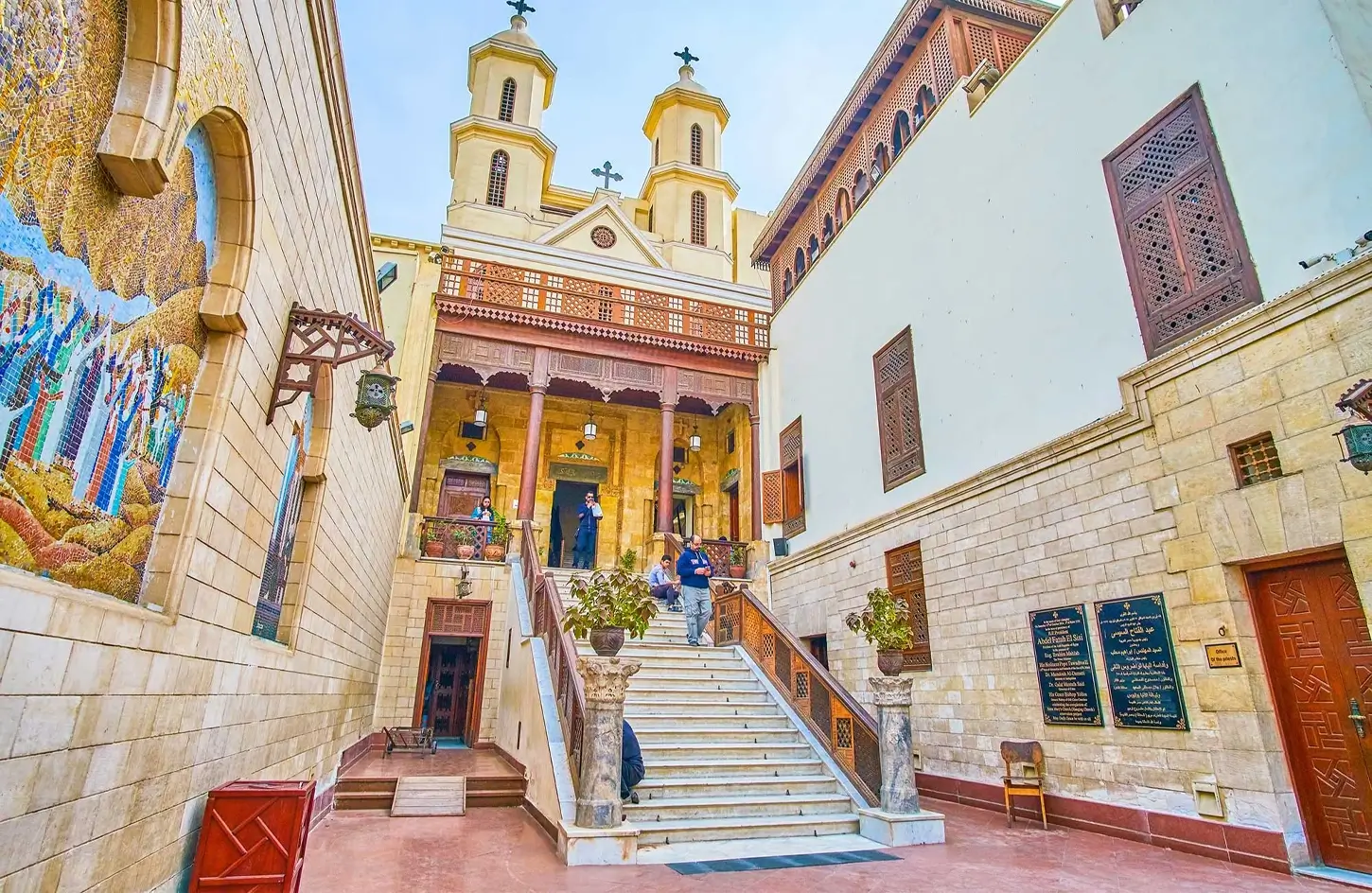
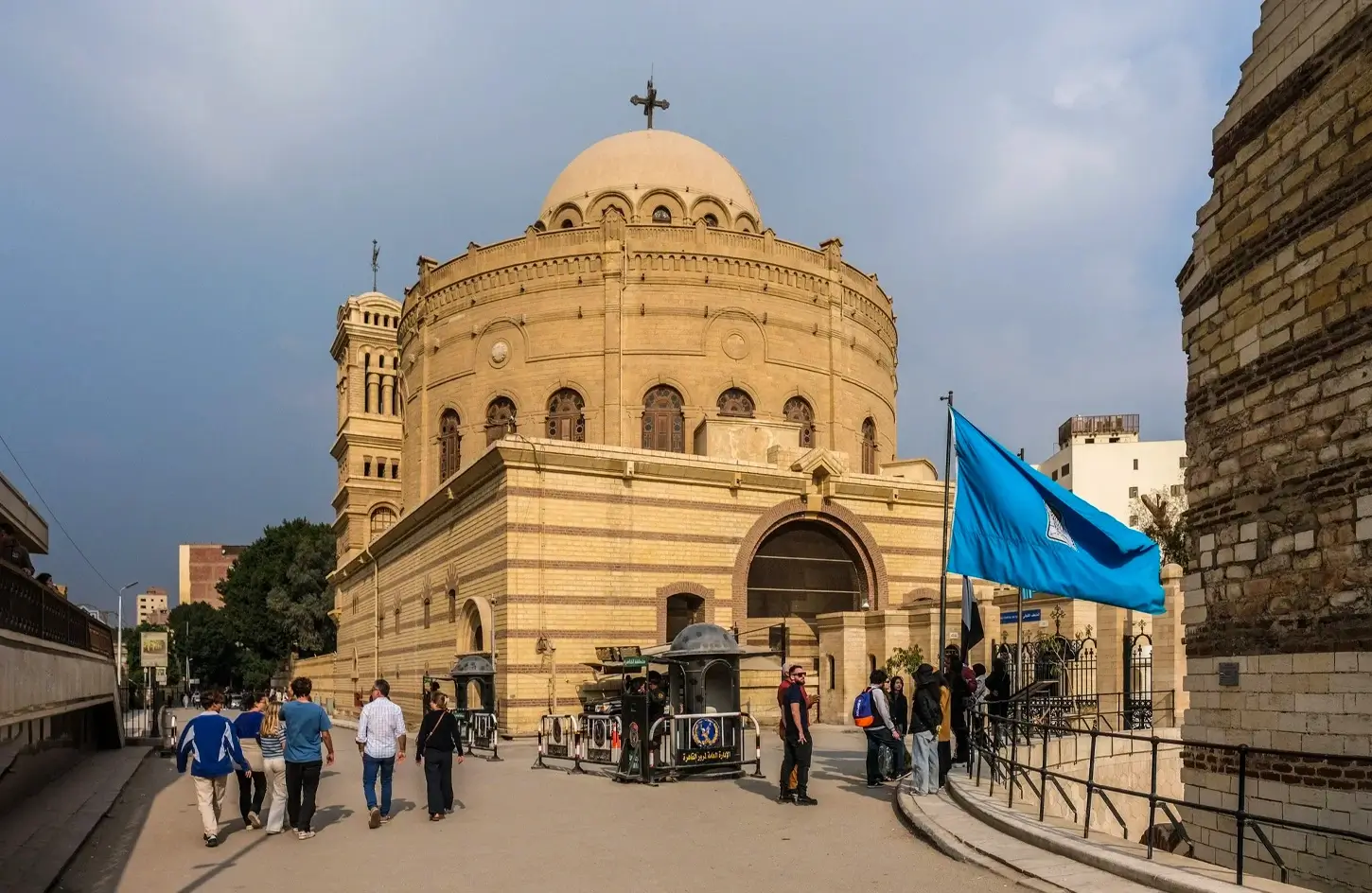
The family passed through the area of today's Zeitoun, where the Coptic Church records apparitions of the Virgin in 1968, and Haret Zuweila, where the Church of the Virgin has an old well. In Old Cairo they sheltered in a cave inside the Roman fortress of Babylon. The Church of Saints Sergius and Bacchus (Abu Serga) is built over that cave, which you can still see as a crypt below the sanctuary.
Maadi
From Maadi the family took a boat south on the Nile. The Church of the Virgin Mary on the river bank marks the place, with steps leading down to the water. A Bible found floating there in 1976, open at Isaiah 19:25 ("Blessed be Egypt my people"), is kept in the church.
Minya: Deir al-Garnous, Al-Bahnasa and Gabal al-Tair
In Middle Egypt the route passes Deir al-Garnous, with its well, Al-Bahnasa, and Gabal al-Tair near Samalout, where a church cut into the cliff above the Nile was founded by Empress Helena in the 4th century according to tradition. Its feast at the end of May draws large crowds.
Ashmunein, Dayrout and Al-Qusiya
The family continued to Ashmunein (ancient Hermopolis), Dayrout and Mir, and reached Mount Qusqam near Al-Qusiya.
Deir al-Muharraq
The southernmost long stay: about six months and ten days. Here, the tradition says, the angel told Joseph that Herod was dead. The Church of the Virgin in the monastery is built over the cave, and its altar stone is held to be the place where the child slept.
Dronka and the return
Before turning north, the family is said to have stayed in a cave in the mountain at Dronka, south-west of Assiut, now a large monastery that hosts the feast of the Virgin every August. They returned the same way through Old Cairo, Matariya and Musturud to Sinai and Palestine, and settled in Nazareth.
What did the Holy Family do in Egypt?
The Gospel says nothing about daily life in Egypt. The tradition remembers the stay as a time of moving on whenever danger came near, of hospitality from some villages and rejection by others, and of signs: springs that appeared, idols that fell and trees that bowed. Joseph was a craftsman, so the family could have lived from his work in the towns they passed. For Egyptian Christians the stay means one thing above all: that their land sheltered the child Jesus, in line with Isaiah 19.
When did the Holy Family return from Egypt?
After Herod's death, which most historians place in 4 BC, an angel told Joseph to return. Herod's son Archelaus then ruled Judea, so Joseph avoided it and took the family to Nazareth in Galilee, ruled by Herod Antipas. Archelaus was removed by the emperor Augustus in AD 6 and exiled to Vienne in Gaul.
The Holy Family Trail today
Egypt launched the Holy Family Trail as a national tourism project in 2018, after Pope Francis blessed an icon of the Flight into Egypt at the Vatican on 4 October 2017. Several stations were restored and reopened in 2023. In 2022 UNESCO inscribed the festivals related to the journey of the Holy Family in Egypt on its Representative List of the Intangible Cultural Heritage of Humanity. The festivals are celebrated mainly between May and August, above all around 1 June and during the August fast of the Virgin.
Holy Family sites you can visit in Cairo in one day
Most travellers see the Cairo stations in one well-planned day. This is the order our guides use:
- Virgin Mary's Tree, Matariya (open daily 9:00 to 17:00; entry EGP 120 for foreign adults and EGP 60 for students at the time of writing): start early, before the traffic.
- Old Cairo (Coptic Cairo): the Church of Saints Sergius and Bacchus with the crypt (open daily 9:00 to 16:00), the Hanging Church, built on the gate towers of the Babylon fortress, and the Coptic Museum, with the largest collection of Coptic art in the world. All are a few minutes' walk apart. Read our guide to the Church of St Sergius and St Bacchus before you go.
- Church of the Virgin in Maadi: 15 to 20 minutes by car from Old Cairo, on the Nile bank. Late afternoon is the best time.
If you have a second day, Wadi El Natrun and its monasteries make a full and peaceful day trip from Cairo. Deir al-Muharraq and Gabal al-Tair are best visited on an Upper Egypt trip with a night in Minya or Assiut; travel in this part of Egypt is coordinated with the local authorities, so plan it with an operator and check the current arrangements before you book.
Practical tips for the Holy Family sites
- Dress: cover shoulders and knees in churches and monasteries. A scarf for women is welcome and sometimes asked for in monasteries.
- Mass and feasts: churches are busiest on Friday and Sunday mornings and on feast days. Visits are quieter on weekday mornings; on 1 June and in August expect large crowds at Musturud, Gabal al-Tair, Deir al-Muharraq and Dronka.
- Photos: ask before photographing people at prayer; some monasteries do not allow photos inside the churches.
- Fees: churches are free; the Coptic Museum and the Virgin Mary's Tree have tickets. Fees change, so check before you go.
- Combine: Old Cairo is 30 to 40 minutes from Tahrir and pairs well with the other Christian sites of Egypt and with the Cave Church in Mokattam.
Plan it with us
Our Holy Family tour in Egypt follows the main stations in Cairo, Wadi El Natrun and Upper Egypt with a guide who knows the tradition. For a longer pilgrimage, the Holy Family tour in Egypt adds the Nile Valley. If you only have a day in Cairo, our Old Cairo day tour covers Abu Serga, the Hanging Church and the Ben Ezra Synagogue.
The Holy Family in Egypt: quick answers
How many years did Jesus live in Egypt?
The Bible gives no number. Coptic tradition says about three and a half years; historians who date Herod's death to 4 BC suggest one to two years.
How old was Jesus when the Holy Family fled to Egypt?
Probably under two. Herod ordered the killing of the boys of Bethlehem aged two and under, based on the time the Magi gave him.
Where did the Holy Family stay longest in Egypt?
At Deir al-Muharraq near Al-Qusiya in Assiut, for about six months and ten days according to Coptic tradition.
Where did the Holy Family stay in Cairo?
Tradition places them at Matariya (the Virgin Mary's Tree), in a cave in Old Cairo under today's Church of Saints Sergius and Bacchus, and at Maadi, where they took a boat south.
When is the feast of the Holy Family's entry into Egypt?
The Coptic Church celebrates it every year on 1 June (24 Bashans in the Coptic calendar).
Did the Holy Family visit the pyramids?
No station of the Coptic tradition is at the Giza pyramids. The nearest stations are Old Cairo and Maadi, on the other side of the Nile.
Ahmed Samir writes and updates the Egypt travel guides of Egypt Online Tour, a licensed tour company based in Cairo (ETAA licence 1466). Our travel advisors review each guide before it is published.
All guides by Ahmed Samir