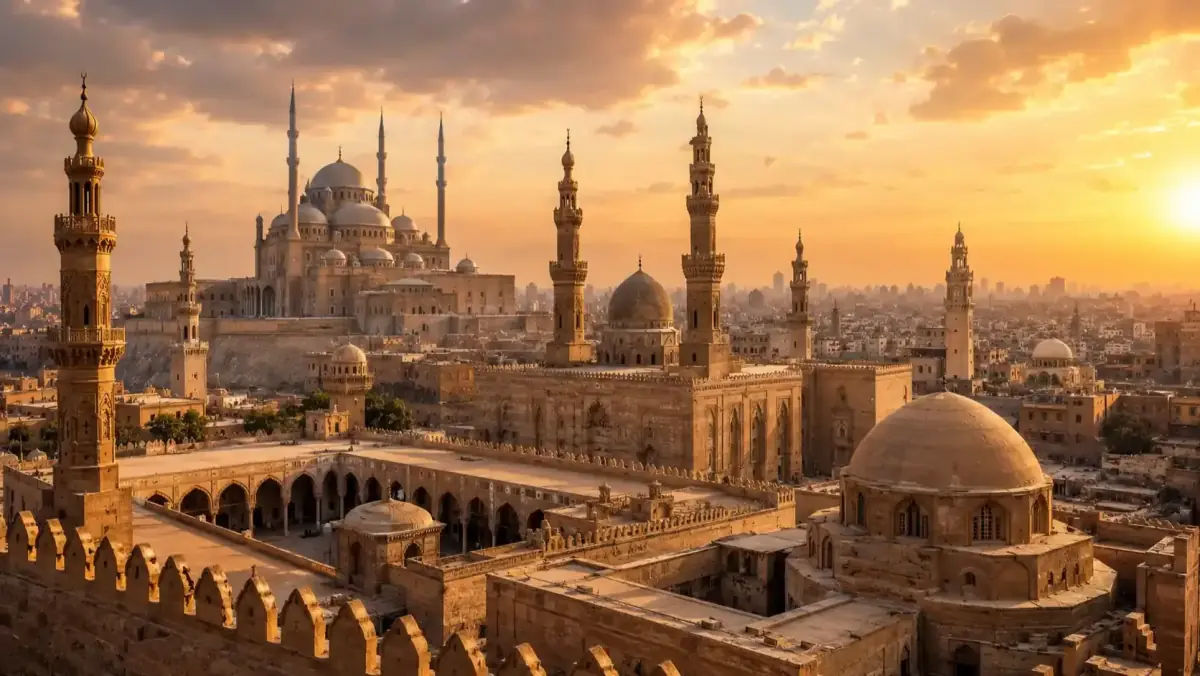

Al Moez Ldin Allah Al Fatmi Street (Al-Muizz Street) is the historic main street of Islamic Cairo: it runs about 1 km from the Fatimid gate of Bab al-Futuh in the north to Bab Zuweila in the south, and 29 listed monuments line it, from the 10th to the 19th century. Walking the street is free. A combined ticket, EGP 220 for a foreign adult (EGP 110 for students) at the time of writing, opens the main Mamluk buildings, and the sites are open daily from 9:00 to 17:00.
The street is part of the UNESCO World Heritage site of Historic Cairo (inscribed in 1979), and the Egyptian monuments authority calls it the largest open-air museum of Islamic monuments in the world. Our guides walk it almost every week; below is the route they use, what each monument is, what the ticket covers, and how to time the walk for light, crowds and Ramadan nights.
Al Moez Street at a glance
| Question | Answer |
|---|---|
| Where | Historic (Islamic) Cairo, next to Khan El Khalili and Al-Hussein Mosque |
| Length | About 1 km inside the old walls, from Bab al-Futuh to Bab Zuweila |
| Street entry | Free |
| Combined monuments ticket | EGP 220 foreign adult, EGP 110 foreign student (at the time of writing) |
| Monument hours | Daily 9:00 to 17:00 (Al-Aqmar Mosque 9:00 to 16:00) |
| Time needed | 1.5 to 2 hours for the main sites, 3 to 4 hours with interiors, Bab Zuweila and Khan El Khalili |
| Best time | Morning for the interiors, late afternoon and evening for the street and the lights |
Why is it called Al Moez Ldin Allah Al Fatmi Street?
The street carries the name of the Fatimid caliph al-Muizz li-Din Allah, who ruled from 953 to 975. His army, led by the general Jawhar al-Siqilli, took Egypt in 969, and Jawhar laid out the new walled city of al-Qahira, Cairo, with this street as its main axis between the caliph's two palaces. The name "Al-Muizz li-Din Allah" was given to the whole street in 1937. Restoration of its monuments began in 1997 to make it an open-air museum.
Four dynasties along one street
| Period | Dates | What it left on the street |
|---|---|---|
| Fatimid | 969 to 1171 | The street plan, the gates Bab al-Futuh and Bab Zuweila (1092), the mosques of Al-Hakim (990 to 1013) and Al-Aqmar (1125) |
| Ayyubid | 1171 to 1250 | The Madrasa of al-Salih Ayyub and the Madrasa of al-Kamil, schools built over the ruins of the Fatimid palaces |
| Mamluk | 1250 to 1517 | The great complexes of Qalawun (1285), al-Nasir Muhammad (1304) and Barquq (1386), Bashtak Palace (1339), the Al-Ghuri complex (1505) |
| Ottoman | 1517 to 1805 and later | Sabil-kuttabs such as Abd al-Rahman Katkhuda (1744), the Mosque of Suleyman Agha al-Silahdar, Bayt al-Suhaymi (1648 to 1796) |
Where is Al Moez Street and how do you get there?
Al-Moez Street crosses old Cairo from north to south, parallel to Port Said Street, and is cut in two by Al-Azhar Street. The northern half, from Bab al-Futuh to Al-Azhar Street, is the restored showpiece; the southern half continues past the Al-Ghuri complex to Bab Zuweila.
| Option | Where it drops you | Notes |
|---|---|---|
| Taxi or ride-hailing app | Bab al-Futuh, or Al-Hussein Square at Khan El Khalili | The easiest choice; 20 to 40 minutes from downtown or Zamalek, depending on traffic. |
| Metro | Line 3, Bab El Shaaria station | About 15 to 20 minutes on foot to Al-Moez through local streets. |
| On foot from Khan El Khalili | The middle of the street, near Bayn al-Qasrayn | Five minutes through the bazaar lanes. |
| Guided tour | Hotel pickup | The driver drops you at one gate and waits at the other. |
The walking route, north to south
We start at Bab al-Futuh because the walk then follows the history of the street and ends at Khan El Khalili and Bab Zuweila, where it is easy to find a café, a taxi or dinner. In the evening you can do the same walk the other way round.
1. Bab al-Futuh and the northern walls
The "Gate of Conquests" was built in stone in 1087 under the vizier Badr al-Jamali, together with the walls that link it to Bab al-Nasr. The rounded towers and the arrow slits are among the finest military architecture of the medieval Islamic world.
2. The Mosque of Al-Hakim bi-Amr Allah
Begun in 990 by the caliph al-Aziz and finished in 1013 by his son al-Hakim, it is the second largest mosque in Cairo after Ibn Tulun. Its huge courtyard is calm, its two minarets flank the façade, and entry is free. It served as a barracks during the French campaign and was later restored.
3. Sabil-kuttab and Mosque of Suleyman Agha al-Silahdar
An Ottoman-style mosque from the 19th century with a sabil-kuttab, a public fountain below and a Quran school above, on the corner of the street.
4. Bayt al-Suhaymi and Darb al-Asfar
Turn left into the lane of Darb al-Asfar for Bayt al-Suhaymi, a merchant house begun in 1648 and extended in 1796, with courtyards, mashrabiya windows and painted ceilings. It needs its own ticket.
5. Al-Aqmar Mosque
Back on the street, the small Fatimid mosque with the carved stone façade (see the full section below).
6. Bashtak Palace and the Sabil of Abd al-Rahman Katkhuda
The Mamluk palace of the Amir Bashtak (1339) keeps its great hall with mashrabiya galleries. Opposite stands the sabil-kuttab of Abd al-Rahman Katkhuda (1744), the most photographed building of the street, where the road forks.
7. Bayn al-Qasrayn: Barquq, al-Nasir Muhammad and Qalawun
"Between the two palaces" is the heart of the street, where the Fatimid palaces once faced each other. Three Mamluk sultans built here side by side:
- Madrasa of Sultan Barquq (1386): a school and mosque with a fine marble courtyard and a painted wooden ceiling.
- Madrasa and mausoleum of al-Nasir Muhammad (1304): its Gothic marble doorway was brought from a church in Acre after the Crusader city fell.
- Qalawun complex (1285): a hospital, a school and the mausoleum of Sultan Qalawun, built in a little over a year. The mausoleum, with its stained glass, inlaid marble and carved stucco, is one of the most beautiful rooms in Cairo.
8. Khan El Khalili and Al-Hussein
Here the street meets the bazaar. Take a 30-minute detour through Khan El Khalili, past Al-Hussein Mosque, then cross Al-Azhar Street by the pedestrian tunnel or bridge to continue south.
9. The Al-Ghuri complex
On both sides of the street stand the mosque-madrasa and the mausoleum of Sultan al-Ghuri, one of the last Mamluk sultans, finished in 1505. The mausoleum side hosts Sufi music and tanoura dance evenings at the Al-Ghuri cultural centre on some nights of the week; check the current schedule locally.
10. Bab Zuweila and the Mosque of al-Muayyad
The southern gate was built in 1092 by Badr al-Jamali. In 1415 to 1421 the Mamluk sultan al-Muayyad Sheikh used its two towers as the bases of the minarets of his mosque next door. You can climb the towers for the best view over the roofs of old Cairo (separate ticket: EGP 100 for foreign adults, EGP 50 for students, at the time of writing).
Al-Aqmar Mosque: the Fatimid façade on Al-Moez Street
The Al-Aqmar Mosque, "the moonlit mosque", is small but it is one of the most important buildings on the street. It was built in 1125 (519 AH) for the Fatimid caliph al-Amir bi-Ahkam Allah under the supervision of his vizier al-Ma'mun al-Bata'ihi.
- The first façade that follows the street: the builders set the stone façade in line with the street while the prayer hall inside still faces Mecca. The difference is taken up by the thickness of the walls. Later Cairo mosques followed this solution, which is why the street looks so continuous today.
- One of the oldest carved stone façades in Egypt: look for the ribbed shell hood over the door, the medallions with the names "Muhammad" and "Ali", and the bands of Quran verses in Kufic script.
- Restorations: an inscription above the mihrab records the restoration by the amir Yalbugha al-Salimi in 1397, under Sultan Barquq. The building has been restored again in modern times.
- Visiting: entry is free, open daily from 9:00 to 16:00. The façade is best photographed in the late morning, when the sun is on it. Its design later inspired the façade of the Coptic Museum in Old Cairo.
What does the Al-Moez combined ticket include?
The street is free to walk. To go inside the main buildings, buy the combined ticket at the ticket office near the Qalawun complex. According to the official monuments site it covers:
- The Qalawun complex
- The Mosque and Sabil of Suleyman Agha al-Silahdar
- The Madrasa of al-Kamil
- The Mosque and Madrasa of al-Nasir Muhammad ibn Qalawun
- The Mosque of Sultan Barquq
- The Synagogue of Rav Moshe (Musa bin Maimun)
- The Hammam of Inal
- The Palace of Amir Bashtak
Bayt al-Suhaymi and Wikalat Bazaraa have separate tickets, and so does Bab Zuweila. The Al-Hakim and Al-Aqmar mosques are free. Prices are those we last checked on 4 November 2026; bring cash in small notes, because card machines are not always working.
How long do you need? Two plans
One hour
- Start at Bab al-Futuh and walk past the Al-Hakim Mosque.
- Look at the Al-Aqmar façade and the Sabil of Abd al-Rahman Katkhuda.
- Go inside the Qalawun complex only.
- Finish at Khan El Khalili.
Half a day
- Bab al-Futuh and the walls, then the Al-Hakim Mosque.
- Bayt al-Suhaymi in Darb al-Asfar.
- Al-Aqmar Mosque and Bashtak Palace.
- Barquq, al-Nasir Muhammad and Qalawun at Bayn al-Qasrayn.
- Tea break in Khan El Khalili.
- The Al-Ghuri complex and Bab Zuweila, with the climb up the towers.
Best time to visit Al Moez Street
- Season: October to April is the most comfortable time for walking. From June to August, walk early in the morning or after sunset.
- Time of day: the interiors are open 9:00 to 17:00, so see them in the morning. The street itself is at its best in the late afternoon and evening, when the façades are lit and families come out.
- Fridays: mosques pause visits around the noon prayer; the monuments open later in the afternoon.
- Ramadan: monument hours are shorter, but after the evening meal the street and Khan El Khalili are full of lanterns, music and people until late. It is one of the best times to see the street alive, and also the most crowded.
Madrasas and sabil-kuttabs: how the street worked
Most buildings on Al-Moez were pious foundations paid for by endowments (waqf). A madrasa was a school of Islamic law with a prayer hall, teaching halls and rooms for students; sultans often built their own mausoleum next to it. A sabil-kuttab is a public drinking fountain on the ground floor with a Quran school for children above. Water was a gift to every passer-by, so the sabils were placed on corners where many people walked. When you look up at the street, you are seeing a city where charity, learning and prayer were part of the shopping street.
Architecture to look for
- Stone façades in line with the street: the idea began at Al-Aqmar and became the rule.
- Mashrabiya: turned wooden screens that let in air and filtered light while keeping the rooms private.
- Ablaq: the Mamluk taste for alternating light and dark stone courses, clear at Qalawun and Barquq.
- Muqarnas: stalactite-like carving over doors and under minaret balconies.
- Domes and minarets: compare the Fatimid minarets of Al-Hakim with the slender Mamluk ones of Qalawun and al-Ghuri.
Shopping, crafts and food on the way
The southern half of the street still has working workshops and shops: brass and copper lanterns, wood inlay, tentmakers' appliqué near Bab Zuweila, perfume oils and spices. Bargain with a smile; prices start high. For a break, the old café El Fishawy in Khan El Khalili is the classic stop for mint tea, and the lanes around Al-Hussein have simple places for koshary, fuul and falafel. Carry small notes for tea and snacks.
Photography tips
- The Sabil of Abd al-Rahman Katkhuda and the Qalawun minaret look best in the late afternoon from the north.
- The view south from the top of Bab Zuweila is the best wide shot of old Cairo.
- Inside the Qalawun mausoleum, wait for the light through the stained glass and avoid flash.
- Ask before you photograph people, shopkeepers and anyone praying. Tripods may need a permit in monuments.
Visitor rules, safety and accessibility
- Dress: cover shoulders and knees; women should carry a scarf for the mosques. Shoes come off in prayer halls.
- Safety: the street is lively and has a visible tourist police presence. As in any crowded market, keep your phone and wallet in a front pocket.
- Traffic: parts of the street are open to motorbikes and carts, so keep an eye behind you.
- Accessibility: the northern half is flat and paved, but many monuments have steps and high thresholds, and the bazaar lanes are crowded. Wheelchair users can enjoy the street itself; going inside most buildings needs help.
Is Al Moez Street worth visiting?
Yes. In one kilometre you see a thousand years of Cairo, from Fatimid gates to Ottoman houses, and it pairs naturally with Khan El Khalili. If you have two or three days in Cairo, give Islamic Cairo half a day: Al-Moez in the morning, the Museum of Islamic Art after lunch, or the Gayer-Anderson Museum and the Mosque of Ibn Tulun for a quieter second stop. Our list of famous mosques in Cairo helps you choose.
Plan it with us
Our Egyptian Museum, Citadel and Khan el-Khalili tour ends in the bazaar, and our guides can add a walk along Al-Moez Street. For a full private day in Islamic Cairo with an Egyptologist, see our Cairo day tours.
Al Moez Street: quick answers
Is it free to walk Al Moez Street?
Yes. Walking the street is free; the combined monuments ticket (EGP 220 for foreign adults, EGP 110 for students at the time of writing) is only needed to enter the main buildings.
How long is Al Moez Street?
About 1 km inside the old city, from Bab al-Futuh in the north to Bab Zuweila in the south.
What are the opening hours of the monuments?
Daily from 9:00 to 17:00; Al-Aqmar Mosque from 9:00 to 16:00. The street itself is open day and night.
Can I visit Al Moez Street at night?
Yes. The monuments close at 17:00, but the street is lit and lively in the evening, especially in Ramadan.
When was Al-Aqmar Mosque built?
In 1125 (519 AH), for the Fatimid caliph al-Amir, under the vizier al-Ma'mun al-Bata'ihi. Entry is free.
What are the must-see sites on Al Moez Street?
The Qalawun complex, the Madrasa of Barquq, Al-Aqmar Mosque, the Al-Hakim Mosque, Bayt al-Suhaymi and Bab Zuweila.
Ahmed Samir writes and updates the Egypt travel guides of Egypt Online Tour, a licensed tour company based in Cairo (ETAA licence 1466). Our travel advisors review each guide before it is published.
All guides by Ahmed Samir