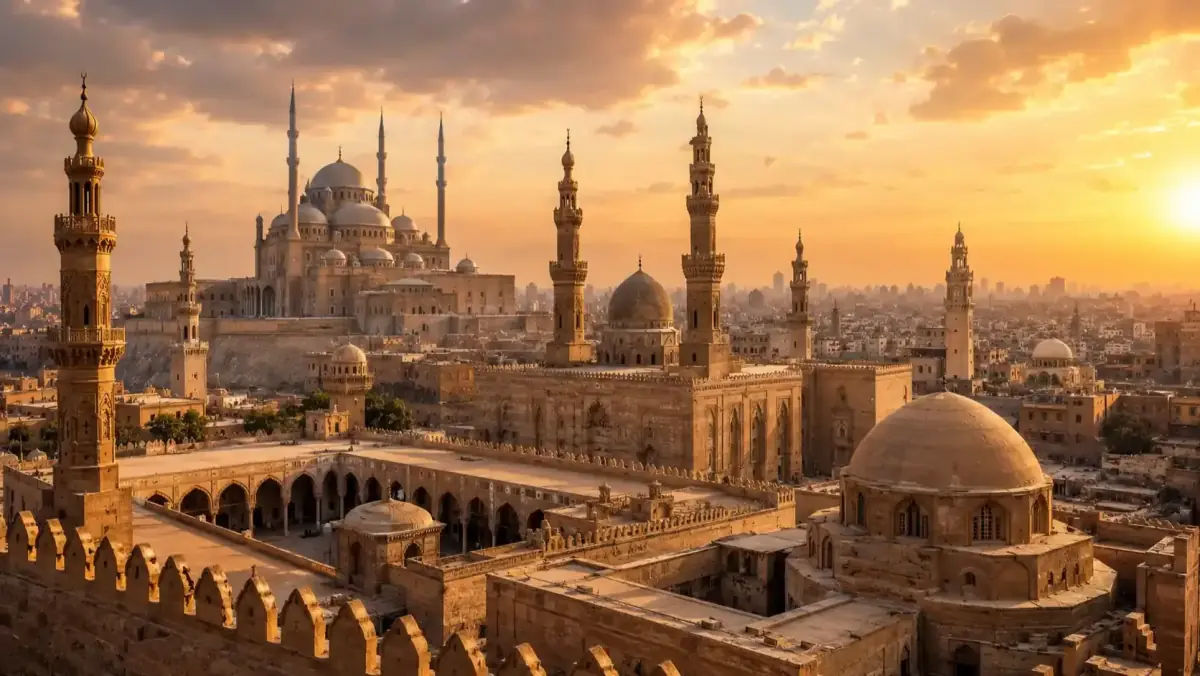

The Salah El Din Citadel (Saladin Citadel) is the medieval fortress on a spur of the Mokattam Hills that ruled Cairo for almost 700 years. Saladin began it in 1176. Today one ticket, EGP 550 for foreign adults and EGP 275 for students at the time of writing, lets you into the whole complex: the Mosque of Muhammad Ali, the Mamluk mosque of al-Nasir Muhammad, the National Military Museum, the Police Museum and the viewpoints over the city. It is open every day from 8:00 to 17:00, and a good visit takes two to three hours.
The Citadel is part of Historic Cairo, a UNESCO World Heritage Site since 1979. Below we cover tickets, how to get there, what to see in the order our guides walk it, the National Military Museum, the history, and practical tips.
Salah El Din Citadel tickets and opening hours
| Ticket (area entry) | Foreign visitors | Egyptians |
|---|---|---|
| Adult | EGP 550 | EGP 60 |
| Student (with valid card) | EGP 275 | EGP 30 |
| Opening hours | Daily, 8:00 to 17:00 | |
We last checked these figures on the official Egyptian monuments site on 4 November 2026. Fees change, hours are often shorter in Ramadan, and the museums inside can close earlier than the Citadel gates, so go in the morning. The ticket includes the mosques and museums inside; there is no separate ticket for the Mosque of Muhammad Ali. The official National Military Museum page still shows an older inclusive line of EGP 200; the ticket sold at the Citadel gate follows the Citadel's own page (EGP 550). Egyptians pay EGP 60 on both pages, so the gap is not a foreigner-versus-Egyptian price. Buy tickets at the gate and bring cash in case card payment is not working. Sultan Hassan and Al-Rifai mosques, below the Citadel, have their own ticket.
Keep your ticket until you leave: staff can check it again at the inner gates and at the museum doors. Personal photography without flash is allowed once you have paid the entry fee, and the official National Military Museum page lists a camera fee of EGP 50 and a video fee of EGP 300 for foreign visitors inside that museum. Flash, tripods and monopods are not allowed in the museums without a commercial permit.
Where is the Citadel and how do you get there?
The Citadel stands on the eastern edge of Islamic Cairo, above Salah Salem road. The visitor entrance is on the Salah Salem side; expect a bag check.
- By car or ride-hailing app: the easiest way. From Tahrir Square it is 20 to 30 minutes, from Giza 45 to 60 minutes depending on traffic.
- Taxi: agree the fare first or use the meter.
- On foot from Islamic Cairo: from Sultan Hassan Mosque it is about a 15-minute walk uphill around the walls.
- With a guide and driver: the simplest option if you combine the Citadel with other sites in one day.
Entry gate and security check
All bags go through a scanner at the gate, as at every major site in Cairo. Travel light: a small day bag with water, a scarf and your student card, if you claim the student rate, is enough. Keep an eye on phones and wallets on the crowded terraces, as you would anywhere busy, and agree any price with unofficial helpers at the car park before you accept their help.
What to see inside the Citadel
The Citadel is two walled enclosures: the southern one with the mosques and palaces, and the northern one with the military buildings and the Military Museum. This is the order our guides use.
1. Mosque of Muhammad Ali (Alabaster Mosque)
The Ottoman-style mosque that dominates the Cairo skyline, built for Muhammad Ali Pasha and dated 1848, with a dome about 52 m high and two minarets of more than 80 m. Inside, the walls are clad in alabaster, and a ring of lamps and chandeliers hangs under the central dome. Muhammad Ali is buried inside, and the courtyard has the French clock given by King Louis Philippe. Read our full guide to the Mosque of Muhammad Ali.
2. The view terrace
Behind the mosque, the terrace looks over the domes and minarets of Islamic Cairo, with Sultan Hassan and Al-Rifai mosques right below and, on a clear day, the pyramids on the horizon. Come back here at the end of the visit if the morning haze has cleared.
3. Mosque of al-Nasir Muhammad
The royal mosque of the Mamluk sultans, built in 1318 by al-Nasir Muhammad ibn Qalawun and enlarged in 1335. Its arcades use columns taken from older buildings, and its two minarets are topped with green tiles, a rare touch in Cairo. This was the royal mosque of the Citadel, where the sultans came for Friday prayers, and it is the only major building of al-Nasir's reign still standing there. It feels very different from the Ottoman mosque a few steps away.
4. Mosque of Suleiman Pasha
Built in 1528 by the Ottoman governor of Egypt, this is the first Ottoman-style mosque in Cairo: small, with a pointed pencil minaret and painted domes. Few groups go in, so it is often quiet.
5. Al-Gawhara Palace
Muhammad Ali's palace of 1814, used to receive guests, is a museum of 19th-century court life with its furniture, chandeliers and throne room. Its craftsmen came from several countries, and one chandelier, a gift of King Louis Philippe of France, weighs about 1,000 kg. Check on the day whether it is open; parts of the Citadel close for restoration from time to time.
6. Joseph's Well (Bir Yusuf)
Saladin had a well cut 85 m down into the rock to give the fortress water during a siege; the work was run by his emir Qaraqush, who oversaw the building of the Citadel. The wide upper shaft has a spiral ramp, and oxen turned waterwheels at two levels to lift groundwater to the top. Its name comes from Salah al-Din's own first name, Yusuf, not from the prophet. It is usually closed to visitors, but you can see the shaft area.
7. The National Police Museum
A small museum in the former Citadel prison, north of Bab al-Alam, with uniforms and the history of policing in Egypt. One room covers famous political assassinations of the 20th century, with weapons from the cases. Allow 20 minutes.
8. Walls, gates and towers
Saladin's walls and the round towers of the northern enclosure are the oldest parts of the fortress. Walk along them between the two enclosures, and look for Bab al-Mudarrag, the only original gate that survives. Its name comes from the steps cut in front of it, its vault carries painted inscriptions of al-Nasir Muhammad dated 1310, and a foundation inscription found there dates the completion of Saladin's fortress to 1183-84.
The National Military Museum
The National Military Museum fills the Harem Palace, built by Muhammad Ali in the northern enclosure in the 19th century. The museum opened in 1937 in the Ministry of Defence building, moved to Garden City in 1938 and came to the Citadel in November 1949; the palace was restored and the museum reopened in 1993.
What you will see
- Ancient Egypt: models and replicas of chariots, bows and battle scenes such as Qadesh, showing the armies of the pharaohs.
- The Islamic period: weapons, armour and dioramas of battles from the Arab conquest to the Mamluks and Ottomans.
- Modern Egypt: Muhammad Ali's army, the 19th century and the wars of the 20th century, with a large section on the October War of 1973.
- The palace itself: painted ceilings, marble and royal rooms of the 19th century.
- The open-air area: real tanks and aircraft used in the October 1973 war, which children usually enjoy most.
Allow 45 to 60 minutes. The museum keeps its own hours (the official page lists 8:00 to 16:00) and its ticket window closes at 16:00, so do it before the mosques if you arrive late. It is the right stop for anyone with an interest in military history, and an easy one for families who need a break from mosques.
History of the Salah El Din Citadel
Saladin started the Citadel in 1176, soon after he ended the Fatimid caliphate, to guard Cairo against a Crusader attack and to give his new government a safe seat, as the citadels of Damascus and Aleppo did in Syria. He planned a wall of about 20 km around both Cairo and the older capital Fustat, with the fortress at its centre, so that one army could defend both cities. The wall was never fully finished, but long stretches of it still stand.
Under the Mamluks the Citadel became the permanent home of the sultans, who added palaces such as the striped stone Qasr al-Ablaq (1313-14) and their royal mosque. Muhammad Ali rebuilt much of the southern enclosure in the 19th century, so most of what you see on top is Ottoman and later. The British army kept a garrison here until 1946, the Egyptian army then took over, and the Citadel opened to the public as a monument in 1983.
| Date | What happened |
|---|---|
| 1176 | Salah al-Din (Saladin) orders the fortress to protect Cairo, with walls joining it to the city. |
| 1207 | His nephew Sultan al-Kamil completes it and makes it the residence of Egypt's rulers. |
| 1250-1517 | The Mamluk sultans rebuild the southern enclosure with palaces and the mosque of al-Nasir Muhammad (1318). |
| 1517-1805 | Ottoman governors rule Egypt from the Citadel; the Mosque of Suleiman Pasha is built in 1528. |
| 1811 | Muhammad Ali has the Mamluk beys killed as they leave a banquet at the Citadel, ending their power. |
| 1814-1848 | Muhammad Ali builds the Gawhara Palace, the Harem Palace and his mosque. |
| Mid-19th century | Khedive Ismail moves the seat of government to Abdeen Palace in the city. |
| 1946 | The British garrison leaves; the Egyptian army takes over the Citadel. |
| 1949 | The National Military Museum moves into the Harem Palace. |
| 1979 | Inscribed with Historic Cairo on the UNESCO World Heritage List. |
| 1983 | Opened to the public as a historic site. |
How long do you need, and when should you go?
| Visit | Time | What it covers |
|---|---|---|
| Short | 60 to 90 minutes | Mosque of Muhammad Ali, view terrace, al-Nasir Muhammad mosque |
| Full | 2 to 3 hours | Add the Military Museum, Suleiman Pasha mosque, Gawhara Palace and the walls |
| Half day | 4 hours | Citadel plus Sultan Hassan and Al-Rifai mosques below it |
Best time: at 8:00, before the school groups and the midday sun; the Citadel has little shade. October to April is the most pleasant season: November to February is cool enough for walking the walls at midday, and a light jacket helps on the windy terrace in the early morning. From June to September, bring a hat, sunglasses and more water than you think you need, because the hilltop is more exposed than the streets below. On Fridays, the mosques are busy with the noon prayer, so do the museums first. For photos, the view terrace is best early morning or late afternoon when the haze is lower.
Photography tips
- Light: early morning gives soft light on the walls and the mosque courtyard with few people in the frame; late afternoon gives warm light on the domes, but the museums will already be closed.
- The skyline shot: from the view terrace behind the Mosque of Muhammad Ali, frame the domes and minarets of Sultan Hassan and Al-Rifai below you.
- Inside the mosques: no flash, no photos of people praying, and wait until after prayer times for interior shots.
- Height: take care on the terraces and walls, where the edges are low.
Dress code and etiquette
- Cover shoulders and knees; women should carry a scarf for the mosques.
- Shoes come off in the mosques: wear socks and shoes that are easy to remove.
- Non-Muslim visitors are welcome in the mosques outside prayer times. Be quiet and do not photograph people praying.
- Wear comfortable walking shoes: the Citadel has slopes, steps and uneven stone.
Facilities and accessibility
There are toilets and a few cafés and kiosks inside, but bring water in summer. The main paths are wide and paved, but the mosques have steps and some areas have uneven stone, so visitors with limited mobility should plan the mosque, the terrace and the Military Museum's ground floor and skip the walls. Golf carts run inside the site for a small fee.
With a guide or on your own?
You can visit the Citadel on your own: the main buildings are close together and easy to find. A licensed Egyptologist guide adds the story behind the stones, such as which sultan built what, where the Mamluks were ambushed in 1811 and how Joseph's Well worked, and saves time if you want to see the mosques below the walls in the same morning. A private guide with a car and driver is the easiest way to combine the Citadel with Islamic Cairo or the museums in one day, since you do not have to find taxis between sites.
Combine the Citadel with Islamic Cairo
The Citadel is the natural start of a day in Islamic Cairo. Walk down to Sultan Hassan and Al-Rifai, then continue to Al-Muizz Street and finish in the market of Khan el-Khalili. Our guide to the famous mosques of Cairo helps you choose more stops, and how many days you need in Cairo helps you fit it all in.
Plan it with us
Our Egyptian Museum, Citadel and Khan el-Khalili tour covers the Citadel with a guide in a single day. For other routes through Islamic and Coptic Cairo, see our Cairo day tours.
Salah El Din Citadel: quick answers
How much is the Salah El Din Citadel ticket?
EGP 550 for a foreign adult and EGP 275 for a foreign student at the time of writing (official monuments website). One ticket covers the mosques and the museums inside.
Can I buy Citadel tickets online?
We found no official online sale for the Citadel. Buy the ticket at the gate and bring cash in case card payment is not working.
What are the Citadel opening hours?
Every day from 8:00 to 17:00. The National Military Museum inside closes earlier: its ticket window closes at 16:00.
How long do you need at the Citadel?
Two to three hours for the Mosque of Muhammad Ali, the al-Nasir Muhammad mosque, the viewpoints and one museum.
Ahmed Samir writes and updates the Egypt travel guides of Egypt Online Tour, a licensed tour company based in Cairo (ETAA licence 1466). Our travel advisors review each guide before it is published.
All guides by Ahmed Samir