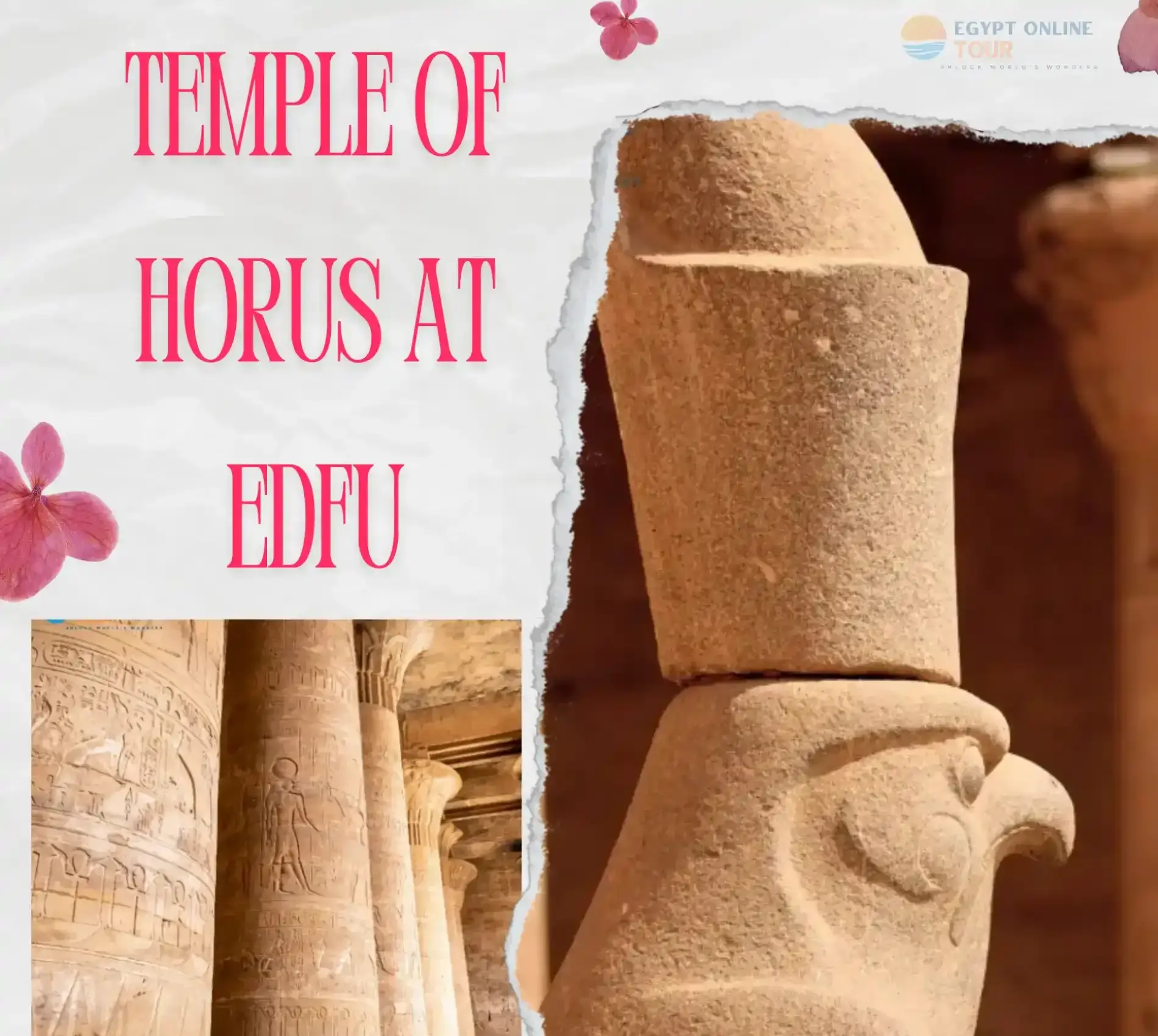
The Temple of Horus at Edfu is the most complete temple of ancient Egypt, dedicated to the falcon god Horus and built under the Ptolemies between 237 and 57 BC. It stands on the west bank of the Nile in the town of Edfu, about 115 km south of Luxor and 105 km north of Aswan, and almost every Nile cruise between the two cities stops here. A ticket for a foreign adult costs EGP 550 (EGP 275 for students), according to the Ministry of Tourism and Antiquities when we last checked on 4 November 2026.
Because the temple kept its roof, its walls and its sanctuary, Edfu is the place where our guides explain how every Egyptian temple worked, from the pylon to the dark shrine of the god. This guide covers the history, what to look for inside, tickets and hours, how to get there and how to fit the visit into your trip.
Edfu Temple tickets and opening hours
| Visitor | Adult | Student |
|---|---|---|
| Foreign visitor | EGP 550 | EGP 275 |
| Egyptian citizen | EGP 40 | EGP 20 |
Source: the official Edfu Temple page of the Ministry of Tourism and Antiquities, checked on 4 November 2026. Ticket prices at Egyptian sites change often, usually once a year, so check again shortly before you travel.
- Opening hours: the ministry lists 7:00 to 17:00 daily, and from 6:00 on Sundays and Wednesdays. Cruise groups usually arrive early in the morning or in the late afternoon.
- Where to buy: at the ticket office at the entrance. Many Egyptian sites now take cards only, so carry one. If you travel on a cruise or with us, the ticket is normally included.
- Students: bring a valid student card with a photo; the international ISIC card is the safest.
- Photos: personal photos with a phone or camera are allowed without flash.
A short history of the Temple of Horus
Edfu was a cult centre of Horus long before the present temple. The town, called Behdet by the Egyptians and Apollonopolis Magna by the Greeks (who linked Horus with Apollo), was the capital of the second nome of Upper Egypt, and remains of older temples lie under and around the site.
The temple you visit was begun under Ptolemy III on 23 August 237 BC, according to the building texts on its walls, and finished under Ptolemy XII in 57 BC, about 180 years later. The Ptolemies were Macedonian Greeks, but they built in pure Egyptian style to win the support of the priests, and they are shown on the walls as pharaohs making offerings to the gods.
Who discovered the Temple of Horus?
The temple was never fully lost: travellers in the 18th and early 19th centuries saw the top of the pylon rising above the village. But after Egypt became Christian and the temple fell out of use, sand and the houses of the later town filled it almost to the roof. That covering is the reason it survived so well. The French archaeologist Auguste Mariette, head of the Egyptian Antiquities Service, began clearing it in 1860, removing the houses on the roof and the debris inside. Some of the reliefs were later damaged by early Christians, who scratched out faces of the gods, and the soot of fires lit by people who lived in the halls still darkens some ceilings.
Why was the Temple of Edfu built?
- To house Horus. An Egyptian temple was the god's house on earth. The cult statue of Horus of Behdet lived in the sanctuary, and priests washed, dressed and fed it every day.
- To mark the place of the myth. Edfu was believed to be where Horus fought Seth to avenge his father Osiris, so the temple celebrated the victory of order over chaos and the right of the king, Horus on earth, to rule.
- To stage festivals. The coronation of the sacred falcon, the New Year rites on the roof and the yearly visit of Hathor from Dendera all took place here.
- To win the priests. For the Ptolemies, building a grand temple in traditional style was a way to be accepted as legitimate pharaohs by the Egyptian elite.
Why the Edfu temple matters
- It is complete. Pylon, court, halls, roof, sanctuary and enclosure wall all stand. Elsewhere you have to imagine what is missing; here you walk through it.
- It is the second-largest temple in Egypt after Karnak, and the largest dedicated to Horus.
- Its walls are a library. The texts record the building dates, the measurements of the temple, the festivals, the offerings, and the myth of Horus and Seth, which makes Edfu one of the main sources for how Egyptian religion worked.
What to see inside the Temple of Horus
The temple follows the classic plan of an Egyptian temple: each room is a little smaller, darker and higher on the floor than the last, as you move from the world of people to the house of the god. Walk it in this order.
The pylon
The gateway is about 36 metres high, one of the tallest surviving in Egypt. Its two towers show Ptolemy XII striking his enemies before Horus and Hathor. The vertical grooves held flagpoles that once rose above the towers.
The granite falcons
Two statues of Horus as a falcon wearing the double crown guard the entrance; a second, smaller one stands at the door of the first hall. This is the photo everyone takes, so be there early or wait until the group in front has moved on.
The court of offerings
A large open court lined on three sides by 32 columns with plant-shaped capitals, each different. On festival days the public could come this far, but no further.
The two hypostyle halls
The outer hall has 12 tall columns and the inner one 12 smaller ones. Small rooms off the outer hall include a library, where the list of sacred books kept in the temple is carved on the wall, and a room where the priests purified themselves. Look up: the ceiling still carries astronomical figures under the soot.
The sanctuary
At the centre stands a dark granite shrine (naos) made under Nectanebo II, the last native king, around 350 BC, older than the temple around it. It held the cult statue of Horus. In front of it is a replica of the sacred boat in which the statue was carried in procession. Chapels around the sanctuary were dedicated to other gods; staircases led the priests to the roof for the New Year rites.
The enclosure wall and the myth of Horus and Seth
Do not leave without walking the passage between the temple and its outer wall. On the inside of the western wall, a long series of reliefs shows Horus spearing Seth, shown as a hippopotamus, a drama that was probably performed every year. Most visitors miss it because their group goes straight back to the boat.
The birth house and the Nilometer
Before the pylon, on your left as you enter, stands the mammisi (birth house), where the birth of the child god was celebrated every year. On the east side of the enclosure a stairway Nilometer measured the height of the flood.
The Feast of the Beautiful Meeting
Every year, in the third month of summer, the statue of Hathor sailed upriver from her temple at Dendera to meet Horus at Edfu. The two gods spent about two weeks together with feasting, music and processions, an event the texts call the Feast of the Beautiful Meeting. Scenes of the journey are carved in the temple. If you also visit Dendera, north of Luxor, you see both ends of the story.
How to get to Edfu Temple
On a Nile cruise
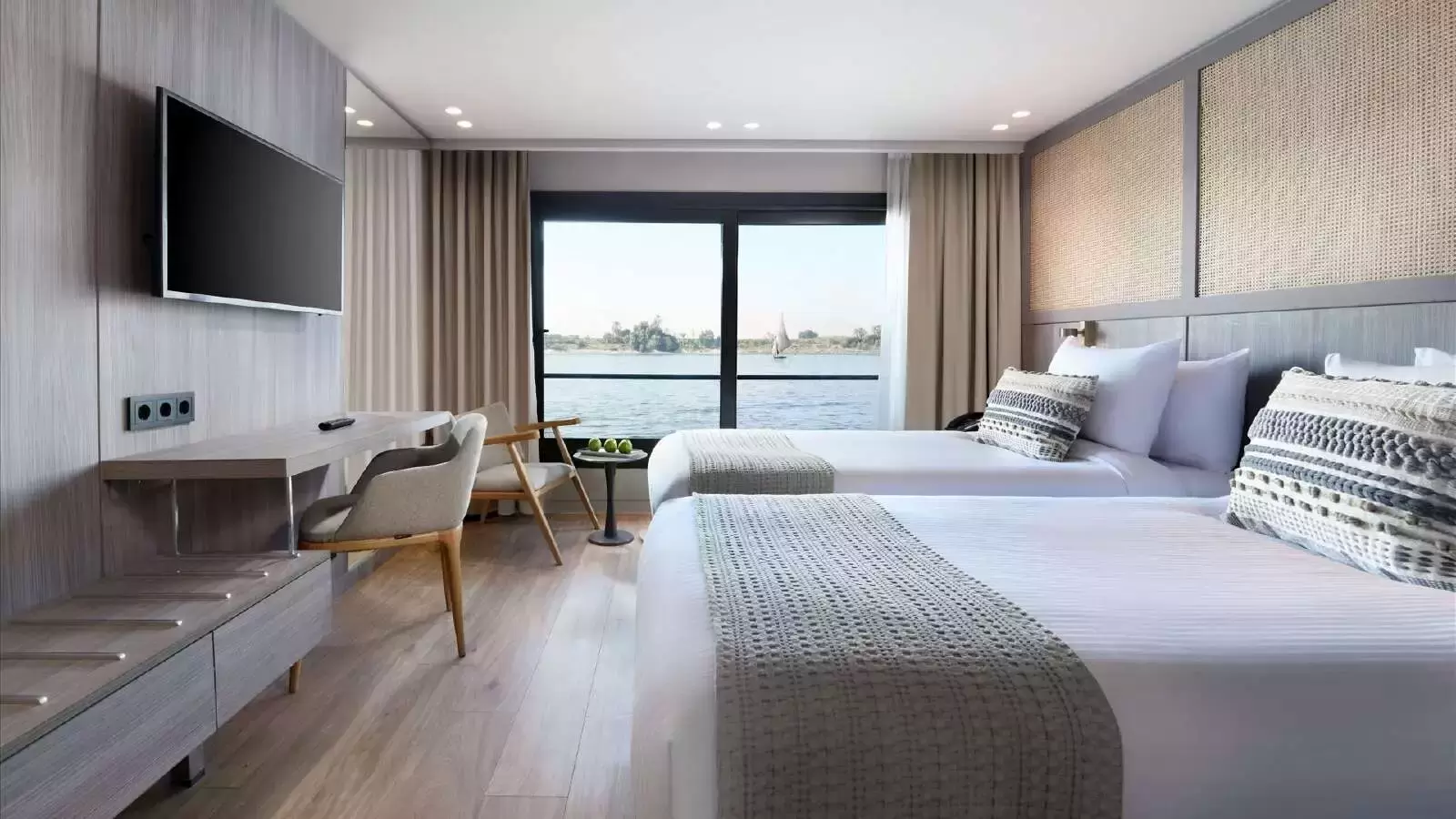
The easiest way. Every standard cruise between Luxor and Aswan moors at Edfu, and the temple is about 1.5 km from the river. The boats arrange horse carriages (hantours) or minibuses for the short ride. The deluxe-class Jaz Crown Jewel, for example, visits Edfu and Kom Ombo on both of its programs. Read how the route differs by direction in our guide to Luxor to Aswan or Aswan to Luxor cruises.
By road from Luxor or Aswan
About 2 hours by car from Luxor and about 1.5 to 2 hours from Aswan. Most travellers combine Edfu with Kom Ombo Temple on the drive between the two cities, which makes a full day with a stop at each temple.
By train
Trains between Luxor and Aswan stop at Edfu station on the east bank. From there you need a taxi across the bridge, so this only suits independent travellers with time.
How long to spend and when to go
- Time: 1 to 1.5 hours with a guide covers the pylon, the court, the halls, the sanctuary and the enclosure passage. Two hours if you like to read the walls.
- Best time of day: right at opening, or the last hour before closing. Cruise boats often moor together and send their guests at the same time, so mid-morning can be crowded.
- Season: October to April is the comfortable season. From May to September, go at opening; the court has no shade and stone reflects the heat.
- Hantour rides: the price of the carriage from the cruise boat is usually included on cruises. If you pay yourself, agree the price for the return trip before you get in, and tip at the end.
Edfu compared with the other Nile temples
| Temple | Main god | Period | Best for |
|---|---|---|---|
| Edfu | Horus | Ptolemaic, 237 to 57 BC | A complete temple, roof and all |
| Kom Ombo | Sobek and Haroeris (a form of Horus) | Mostly Ptolemaic | The double temple by the river, crocodile museum, sunset |
| Dendera | Hathor | Late Ptolemaic and Roman | Painted ceilings, the roof chapels, the other end of the Hathor festival |
| Philae | Isis | Ptolemaic and Roman | The island setting near Aswan |
| Karnak | Amun | 2,000 years of building, mainly New Kingdom | Scale and the Great Hypostyle Hall |
On a standard four or five-day cruise you see Edfu and Kom Ombo in the same day; Dendera and Abydos need a day trip from Luxor. Dahabiyas such as Queen Nefer give the stops more time, with Edfu on one day and Gebel el-Silsila and Kom Ombo on the next.
Is Edfu Temple worth visiting?
Yes. If you see only one temple between Luxor and Aswan, make it Edfu: it is the one place where a complete Egyptian temple still stands, roof and all. Karnak is bigger and older, Philae has the setting, but Edfu shows you how the rooms, the light and the rituals fitted together. It also makes Karnak and Luxor Temple easier to understand when you see them in ruins later.
Before you go, our article on ancient Egyptian gods and temples explains who Horus, Hathor and Seth are, and what to expect on a Nile cruise shows how the temple stops fit into the days on board.
Plan it with us
Edfu is included on our 5 days, 4 nights Nile cruise from Luxor and on the 4 days, 3 nights cruise from Aswan, with Kom Ombo, a guide and the entrance tickets. For a smaller boat, the Yakouta dahabiya stops at Edfu, Gebel el-Silsila and Kom Ombo. If you prefer the road, ask us to add Edfu and Kom Ombo to a private transfer between Luxor and Aswan.
Edfu Temple: quick answers
How much is the ticket to Edfu Temple?
EGP 550 for a foreign adult and EGP 275 for a foreign student, according to the Ministry of Tourism and Antiquities (checked 4 November 2026).
Who built the Temple of Horus at Edfu?
Ptolemy III began it in 237 BC and it was completed under Ptolemy XII in 57 BC. The granite shrine in the sanctuary is older, from Nectanebo II.
How long do you need at Edfu Temple?
One to one and a half hours with a guide, including the walk around the enclosure wall.
How far is Edfu from Luxor and Aswan?
About 115 km from Luxor (around 2 hours by car) and 105 km from Aswan (1.5 to 2 hours).
Why is Edfu Temple so well preserved?
It was buried by sand and later houses almost to the roof until Auguste Mariette cleared it from 1860, which protected the walls and ceilings.
Ahmed Samir writes and updates the Egypt travel guides of Egypt Online Tour, a licensed tour company based in Cairo (ETAA licence 1466). Our travel advisors review each guide before it is published.
All guides by Ahmed Samir