Standard
ComfortComfortable ship, good value
$1,250per person
- Nile cruise 7 nights

Seven nights on a Nile cruise ship from Luxor to Aswan and back, at the level you choose, with Edfu, Philae, Abu Simbel by road and the Valley of the Kings, plus two days of sailing. Full board, a certified Egyptologist guide, entrance fees and private transfers are included.
This is the long way to see Upper Egypt: seven nights on one ship, sailing from Luxor up the river to Aswan and back again. Because the ship covers the same stretch twice, the sightseeing is spread out, with a free day on board in each direction, and you never pack a suitcase between Day 1 and Day 8. The cruise starts and ends in Luxor, so you can fly in and out of the same airport.
You see the great temples of both banks of Luxor, Karnak, Luxor Temple, the Valley of the Kings, the temple of Hatshepsut and the Colossi of Memnon; the Temple of Horus at Edfu; the High Dam, the Unfinished Obelisk and Philae Temple in Aswan; and the two rock-cut temples of Ramses II at Abu Simbel, which many shorter cruises leave as an extra. Full board on the ship, an Egyptologist guide on every visit, the transfers and the entrance fees to the sites in the itinerary are included. Departures run on fixed weekdays, currently Saturday and Monday.
It is a weaker fit if you have only a few days: the classic three- or four-night one-way cruise sees most of the same temples in half the time. Cairo and the Pyramids are not included; combine the cruise with a few nights in Cairo through a tailor-made trip, or browse our other Nile cruise itineraries.
The pace is relaxed by Egyptian standards. Days 2 and 6 have no sightseeing, and most visits end by lunchtime, leaving the afternoons on board. Two days start early:
Monday from Luxor, Thursday from Luxor, Saturday from Luxor
Our representative meets you at Luxor airport, the railway station or your hotel, and your Egyptologist takes you first to Karnak, the temple of Amun and the largest religious site of ancient Egypt. It was built and enlarged over some 2,000 years, from the Middle Kingdom to the Ptolemies. You walk through the pylons into the Great Hypostyle Hall, with 134 columns, and past the obelisks of Thutmose I and Hatshepsut to the sacred lake. Read more facts about Karnak.
You board the ship on the East Bank, check in and have lunch on board, then rest in the heat of the day.
Luxor Temple, built mainly by Amenhotep III and Ramses II, stands in the centre of the town and is at its best as the sun goes down and the lights come on. One of the two obelisks of its entrance is still in place; the other has stood in the Place de la Concorde in Paris since 1836. The Avenue of Sphinxes, about 2.7 km long, runs from here to Karnak.
Dinner is on board, and you spend the night moored in Luxor.
Today has no sightseeing. The ship sails south after breakfast, and the day is yours on the sun deck, by the pool or in the lounge, watching the fields, palm groves and villages go by.
On the way the ship passes the lock at Esna, which lifts boats to the level of the river upstream of the barrage. It is worth being on deck for it: ships wait their turn, and traders in rowing boats come alongside to sell scarves and tablecloths, throwing them up to the deck.
Breakfast, lunch and dinner are served on board, often with afternoon tea in the lounge. The ship sails on towards Edfu for the night.
After breakfast you ride in a horse carriage from the riverbank to the Temple of Horus. Built between 237 and 57 BC under the Ptolemies, it is the most complete temple in Egypt: the pylon, the roofed halls and the granite shrine still stand much as they were finished. The reliefs on its walls tell the story of the struggle between Horus and his uncle Seth, and two granite falcons guard the entrance.
Back on board, lunch is served and the ship sails on. It passes Kom Ombo, where the double temple of Sobek and Haroeris stands on a bend of the river; the visit is not part of this programme, but you see the temple from the deck.
Dinner is on board. The ship reaches Aswan late in the evening and moors there for the next three nights.
After breakfast your guide takes you to the High Dam, completed in 1970, which ended the yearly Nile flood, generates electricity for much of the country and created Lake Nasser, one of the largest man-made lakes in the world. In the ancient granite quarries of Aswan you then see the Unfinished Obelisk, probably cut in the New Kingdom. Had it been finished it would have stood about 42 metres tall; a crack in the stone stopped the work, and it still lies where it was cut, with the marks of the ancient stoneworkers on it.
A short motorboat ride takes you to Philae, the temple of the goddess Isis. When the old Aswan dam left it under water for much of the year, it was taken apart and rebuilt, stone by stone, on the island of Agilkia in a UNESCO campaign completed in 1980. Its courts, colonnades and the small kiosk of Trajan by the water make it one of the most beautiful sites in Egypt.
Lunch is on board, and the afternoon is free. A felucca ride around Elephantine Island or a visit to a Nubian village are popular optional extras. Dinner is on board, moored in Aswan.
This is the earliest start of the cruise. You leave the ship around 4:00 with a breakfast box, in a private air-conditioned vehicle with your guide. The road runs about 280 km south through the desert, roughly three and a half hours, and you arrive as the sun is up over Lake Nasser.
Ramses II had two temples cut into the sandstone cliff here in the 13th century BC. The Great Temple is fronted by four seated statues of the king, each about 20 metres tall; inside, its axis is aligned so that the rising sun lights the statues in the sanctuary twice a year, around 22 February and 22 October. The smaller temple is dedicated to the goddess Hathor and to Nefertari, the king's chief wife. In the 1960s both temples were cut into blocks and rebuilt about 65 metres higher to save them from the rising lake. See our guide to Abu Simbel.
You drive back to Aswan and are on board by early afternoon for a late lunch. The rest of the day is free. Dinner is on board, moored in Aswan.
After three days of early starts, today is for rest. The ship leaves Aswan and sails north, downstream, back past Kom Ombo and Edfu towards Luxor.
Spend the day as you like: on the sun deck, by the pool, in the spa if your ship has one, or with a book in the lounge. This is the day to photograph the river life you rushed past on the way up, the water buffalo at the edge of the fields, the mud-brick villages and the fishermen in their small boats.
Breakfast, lunch and dinner are served on board. The ship passes the Esna lock again and reaches Luxor in the evening or overnight.
After an early breakfast you cross to the West Bank. The Valley of the Kings holds more than 60 tombs cut into the hills for the pharaohs of the New Kingdom, from about 1550 to 1070 BC. The standard ticket opens three of the tombs open on the day; the tombs of Tutankhamun, Seti I and Ramses VI need a separate ticket bought at the site. Inside, the painted corridors show the king's journey through the underworld. See the best tombs to visit.
At Deir el-Bahari, the temple of Queen Hatshepsut rises in three terraces against the cliffs. She ruled as pharaoh for about two decades, and the reliefs record her trading expedition to the land of Punt and the story of her divine birth.
On the way back to the river you stop at the Colossi of Memnon, two seated statues of Amenhotep III, each about 18 metres tall, that guarded the entrance of his mortuary temple.
Lunch is on board and the afternoon is free. A sunrise balloon flight over the West Bank is an optional extra for this morning or tomorrow. Dinner is on board, your last night on the ship.
After breakfast you check out of the ship, usually by about 8:00 to 9:00. Our representative drives you to Luxor airport, the railway station or a hotel in Luxor, and the cruise ends there.
If your flight leaves later in the day, ask us when you book about a visit to the Luxor Museum or the Mummification Museum on the Corniche, both optional extras, or simply a walk along the river.
Comfortable ship, good value
More space and better service
Our highest level
Children pay less, see the children policy below. Christmas, New Year and Easter dates add 25%. Prices are per person in US dollars.
October to April is the most comfortable season. From December to February, days in Luxor and Aswan are around 23 to 26 °C and nights fall to around 8 to 12 °C, so the deck is cool in the evening. March, April, October and November are warmer, often 30 °C or more by midday. From May to September the temperature regularly passes 40 °C; the ships run all year, with the visits moved to the early morning and the afternoons spent in the shade or the pool. Christmas, New Year and Easter are the busiest weeks.
Our list of what to pack for a Nile cruise has more detail.
Many nationalities can buy a tourist visa on arrival at Luxor or Cairo airport, or apply in advance for an e-visa on the official portal, visa2egypt.gov.eg. The rules and the fee depend on your passport, so check before you book. Your passport should be valid for at least six months from the day you arrive. The visa is not included in the price.
The currency is the Egyptian pound. Drinks and extras on board are usually settled at the end of the cruise, by card or cash; ask the reception desk which cards are accepted. Keep small notes for the horse carriage at Edfu, toilets at some sites and markets. Tips for the guide and the crew are not included; the tipping guide in the travel policies below gives the usual amounts.
All prices are per person in US dollars. The price changes with the season (winter 1 September to 30 April, summer 1 May to 31 August), the accommodation level and the size of the group. Christmas, New Year and Easter dates add 25%. Your quote lists the final price and everything it covers. After the deposit, changes to your itinerary cost US$25 per request, plus any third-party fees.
A deposit of 30% of the total tour cost confirms your booking. We send you a secure payment link for the deposit; the balance is paid in cash or by card on arrival in Egypt, unless your written offer gives another date. We never ask for card details by email, chat or WhatsApp. We confirm every booking by email.
No-show travelers are charged 100%. During peak events in Egypt, hotels and Nile cruises do not refund deposits. Groups of more than 10 people may have different terms.
Add each child and their age in the enquiry form so the quote is exact.
Optional visits, such as a hot air balloon ride in Luxor, a Sound and Light show or a felucca ride, are not in the price. Tell us which ones you want and we add them to your quote with their cost.
Not included in the price: Tips for the guide, driver and cruise staff; Personal expenses, such as drinks on board, laundry and shopping; Optional activities, such as a balloon flight in Luxor or a felucca ride in Aswan; International flights and your travel to Luxor: the cruise starts and ends in Luxor, so no domestic flight or train is part of this trip; Extra tickets at the sites: the tombs of Tutankhamun, Seti I and Ramses VI; Egypt entry visa.
Tipping is customary in Egypt and is not included in the price. A usual amount for a private tour is US$8 to 10 per person per day for your guide, US$4 to 5 for your driver and US$5 to 8 per person per day for the crew on a Nile cruise. Your guide can advise you on the day.
The seven-night cruise sails from Luxor on fixed weekdays, currently Saturday and Monday. Tell us your dates and we match them to a sailing.
A one-way cruise sees most of the same temples in half the time. The round trip adds Abu Simbel, two free days on the river and a start and end in the same city, so it suits travelers who want a slower holiday on the water rather than more sites.
Most guests fly to Luxor, either directly from Europe or through Cairo (about one hour), or take the train from Cairo. These are not included in the price; we can book them, or add nights in Cairo with the Pyramids before or after the cruise.
It is a long morning: about three and a half hours each way by road, with a start around 4:00. Most guests sleep on the way there. You are back on the ship by early afternoon, and the next day is a rest day on board.
Independent reviews on the platforms travelers already trust.
Amazing Egyptian vacation! We did an 11 day private tour of Cairo, cruise on the Nile between Aswan and Luxor and a 4 day stay in Hurghada. The guided tours were very interesting, with extremely knowledgeable guides, attentive and helpful.
Egypt package to the Pyramids of Giza and Saqqara was a fascinating journey through Egypt's ancient past ,guide knowledge, the majesty of the pyramids, and the historical depth of Saqqara made this tour truly enriching!
our honeymoon to Egypt ,Giza and Saqqara was a magical escape into history The pyramids looming in the distance, the quiet serenity of the desert, and the ancient wonders of Saqqara created moments that will be with me forever!
Answers to the questions travelers ask before they book.

The Temple of Horus at Edfu is the best-preserved temple in Egypt, built by the Ptolemies between 237 and 57 BC halfway between Luxor and Aswan. A foreign adult ticket costs EGP 550. Here is its history, what to see inside, how to get there and how long to stay.
Read the guide
The best months for a Nile river cruise between Luxor and Aswan are October to April, when daytime highs are about 23 to 30 degrees. November, February and March balance weather and crowds best; December and January are busiest; summer is hot but cheaper. A month-by-month guide with holidays and booking tips.
Read the guide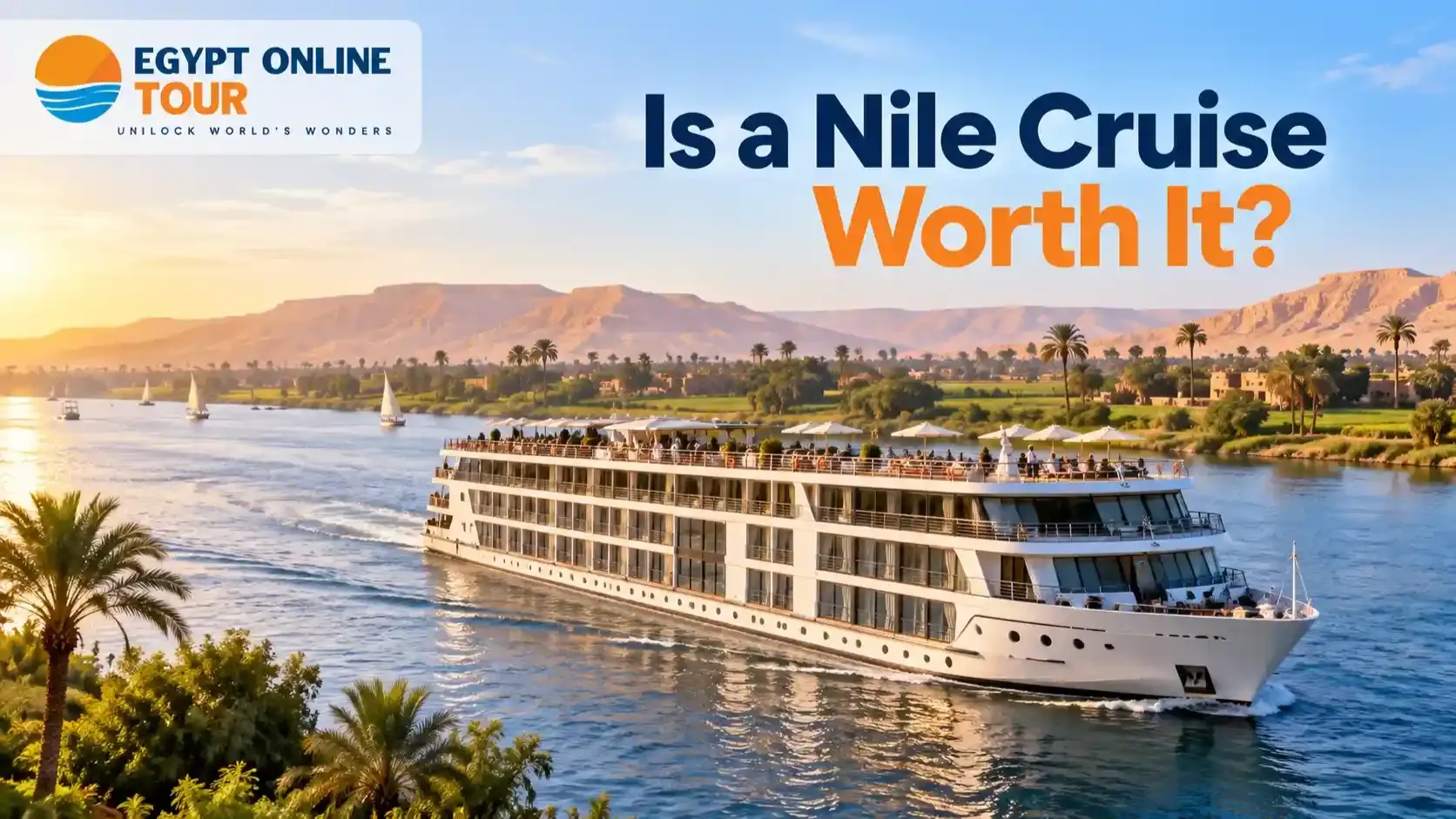
Is a Nile Cruise Worth It? Yes. Enjoy easy sightseeing, relaxing travel, and iconic temples between Luxor and Aswan. Compare cruises and book today.
Read the guideWe always use the cookies this site needs to work. With your permission we also use the optional ones listed under Settings. You can change your choice at any time. Privacy policy