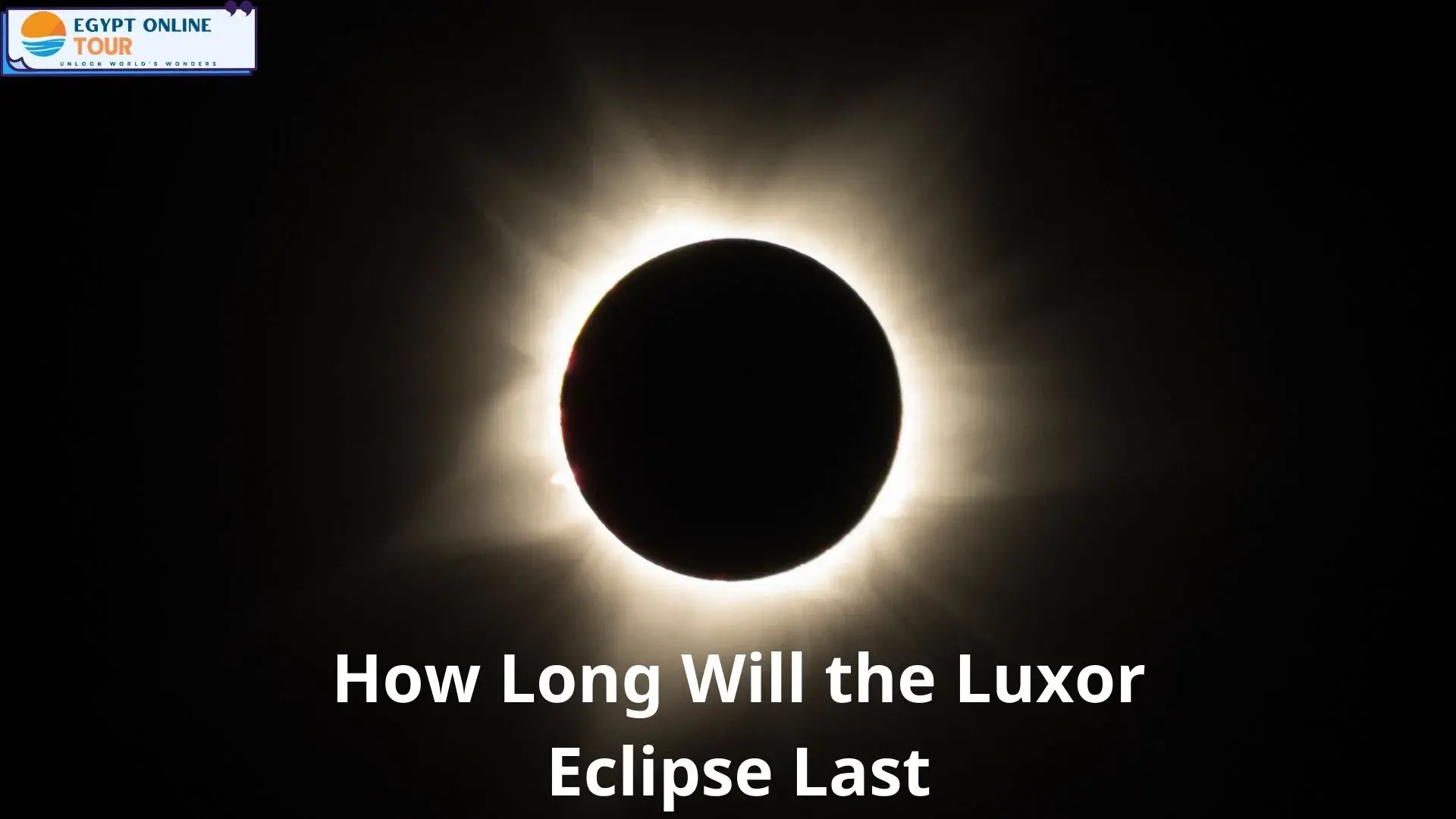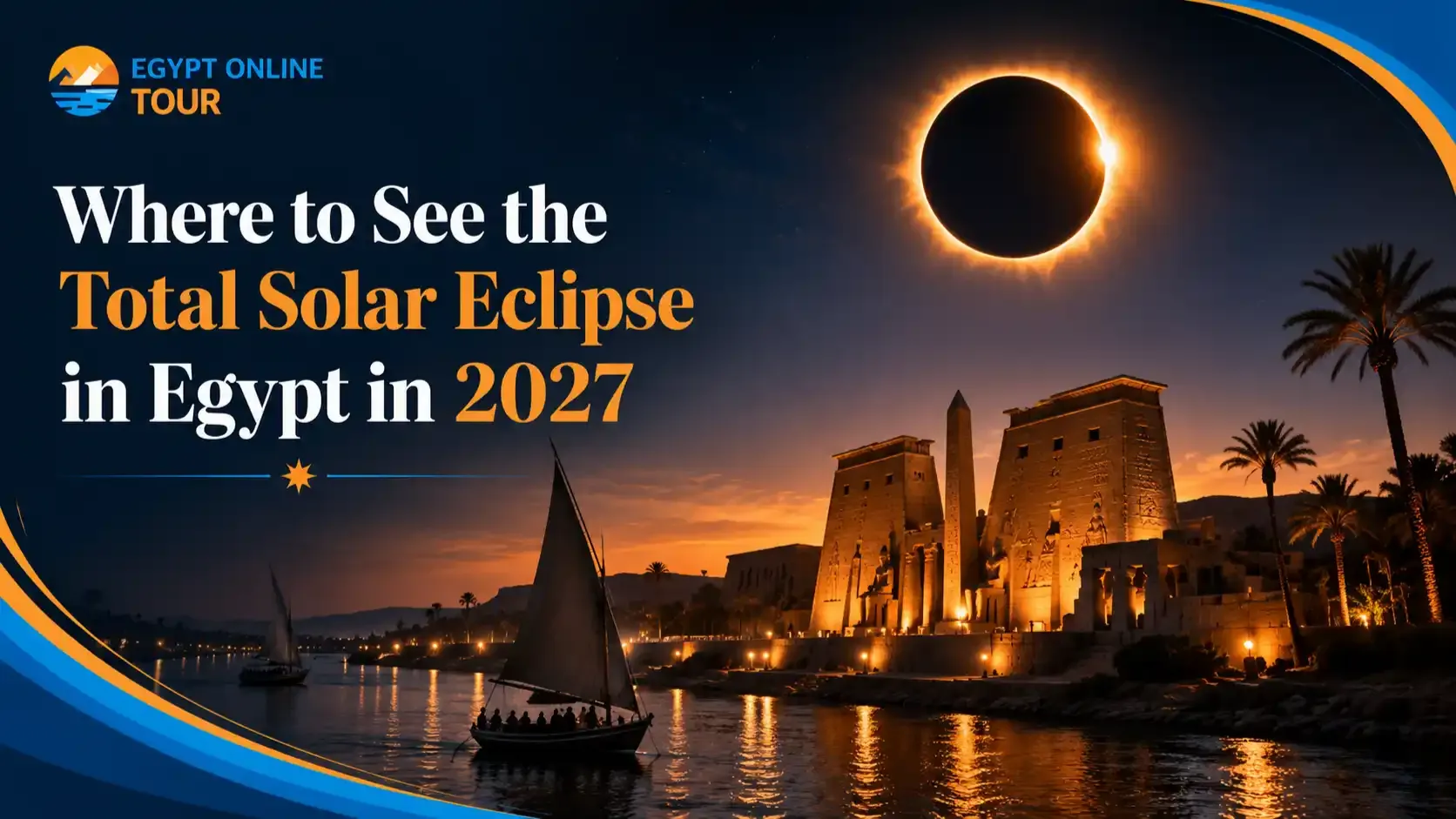
The total solar eclipse over the Nile takes place on Monday, 2 August 2027. In Luxor the moon fully covers the sun from 13:02 to 13:08 local time, for about 6 minutes 22 seconds; the longest totality on Earth, 6 minutes 23 seconds, falls in the desert just west of the Nile near Luxor. Totality this long over land is rare, which is why it is often called the eclipse of the century.
Some websites give the wrong weekday (Saturday) or say only "summer 2027". The date and times below come from the eclipse predictions published from NASA data, checked on 4 November 2026. Our team in Luxor is already planning eclipse-day programmes, and this guide covers what we tell travellers: the times by city, where to stand, how to watch safely and how to cope with the August heat.
2 August 2027 eclipse: the key facts
| Item | Detail |
|---|---|
| Date | Monday, 2 August 2027 |
| Type | Total solar eclipse (Saros 136) |
| Greatest eclipse | 10:07:50 UTC (13:07 Egypt summer time), at 25°30'N 33°12'E, near Luxor |
| Longest totality | 6 minutes 23 seconds |
| Width of the path of totality | Up to 258 km |
| Countries in totality | Spain, Morocco, Algeria, Tunisia, Libya, Egypt, Saudi Arabia, Yemen, Somalia |
| Cairo | Partial only, about 95% of the sun covered at 12:56 |
Eclipse times in Egyptian cities
Local times (Egypt summer time, UTC+3). The partial phases start about 1 hour 20 minutes before totality and end about 1 hour 20 minutes after.
| Place | Totality begins | Maximum | Totality ends | Duration |
|---|---|---|---|---|
| Luxor | 13:02:14 | 13:05:26 | 13:08:36 | 6 min 22 s |
| Nag Hammadi | 13:00:46 | 13:03:58 | 13:07:10 | 6 min 24 s |
| Sohag | 12:58:46 | 13:01:58 | 13:05:09 | 6 min 23 s |
| Qena | 13:01:34 | 13:04:41 | 13:07:46 | 6 min 12 s |
| Asyut | 12:57:03 | 13:00:06 | 13:03:10 | 6 min 7 s |
| Edfu | 13:04:08 | 13:06:55 | 13:09:41 | 5 min 33 s |
| Siwa Oasis | 12:42:42 | 12:45:28 | 12:48:15 | 5 min 33 s |
| Minya | 12:55:36 | 12:57:44 | 12:59:51 | 4 min 15 s |
| Cairo | Partial only: 11:33 to 14:16, maximum about 95% at 12:56 | |||
Durations vary by a few seconds within a city depending on where you stand; the centre line of the path gives the longest totality.
What is a total solar eclipse, and how often does it happen?
A solar eclipse happens at new moon when the moon passes directly between the Earth and the sun. Because the sun is about 400 times wider than the moon and about 400 times farther away, the two discs look almost the same size in the sky, and when the alignment is exact the moon covers the sun completely. Only a narrow band on Earth, the path of totality, sees the total eclipse; on either side people see a partial eclipse. As the Earth turns and the moon moves along its orbit, the shadow races across the surface from west to east.
The four types of solar eclipse
- Total: the observer stands in the umbra, the dark inner shadow of the moon. The sun's bright disc is fully hidden and its outer atmosphere, the corona, becomes visible. This is what Luxor sees in 2027. Day 5 of our 10-day solar eclipse tour with a Nile cruise is set aside for the total eclipse in Luxor.
- Partial: the observer is in the penumbra, the lighter outer shadow, and the moon covers only part of the sun. The closer you are to the path of totality, the larger the bite. Cairo, Aswan and Hurghada see this type in 2027.
- Annular: the moon's orbit is an ellipse, so when the moon is near its farthest point its disc is slightly too small to cover the sun, and a bright ring remains around it. Eye protection is needed the whole time.
- Hybrid: the curve of the Earth makes the same eclipse annular in some places and total in others. Hybrids are the rarest type: 7 of the 224 solar eclipses of the 21st century, the most recent on 20 April 2023.
- How often: somewhere on Earth there are two to five solar eclipses a year and a total eclipse roughly every 18 months, but a given place sees totality only once in several centuries on average.
- How long: the partial phases last two to three hours in total; totality lasts from a few seconds to a theoretical maximum of about seven and a half minutes. The 2027 totality of over six minutes is near the long end.
The path of the 2027 eclipse, and where it is only partial
The shadow of the moon touches the Earth over the eastern Atlantic, crosses the Strait of Gibraltar between southern Spain and Morocco, then runs across Algeria, Tunisia, Libya and Egypt, over the Red Sea to Saudi Arabia and Yemen, and leaves land in north-eastern Somalia before ending over the Indian Ocean. Outside this band a partial eclipse is visible over nearly all of Europe, most of Africa, the Middle East and South Asia.
In Egypt the band covers Luxor, Qena, Sohag, Asyut, Edfu and Siwa. Several popular places sit just outside it, which matters if you plan to watch from a beach or from Aswan:
| Place | What you see |
|---|---|
| Aswan | Partial, about 99.8% covered at about 13:08, just short of the southern limit |
| Safaga | Partial, about 99.6% |
| Hurghada | Partial, about 98.5% at about 13:05 |
| Sharm el-Sheikh | Partial, about 95.5% |
| Cairo | Partial, about 95% at 12:56 |
| Alexandria | Partial, about 93% at about 12:51 |
Even 99% is not totality: the sky stays bright, the corona does not appear and glasses must stay on. From Hurghada or Aswan a morning drive to the Nile Valley around Qena or Luxor puts you inside the band; on the Red Sea coast, the band reaches the shore south of Safaga, so El Quseir (near its northern edge) and Marsa Alam see totality. Leave early, because roads will be busy on the day.
Where to watch the eclipse in Egypt
Luxor: the first choice
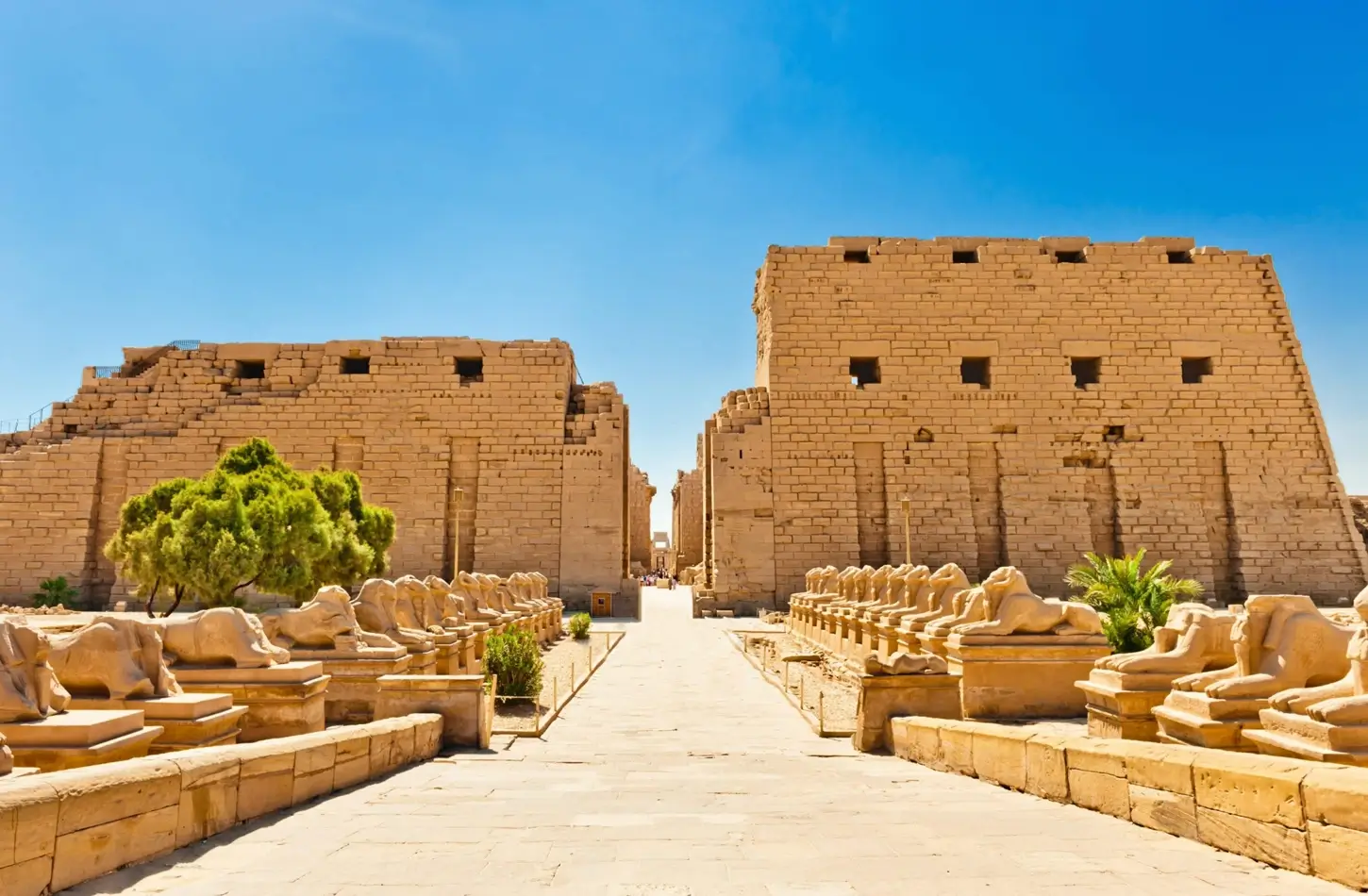
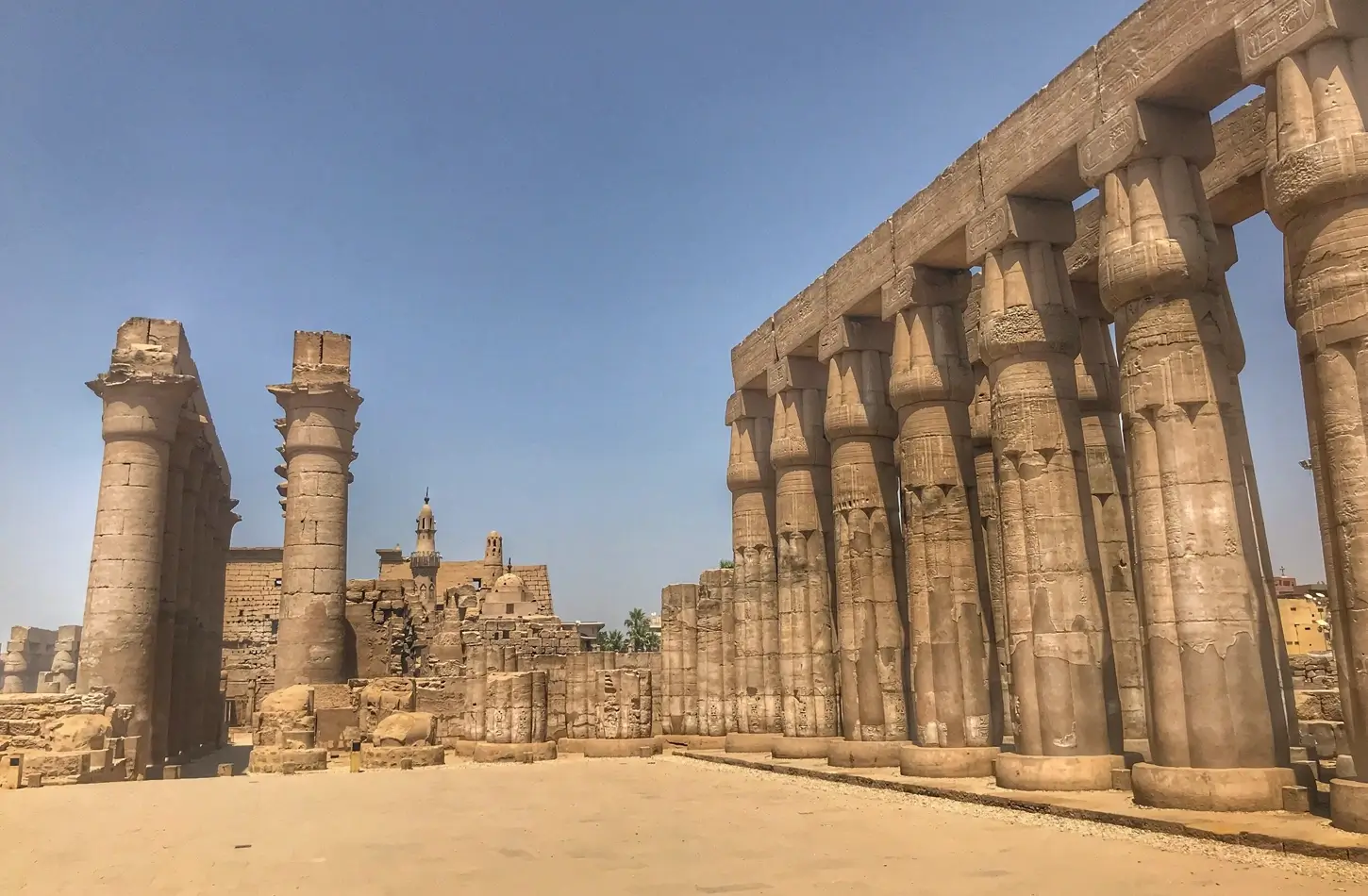
Luxor sits almost on the centre line, has the hotels, the airport and the monuments, and offers more than six minutes of totality. Watching from the West Bank, with the Theban hills, the Colossi of Memnon or Hatshepsut's temple around you, or from the East Bank near Karnak, joins the event with the sites built for the sun god. Expect special arrangements and crowds at the famous temples; open fields and hotel gardens on the West Bank are calmer. Our guide to how long the Luxor eclipse will last goes into the timing.
Between Sohag and Qena
The stretch of the Nile from Sohag to Nag Hammadi and Qena has the same long totality and fewer visitors, with Abydos and Dendera temples nearby. It suits travellers who come with a guide and a vehicle.
On a Nile cruise or dahabiya
A boat moored between Luxor and Qena gives an open horizon, shade and a cool cabin before and after. Cruise and dahabiya cabins for the eclipse week are among the first things to sell out.
Siwa and the Western Desert
Siwa has over five and a half minutes of totality and a dramatic desert setting, but it is far from airports and very hot in August.
What else to see in Luxor around eclipse day
Plan the monuments for the early mornings and evenings of the days before and after. On the East Bank, Karnak and Luxor Temple are linked by the restored Avenue of Sphinxes; on the West Bank are the Valley of the Kings, Hatshepsut's temple at Deir el-Bahri, Medinet Habu and the Colossi of Memnon. Outside the eclipse dates, the deluxe-class Iberotel Crown Emperor covers both banks on Day 3 of its 3-night program from Aswan, the day before you leave the ship in Luxor. A felucca on the Nile at sunset, the souk and a meal by the river fill the hot hours.
For a wider comparison, see where to see the total solar eclipse in Egypt in 2027.
Weather and heat on eclipse day
Upper Egypt in early August has almost no cloud and almost no rain, which gives the Nile Valley some of the best chances of a clear sky anywhere on the path. The price is heat: Luxor averages about 41°C in August, and totality happens around 13:00, the hottest part of the day.
- Stay in the shade during the partial phase and step out only for the last minutes before totality.
- Drink water from the morning on; carry at least 1.5 litres per person for the eclipse itself.
- Wear a wide hat, loose long sleeves and closed shoes; ground and stone get very hot.
- Plan sightseeing for early morning and evening on the days around the eclipse.
How to watch the eclipse safely
- Use certified eclipse glasses (ISO 12312-2) or a solar viewer for all partial phases. Ordinary sunglasses are not safe.
- Remove the glasses only during totality, when the sun is completely covered and the corona is visible, and put them back on as soon as the first bright point of sunlight returns.
- Cameras, binoculars and telescopes need a proper solar filter on the front during the partial phases; never look through them at the uncovered sun.
- In Cairo and other places outside the path, the eclipse is only partial: keep the glasses on the whole time.
- Children should watch with an adult checking their glasses.
Buy glasses from a known supplier before you travel; demand in Egypt will be high in the last weeks.
What you will see during totality
- In the last minutes the light turns grey and metallic, shadows sharpen and the temperature drops by several degrees.
- Just before totality, "Baily's beads" and the "diamond ring" flash on the edge of the moon.
- During totality the white corona surrounds the black disc, bright planets and stars appear, and a 360-degree sunset glow lights the horizon.
- Birds and animals often go quiet, and on the Nile the fishermen and farmers stop to watch with you.
Photography tips
- Practise beforehand with the solar filter on; set focus to infinity and use a tripod.
- Remove the filter only at totality and bracket your exposures to catch the inner and outer corona.
- Do not spend all six minutes behind the camera: set it to shoot automatically and look up.
The sun in ancient Egypt
Watching an eclipse in Luxor has a special resonance. The ancient Egyptians placed the sun god Ra at the centre of their religion: in their tradition he crossed the sky by day in his boat and travelled through the underworld at night, where the serpent Apophis tried to stop him. Ra is usually shown with a falcon head crowned by a sun disc and a cobra. No clear ancient Egyptian record of a solar eclipse has been identified, so claims that a particular text or drawing "shows" one should be read with caution.
The sun in the calendar and the clock
The civil calendar had 365 days: twelve months of 30 days plus five extra days, grouped into three seasons named after the Nile: inundation, emergence and low water. Its new year was probably tied to the reappearance of the star Sirius, Sopdet to the Egyptians, at dawn in the weeks when the flood used to begin, in July in our calendar. Time by day was read from shadows; a shadow clock from the Valley of the Kings, dated to about 1500 BC, is counted among the oldest sundials in the world.
Temples were aligned to the sun as well, such as Karnak, whose main axis points towards the winter solstice sunrise, and Abu Simbel, where the sun reaches the sanctuary twice a year. Read our facts about Karnak Temple before the trip.
Planning and booking
- Book early: hotels in Luxor, cruise ships and flights for 30 July to 5 August 2027 are in very high demand.
- Arrive at least two days before to allow for flight changes and to settle into the heat.
- Combine the eclipse with Cairo before (pyramids at 8:00, museums at midday) and the Red Sea after to cool off.
- Insurance: choose cover that includes trip interruption; it is peak demand for a single day.
Also useful: things to do in Luxor and our guide to a summer vacation in Egypt.
When is the next total eclipse in Egypt?
The last total eclipse seen in Egypt was on 29 March 2006, at Salloum on the Libyan border. After 2027, the total eclipse of 20 March 2034 is expected to cross the far south-east of Egypt near the Red Sea coast. For most travellers, 2 August 2027 is the opportunity of a lifetime.
Worldwide, the next total eclipse after 2027 comes on 22 July 2028 over Australia and New Zealand. No total eclipse on easily reached land will last longer than the 2027 one until 3 June 2114, which is the real reason it is called the eclipse of the century; the 2009 eclipse was longer, but its maximum fell over the Pacific Ocean.
Plan it with us
Our 2027 solar eclipse tour packages include a viewing spot in the path of totality, eclipse glasses and an Egyptologist guide. See all options among our Egypt solar eclipse 2027 tours, including the 4-day Cairo and Luxor eclipse tour.
The 2027 eclipse over the Nile: quick answers
What day is the total eclipse of the Nile in 2027?
Monday, 2 August 2027.
What time is the eclipse in Luxor?
Totality lasts from 13:02:14 to 13:08:36 local time, with maximum at 13:05:26. The partial phases start and end about 1 hour 20 minutes before and after.
How long is totality?
About 6 minutes 22 seconds in Luxor; the maximum anywhere is 6 minutes 23 seconds, just west of the Nile near Luxor.
Is the eclipse total in Cairo?
No. Cairo sees a deep partial eclipse, about 95% at 12:56 local time. Keep eclipse glasses on the whole time.
Ahmed Samir writes and updates the Egypt travel guides of Egypt Online Tour, a licensed tour company based in Cairo (ETAA licence 1466). Our travel advisors review each guide before it is published.
All guides by Ahmed Samir