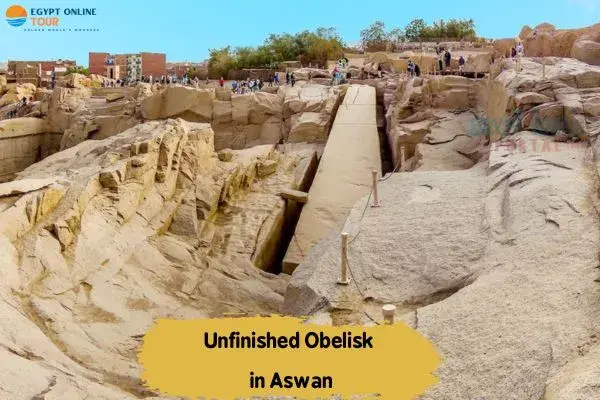
The Unfinished Obelisk in Aswan is a giant granite obelisk that was never cut free from its quarry. Had it been finished, it would have been about 42 metres tall and weighed about 1,168 tonnes, bigger than any obelisk the Egyptians ever raised; the work stopped when the stone cracked. It is generally dated to the reign of Hatshepsut, around 1470 BC.
The ticket costs EGP 220 for a foreign adult and EGP 110 for a student, and the site opens daily from 7:00 to 16:00 (Ministry of Tourism and Antiquities, checked 5 November 2026). Most visitors need 30 to 45 minutes. Our Aswan guides usually make it the first stop of the day, before the High Dam and Philae, and below is what they point out that the signs do not.
What is the Unfinished Obelisk?
An obelisk is a tall, four-sided tapering pillar cut from a single block of stone and topped by a small pyramid (the pyramidion). Pairs of obelisks stood in front of temple gateways as symbols of the sun god. The Aswan quarries supplied the red-pink granite for many of them.
The Unfinished Obelisk still lies on its side in the northern quarry on the east bank of Aswan, attached to the bedrock along its underside. Three of its faces were shaped before the workers found cracks running across the stone. They abandoned it where it lay, so it is the clearest example anywhere of how an obelisk was made.
| Fact | Detail |
|---|---|
| Planned length | About 42 m |
| Planned weight | About 1,168 tonnes |
| Stone | Aswan red granite |
| Date | New Kingdom, probably Hatshepsut (c. 1473-1458 BC) |
| Planned for | Most likely the temple of Amun at Karnak |
| Why abandoned | Flaws and fissures in the granite |
| Rediscovered | Early 20th century, cleared and studied in the 1920s |
| Protection | Part of the UNESCO World Heritage site "Nubian Monuments from Abu Simbel to Philae" (1979) |
7 things they don't tell you about the Unfinished Obelisk
1. It would have been one third taller than any obelisk ever raised
The tallest ancient Egyptian obelisk still standing, now in front of the Lateran basilica in Rome, is about 32 metres. Hatshepsut's standing obelisk at Karnak is about 29.5 metres. At 42 metres and more than 1,100 tonnes, the Aswan obelisk would have been roughly three times the weight of either. Many engineers doubt it could have been moved and raised in one piece, which may be one reason it was given up.
2. The crack is visible, and so are the attempts to save it
Look for the long fissure that crosses the obelisk near its middle. Some scholars think the workers first tried to shorten the obelisk to cut out the flawed section, then stopped when more cracks appeared. That is why the outline does not look perfectly regular.
3. It was cut with stone, not metal
Copper tools are too soft for granite. The workers pounded the stone with balls of dolerite, an even harder rock, many of which were found in the quarry. Groups of workers crouched in the trench and bashed away the granite a few millimetres at a time. Look along the sides of the trench for the rows of rounded, cup-like hollows each team left.
4. The red lines are 3,500-year-old work marks
Painted ochre lines and marks on the surface show the measuring and the division of work between teams. They are among the oldest construction marks you can see in situ anywhere.
5. There are other unfinished works in the same quarries
The obelisk is not alone. The Aswan quarries hold outlines of smaller obelisks, unfinished statues, and wedge-slots from later periods, when Romans split granite with iron wedges, a very different technique from the pharaonic pounding. Ask your guide to show you the wedge marks: they make the comparison easy.
6. Nobody knows exactly how it would have been lifted out
To free the obelisk the workers would have had to undercut the bottom completely, then lever it onto a sledge and drag it to the Nile, about a kilometre away, during the flood. Then it had to sail some 200 kilometres downstream to Luxor. Theories about the method are many; evidence is limited.
7. The date is an educated guess
No inscription on the obelisk names a king. The attribution to Hatshepsut rests on its size and style and on her known obelisk projects at Karnak, recorded in her temple at Deir el-Bahari. It is the most widely accepted view, and the one given by the Ministry of Tourism and Antiquities, but it is not proven. Read more about what Hatshepsut did.
History of the Aswan granite quarries
Aswan granite was prized from the Old Kingdom onwards. It was used for the King's Chamber of the Great Pyramid, for sarcophagi, colossal statues, temple doorways and obelisks shipped as far as the Delta. The stone was quarried along a stretch of hills on the east bank, today partly inside the modern city.
The Unfinished Obelisk lay buried under sand and debris for thousands of years. It was cleared in the early 20th century, and the British engineer Reginald Engelbach studied and published it in the 1920s. The quarry was then protected and opened as an open-air museum.
Tickets and opening hours
| Ticket | Adult | Student |
|---|---|---|
| Foreign visitor | EGP 220 | EGP 110 |
| Egyptian visitor | EGP 20 | EGP 10 |
- Opening hours: daily 7:00 to 16:00. Hours can be shorter in Ramadan.
- Payment: most antiquities sites in Egypt now take payment by card at the ticket office; carry a Visa or Mastercard and some cash for tips and toilets.
- No combined ticket: Philae, the High Dam and the Nubian Museum are paid separately.
- Students: the reduced price needs a valid student card with a photo; an ISIC card is the safest.
Prices are those of the official monuments site on 4 November 2026. They change from time to time, so check close to your trip.
Location and how to get there
The quarry is in the southern part of Aswan city on the east bank, about 2 to 3 kilometres from the Corniche and close to the Fatimid cemetery. Most visitors arrive:
- With a tour or private driver, combined with the High Dam and Philae. This is the most practical way.
- By taxi or ride-hailing app from the Corniche or the railway station, about 10 minutes.
- From Aswan airport, about 25 to 30 minutes by car.
Nile cruise passengers usually visit it on the Aswan sightseeing morning that the cruise includes. On the deluxe-class Lady Mary, for example, it is part of Day 4 of the 4-night program from Luxor, with the High Dam and Philae.
What you see on site
From the ticket office a path and steps climb to a viewing platform above the quarry. From here you see the full length of the obelisk lying in its trench. A walkway lets you go down beside it and look at the tool marks closely. Barriers keep visitors off the obelisk itself; do not climb on it.
- The three shaped faces and the uncut bedrock under the obelisk.
- The cracks, especially the large one across the middle.
- The trench around it and the pounding marks in rows.
- Painted ochre lines.
- Other quarry cuts nearby, including wedge slots.
- Views over Aswan and the granite hills from the top of the quarry.
Expect 30 to 45 minutes. Photography with a phone or camera is allowed.
Best time to visit and practical tips
- Go early. The quarry is a granite bowl with almost no shade, and from April to October it gets very hot by late morning. At 7:00 or 8:00 the light is soft and the site is nearly empty.
- Afternoon light after 15:00 is good for photos in winter, but the site closes at 16:00.
- Shoes: wear closed shoes with grip. The steps and paths are uneven and the granite can be slippery with dust.
- Sun: hat, sunglasses, sunscreen and at least half a litre of water per person.
- Accessibility: the main viewpoint involves steps; visitors with limited mobility can see the obelisk from the upper level with help, but not reach the trench.
- Children usually enjoy it more than a temple: the giant "stone that broke" is easy to understand. Hold small children's hands near the edges.
- Toilets and shops: there are basic facilities and souvenir stalls at the entrance; agree on prices before you buy.
How it compares with finished obelisks
| Obelisk | Where it stands | Height (approx.) |
|---|---|---|
| Unfinished Obelisk (planned) | Aswan quarry | 42 m |
| Lateran Obelisk (Thutmose III and IV) | Rome | 32 m |
| Hatshepsut's obelisk | Karnak, Luxor | 29.5 m |
| Luxor Obelisk (Ramesses II) | Place de la Concorde, Paris | 23 m |
| Luxor Temple obelisk (its twin) | Luxor Temple | 25 m |
Photography tips
- From the upper platform, use a wide angle to get the whole length; a person standing in the trench gives the scale.
- Early morning light from the side brings out the pounding marks; at midday everything looks flat.
- Close-ups of the ochre lines and the crack tell the story better than another wide shot.
- Drones need a permit in Egypt; leave yours at the hotel.
Should you visit with a guide?
The site is easy to see on your own in half an hour, and the signs are basic. A guide makes the difference in reading the quarry: where the pounding teams worked, how the crack ran, which marks are Roman. Since most travellers see the obelisk with Philae and the High Dam the same morning, a guided half day with a driver is the simplest option; if you are on a Nile cruise, the ship's guide usually includes it. That is the case on the 4-night program of the deluxe-class Radamis I, which lists the High Dam, the Unfinished Obelisk and Philae on the same day.
Is the Unfinished Obelisk worth visiting?
Yes, if you are interested in how the Egyptians built their monuments. It is a short, cheap stop that makes every obelisk you see later, at Karnak, Luxor Temple or in Paris and Rome, easier to understand. It is not a temple: there are no reliefs or colourful scenes. If you have only one morning in Aswan and must choose, Philae Temple comes first; the obelisk fits easily on the way.
How to combine it with other Aswan sights
| Time | Stop | Notes |
|---|---|---|
| 7:30-8:15 | Unfinished Obelisk | Coolest time of day |
| 8:45-9:15 | High Dam | Viewpoint over Lake Nasser |
| 9:30-11:30 | Philae Temple | Short motorboat ride to the island |
| Afternoon | Nubian Museum or a felucca | Rest at midday first |
| Evening | Aswan souq | Spices, baskets, Nubian crafts |
Read our guides to visiting Philae Temple and the Aswan High Dam, or see our full list of things to do in Aswan. If you go on to Abu Simbel, you leave very early in the morning, so do the obelisk on another day.
Plan it with us
Our Philae Temple, High Dam and Obelisk private tour covers the three classic sights in one morning with an Egyptologist, tickets and a driver. For more ideas see our Aswan day tours.
Unfinished Obelisk: quick answers
How much is the Unfinished Obelisk ticket?
EGP 220 for a foreign adult and EGP 110 for a foreign student, according to the official monuments site in November 2026.
Why was the Unfinished Obelisk never finished?
Cracks and flaws appeared in the granite while it was being cut, so the workers abandoned it in the quarry.
How big is the Unfinished Obelisk?
About 42 metres long, with an estimated weight of 1,168 tonnes, larger than any obelisk the Egyptians raised.
How long do you need at the Unfinished Obelisk?
Thirty to 45 minutes is enough for most visitors.
Ahmed Samir writes and updates the Egypt travel guides of Egypt Online Tour, a licensed tour company based in Cairo (ETAA licence 1466). Our travel advisors review each guide before it is published.
All guides by Ahmed Samir