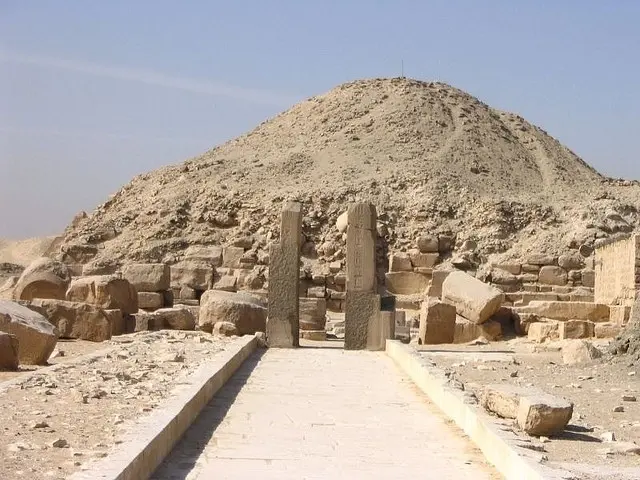
The Pyramid of Teti reveals the burial place of Egypt’s first Sixth Dynasty king in Saqqara. Yet the real wonder lies inside, where the earliest full Pyramid Texts cover the stone walls and guide the ruler’s journey after death. Because visitors can enter the chambers today, the site offers rare contact with Old Kingdom belief, history, and design. So this guide explains facts, meaning, and travel value in clear, simple words.
Pyramid of Teti
The Pyramid of Teti is the earliest accessible royal tomb in Saqqara, where complete Pyramid Texts still cover the burial chamber walls.
Because visitors can enter the monument and read these sacred inscriptions in place, the site offers one of the clearest links to Old Kingdom belief and royal ritual.
This guide brings together verified history, architectural detail, and practical travel insight to help you experience the Pyramid of Teti with full context and confidence.
The Pyramid of Teti stands as a major historical landmark in the Saqqara necropolis, famous for its preserved interior inscriptions. This monument belonged to the first king of the Sixth Dynasty and serves as a primary source for understanding ancient Egyptian afterlife rituals. Visitors flock to this site because it allows rare access to the heart of a royal tomb.
- King: Teti (6th Dynasty).
- Location: North Saqqara.
- Feature: Intricate Pyramid Texts.
- Status: Accessible to the public.
About the Pyramid of Teti
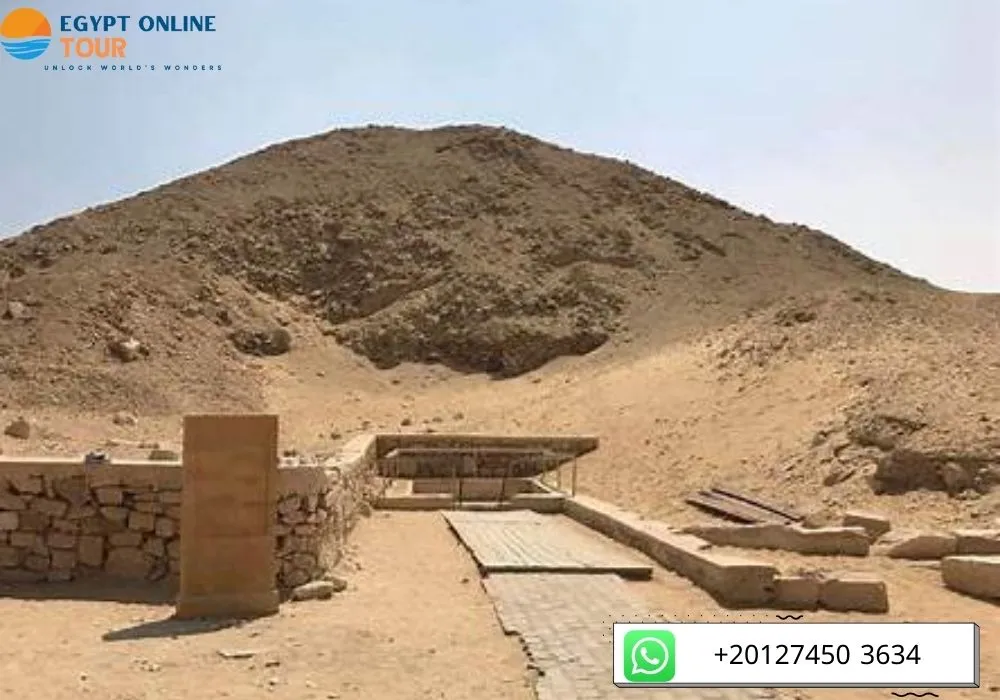
The Pyramid of Teti is a royal funerary monument built for Pharaoh Teti around 2320 BCE.
This structure stands as one of the most important Old Kingdom pyramid sites in Egypt.
The Pyramid of Teti is an Old Kingdom royal tomb famous for its highly detailed religious hieroglyphs and limestone construction.
While its exterior appears as a mound of rubble today, the internal structure remains remarkably intact for modern visitors to explore.
It represents a bridge between the classic massive pyramids and the smaller, text-heavy tombs of later dynasties.
- Original Height: 52.5 meters.
- Base Length: 78.5 meters.
- Material: Limestone and mudbrick.
- Condition: Eroded exterior with a pristine interior.
Archaeologists focus on this site to study the Old Kingdom transition between the Fifth and Sixth Dynasties. Because the outer casing was stolen centuries ago, the core masonry is now visible to the naked eye. However, the burial chamber still holds the king's massive basalt sarcophagus. This contrast between the weathered outside and the sacred inside defines its unique character.
Know about: Pyramid of Menkaure
Location of the Pyramid of Teti in Saqqara
The Pyramid of Teti is located in the northern section of the Saqqara necropolis, sitting just northeast of the Step Pyramid of Djoser. This strategic position placed the king near his ancestors while establishing a new dynastic center for his court. It sits on a plateau that offers a clear view of the surrounding desert and ancient noble tombs.
Region
- Giza Governorate.
Proximity
- Near the Serapeum and Userkaf’s pyramid.
Accessibility
- Easily reached via the main Saqqara entrance.
Geography
- Elevated limestone plateau.
Finding this site is simple for travelers because it lies near the famous Saqqara burial grounds entrance. Most guides lead visitors here immediately after seeing the Step Pyramid. The area also houses the tombs of Teti’s viziers, making the location a hub of political history. You can feel the weight of history as you walk the sandy paths toward the entrance.
Who Was Pharaoh Teti?
Pharaoh Teti was the founding monarch of the Sixth Dynasty who ruled Egypt for approximately 12 to 23 years during the 24th century BC.
Egyptological chronology places the reign of King Teti at the beginning of the Sixth Dynasty, around the mid-twenty-fourth century BCE, marking a political and religious transition in the late Old Kingdom.
Family, Rule, and Political Challenges
He took the throne after Unas and worked to stabilize the central government by marrying into the previous royal family. History remembers him as a king who faced significant internal political challenges from powerful local governors.
Key facts
- Reign: c. 2345–2333 BC.
- Family: Married Iput I, daughter of Unas.
- Legacy: Established the Sixth Dynasty.
- Death: Allegedly assassinated by his bodyguards.
Teti focused on restoring the ancient Egyptian administration by appointing loyal officials to key roles. Manetho, the ancient historian, claims the king met a violent end at the hands of his own guards. Despite this, his cult remained active for centuries after his death. His reign marked a shift toward more complex religious expressions in royal burials.
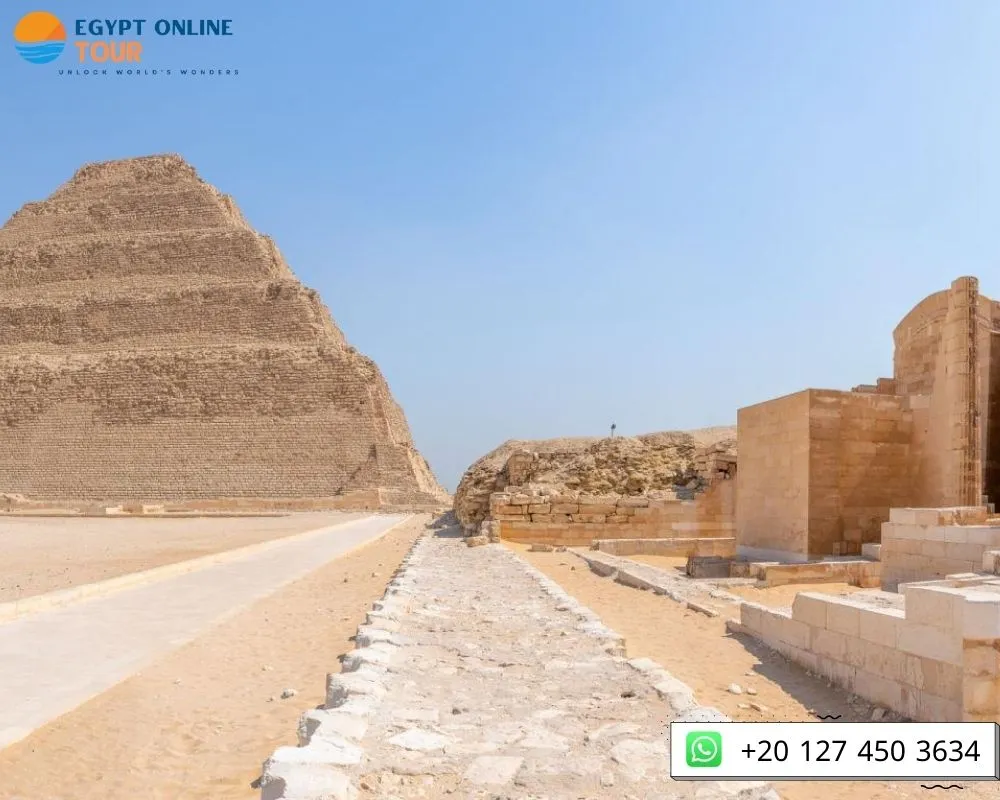
History of the Pyramid of Teti
The Pyramid of Teti was built during the early Sixth Dynasty as the royal burial monument of King Teti.
Egyptological evidence dates its construction to about 2345–2333 BCE, marking the shift from late Fifth Dynasty traditions to Sixth Dynasty rule.
Discovery and Early Exploration
- Systematic study of the pyramid interior began in the nineteenth century under the French Egyptologist Gaston Maspero.
- His work recorded the inscriptions and layout, proving the monument’s value for understanding Pyramid Texts.
- Since antiquity, robbers entered the structure, yet its sacred role kept the site important across centuries.
Later History and Preservation
- Maspero’s exploration in 1881–1882 opened the way for modern research and tourism.
- Priests once served an active mortuary cult here during the Sixth Dynasty.
- Later stone removal damaged the outer casing, leaving the pyramid mound visible today.
Key facts
- Built around 2330 BCE
- Royal funerary and ritual purpose
- First documented exploration in 1881–1882
- Opened to visitors in the modern era
Read about: Pyramid of Khafre Facts
Architecture of the Pyramid of Teti
The architecture of Teti’s pyramid follows the standard smooth-sided design with a core of five steps made from local limestone. Fine Tura limestone originally covered the entire surface to create a gleaming, reflective finish under the sun. The design emphasizes a precise North-South orientation to align the king with the circumpolar stars.
- Core: Step-like layers of stone.
- Casing: Polished Tura limestone (mostly gone).
- Entrance: Located on the north side at ground level.
- Angle: 53 degrees.
This structure highlights the Egyptian construction methods used during the transition from the 5th Dynasty. Engineers used large blocks for the base to ensure stability on the desert floor. However, the quality of the inner core was lower than that of earlier pyramids, which led to its current collapsed state. Only the lower casing stones remain in place to show their original footprint.
Interior Layout of the Pyramid
The interior layout consists of a descending corridor, a horizontal passage with three portcullises, an antechamber, and a burial room. Visitors descend through a narrow tunnel that leads deep into the bedrock, where the temperature remains constant. The walls of these rooms are covered from floor to ceiling with sacred inscriptions that guide the king to the stars.
Architectural Features and Burial Chamber Design
- Passage: Descending at a sharp angle.
- Barriers: Massive granite sliding blocks.
- Chambers: Divided into public and private spiritual zones.
- Sarcophagus: Made of dark, polished greywacke.
The burial chamber design includes a gabled roof decorated with thousands of yellow stars against a dark blue background.
Star-decorated ceilings in Old Kingdom royal burial chambers symbolized the celestial realm and the king’s eternal ascent among the imperishable stars.
This creates the illusion of a night sky, protecting the king for eternity. To the east of the antechamber lies a small room known as the serdab, used for storing ritual items. Every inch of the space serves a specific theological purpose.
Pyramid Texts Inside Teti’s Pyramid
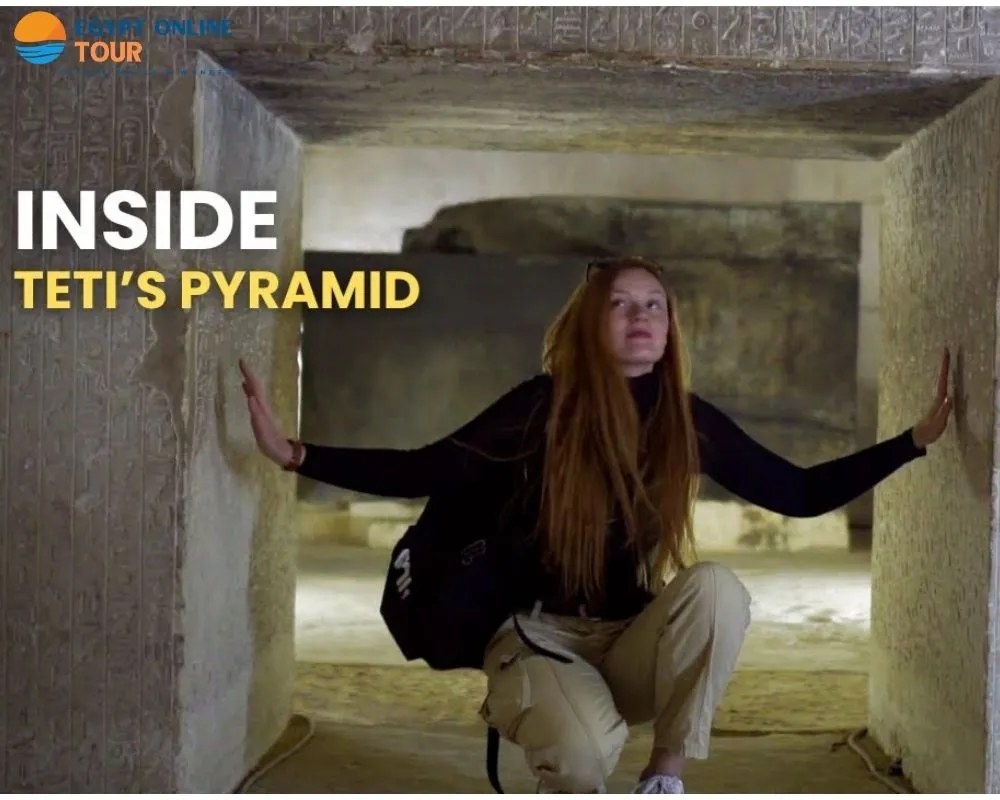
The Pyramid Texts inside Teti’s burial chambers are sacred funerary spells created to secure the king’s resurrection and eternal life.
They form one of the earliest surviving bodies of royal religious literature from the Old Kingdom and reveal a mature belief in divine kingship and the afterlife.
Content, Style, and Religious Meaning
Scholars date these inscriptions to about 2350–2325 BCE.
They follow the earlier tradition seen in the pyramid of Unas and use green-painted hieroglyphs to express rebirth and protection.
Key facts
- Hundreds of ritual utterances
- Written in Old Egyptian hieroglyphs
- Themes of protection, transformation, and ascent to the sky
- Carefully carved and painted wall inscriptions
These texts map the royal journey after death.
They describe flight to the heavens and union with the gods.
Today, they remain a major source for studying early Egyptian religion and language.
Mortuary Complex of Teti
Teti’s mortuary complex includes a valley temple, a causeway, and a high-walled enclosure containing the main pyramid and a smaller cult pyramid. The complex was not just a tomb but a functional city for the dead where workers and priests lived. Surrounding the king are the smaller pyramids of his queens, Iput I and Khuit, showing a unified royal family.
- Cult Pyramid: Used for the king's "Ka" or soul.
- Causeway: A long, covered path for the funeral procession.
- Queen Pyramids: Two smaller structures nearby.
- Temples: Used for daily offerings and prayers.
The mortuary temple ruins reveal where the most sacred rituals took place. Archaeologists have found altars and storage rooms for incense, linen, and food. This layout ensured the king remained part of the living world through continuous worship. It was a massive architectural undertaking that required thousands of skilled laborers.
Pyramid Teti Texts
Teti’s Pyramid Texts present the king as a divine ruler who gains eternal life and cosmic authority after death.
These inscriptions describe the transformation from mortal king to eternal god within Old Kingdom belief.
Structure and Symbolism
- Religious focus: Divine kingship and control over cosmic forces
- Text organization: Vertical hieroglyphic columns in burial chambers
- Preservation state: Exceptionally clear wall carvings
- Theological value: Foundation for later Egyptian afterlife doctrine
Scholars use these inscriptions to trace the rise of the Osiris belief system.
Some passages include the so-called cannibal hymns, where the king absorbs divine power.
This imagery reflects early royal theology unique to the Old Kingdom.
Archaeological Discoveries Around the Pyramid
Excavations around the Pyramid of Teti reveal continuous sacred burial activity at Saqqara from the Old Kingdom through the New Kingdom.
Recent archaeological discoveries include a New Kingdom cemetery, statues, and elite tombs built near the king.
Excavations in the early 2000s uncovered the burial of a mission leader and high-ranking officials, confirming the site’s long religious importance.
Archaeological evidence also shows that Saqqara continued to receive elite burials and ritual activity across multiple dynasties, demonstrating its enduring sacred status.
Key Finds from Modern Excavations
- Royal burial discovery: Tomb of Queen Neerit
- Funerary objects: Masks, statues, and pottery vessels
- Textual remains: Fragments of the Book of the Dead on papyrus
- Elite shaft tombs: Burials of high-ranking viziers
Ongoing excavations continue to produce major finds.
In 2021, archaeologists uncovered a large wooden sarcophagus and a four-meter papyrus scroll, confirming that the Teti complex remained a burial focus in later periods.
Visiting the Pyramid of Teti Today
Visitors can enter the burial chamber of the Pyramid of Teti, making it one of the few accessible royal tombs in Saqqara.
- Access: Entry included in the main Saqqara ticket
- Opening hours: 8:00 AM to 5:00 PM daily
- Descent level: Steep but manageable for most visitors
- Visit duration: About 30 to 45 minutes inside and around the mastabas
- Best time to visit: Early morning to avoid heat and crowds
- What to bring: Comfortable shoes and a small flashlight
- Atmosphere: Quiet interior with visible ancient inscriptions
- Photography: Rules may change, so confirm at the entrance
The Saqqara site feels calmer than the Giza plateau, which allows deeper focus on history and architecture.
Learn about: Best Months to Visit Egypt
Ticket Price, Opening Hours, and Best Time to Visit the Pyramid of Teti
Visitors can explore the Pyramid of Teti with a standard Saqqara entry ticket, which keeps the visit simple and affordable.
Ticket cost
- The general Saqqara entry usually ranges from 300 to 450 EGP for adults
- Student discounts may apply with a valid ID
- Extra tomb access may require a small additional fee
Distance from Cairo
- About 30 km south of central Cairo
- Travel time averages 40 to 60 minutes by car, depending on traffic
Opening hours
- Open daily from 8:00 AM to 5:00 PM
- Last entry often allowed about one hour before closing
Best time to visit
- October to April offers cooler weather and clearer walking conditions
- Early morning visits provide softer light and fewer crowds
Learn about: Cheapest Time to Go to Egypt
Suggested Saqqara combo itinerary
- Step Pyramid of Djoser
- Tombs of Kagemni and Mereruka
- Pyramid of Unas with early Pyramid Texts
- Pyramid of Teti interior chambers
This timing and route help visitors see the most important Saqqara monuments in one smooth half-day journey.
Learn more about: How Much Does It Cost to Go to Egypt
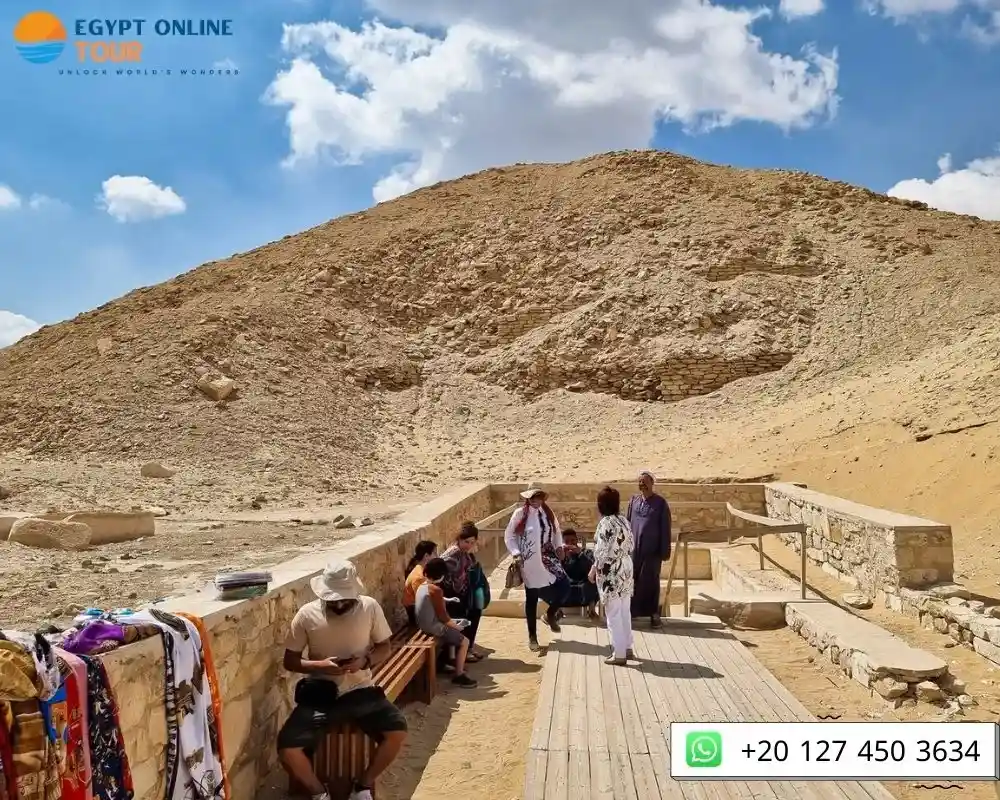
Pyramid of Teti Compared to Other Saqqara Pyramids
The Pyramid of Teti stands out in Saqqara because it combines full interior access, complete Pyramid Texts, and strong religious symbolism within a smaller structure.
Although the Step Pyramid of Djoser dominates in scale, Teti’s monument preserves deeper funerary writing and clearer insight into Old Kingdom belief.
It also continues the textual tradition first seen in the Pyramid of Unas while remaining easier for visitors to explore.
Saqqara Pyramid Comparison
This comparison helps travelers decide quickly.
Choose Teti for interior texts and access.
Choose Djoser for scale and early architecture.
Why Visit the Pyramid of Teti with Egypt Online Tour
Egypt Online Tour gives you expert guidance, smooth transport, and clear historical insight during your visit to the Pyramid of Teti.
- Expert guides: Licensed Egyptologists explain the Pyramid Texts in simple words
- Comfortable travel: Private air-conditioned vehicles for every tour
- Flexible timing: Extra time inside chambers and nearby mastabas
- Transparent price: Clear cost with no hidden fees
You also discover hidden tombs near Teti, including Kagemni and Mereruka.
So the visit becomes a full historical journey, not just a short stop.
Book your guided tour now and experience Saqqara with real knowledge and comfort.
Conclusion
The Pyramid of Teti Guide in Saqqara: History, Texts, Visit Tips leads you to one of Egypt’s most meaningful royal tombs. Here, the Pyramid of Teti opens real contact with ancient belief, quiet chambers, and living history. So plan your visit with Egypt Online Tour for clear insight, smooth travel, and time to explore deeply. Start your journey now, because moments inside Saqqara stay with you long after the desert road ends.