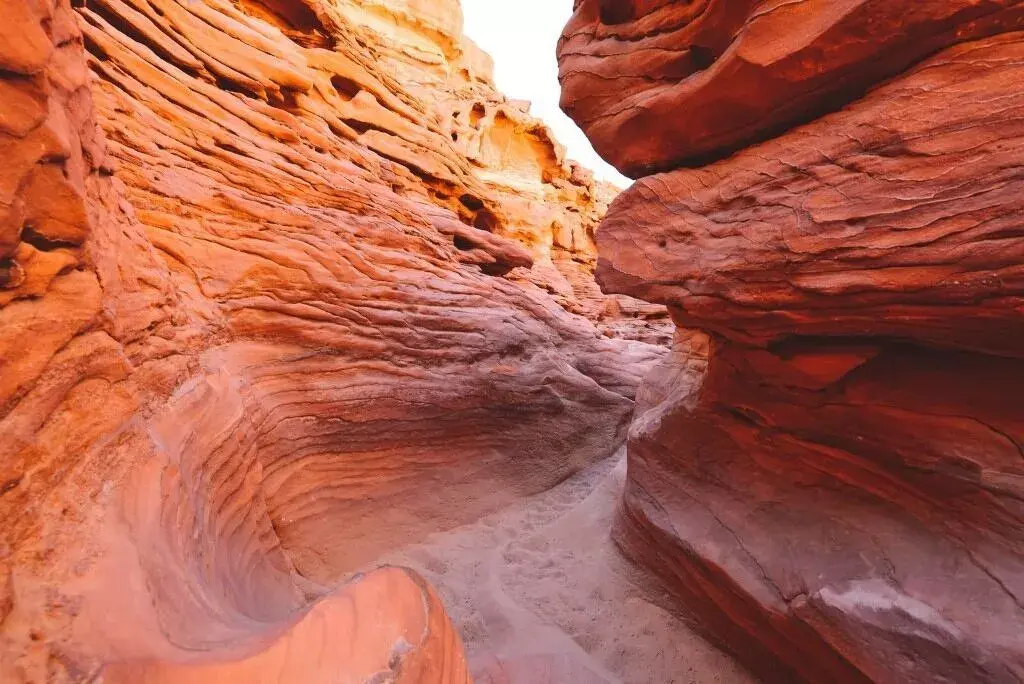
The Colored Canyon in Sinai is a narrow sandstone canyon in the mountains inland from Nuweiba, about 90 km north of Dahab, whose walls rise up to 40 metres and are banded in red, orange, yellow, purple and white. The walk through it is about 800 metres long and takes one to two hours with some easy scrambling. You can only reach it by 4x4 with a local Bedouin driver, usually on a day trip from Dahab, Nuweiba or Sharm El Sheikh.
It is one of the most photographed natural sites in Sinai, and in the narrowest parts you walk sideways between the walls with a strip of sky above. Our guides run this trip with Bedouin drivers from the area; below is what to expect, how the colours were made and how to plan the day. We last checked the practical details on 4 November 2026.
Where is the Colored Canyon?
The canyon lies in the South Sinai Governorate, in the desert mountains west of Nuweiba on the Gulf of Aqaba. The last stretch is an off-road track through sandy wadis, so ordinary cars cannot reach it.
| From | Approximate travel time |
|---|---|
| Nuweiba | About 1 hour, partly off-road |
| Dahab | About 1.5 to 2 hours |
| Sharm El Sheikh | About 3 to 3.5 hours each way |
| St Catherine | About 1.5 to 2 hours |
From Sharm El Sheikh it is a long day, which is why many travellers visit from Dahab or Nuweiba, or combine it with St Catherine and Mount Sinai. For another geological site in South Sinai, read our guide to the seismic cracks of Ras Mamlah and Ras Abu Galum.
How the Colored Canyon was formed
Rock and water
The canyon is cut into layers of sandstone laid down over millions of years. As the land of Sinai rose with the opening of the Red Sea rift, rare but violent flash floods poured off the mountains and cut down through the soft layers along cracks in the rock. Each flood carried sand and stones that scoured the walls, widening some sections into chambers and leaving others as tight slots less than a metre wide. Wind finished the work, polishing the surfaces into the smooth curves you see today.
Why the walls are colored
The colours come from minerals in the sandstone. Geologists explain them mainly by iron and manganese oxides deposited by water moving through the rock:
- Red, orange and brown: iron oxides such as hematite.
- Yellow and ochre: hydrated iron oxides.
- Purple, grey and black: manganese.
- White and cream: clean quartz sand with little iron.
Because each layer had a slightly different mineral content, the bands follow the layers of the rock and swirl where the flows of water were uneven.
Hiking the Colored Canyon
Length and difficulty
- Length: about 800 metres through the canyon, plus a short walk in and a climb back out to the vehicles.
- Time: one to two hours, depending on the group and photo stops.
- Difficulty: easy to moderate. There are some boulders to climb down, narrow squeezes and a few spots where the guide helps you with a hand or a rope.
- Who can do it: most reasonably fit adults and children from about 8 years. It is not suitable for people with limited mobility, serious back or knee problems, or for anyone uncomfortable in tight spaces.
Safety
- Always go with a local guide. The wadis around the canyon look alike, phone signal is patchy and there are no facilities.
- Flash floods: rain is rare, but storms over the mountains in autumn and winter can send water through the canyon within minutes. Guides cancel the trip when rain is forecast; accept their decision.
- Heat: the narrow walls trap the heat in summer. Start early and carry at least 1.5 litres of water per person.
Best time to visit
October to April is the best season, with daytime temperatures that make walking comfortable. From June to September go only at first light. The light inside the canyon is best around midday, when the sun reaches down between the walls and the colours glow; early morning and late afternoon give softer shadows. Most day trips arrive between 9:00 and 11:00.
What to bring
- Closed shoes with good grip; sandals are not suitable for the scrambles.
- Water, sun hat, sunscreen and sunglasses.
- A small backpack, so that your hands are free.
- A light jacket in winter: mornings in the Sinai mountains are cold.
- A phone or camera with a wide-angle setting; tripods are awkward in the narrow parts.
- Cash for drinks at the Bedouin rest stop.
How to visit: tour options
Day trip from Dahab or Nuweiba
The simplest option: a 4x4 with a Bedouin driver and guide, the hike, and often tea or lunch at a Bedouin camp. Half a day from Nuweiba, most of a day from Dahab.
Day trip from Sharm El Sheikh
A long but popular day: road transfer to the mountains, the change to a 4x4, the hike, and lunch, often combined with a swim or snorkel in Dahab on the way back.
Combined with St Catherine
Travellers who stay overnight in St Catherine can combine the canyon with the monastery and the night climb of Mount Sinai. This is the most rewarding way to see the area without long return drives.
A typical day from Sharm El Sheikh
- About 7:00: pick-up from your hotel and the drive north past Dahab, with a passport check on the way.
- About 10:00: change to a 4x4 with a Bedouin driver for the last stretch through the wadis.
- 10:30 to 12:30: the walk through the canyon, with photo stops and help on the scrambles.
- Lunch at a Bedouin camp or in Nuweiba, then a swim or snorkel stop in Dahab on the way back if time allows.
- About 18:00: back at your hotel.
Private or group trip?
| Private trip | Group trip | |
|---|---|---|
| Price | Higher, the vehicle and guide are yours | Lower, costs are shared |
| Timing | You choose the start, so you can arrive before the groups | Fixed schedule, usually mid-morning |
| Pace | Your own, with time for photos | The group's pace, less time in the narrow sections |
| Best for | Families, photographers, slower walkers | Solo travellers and budget trips |
Entry fees and permits
There is no national park ticket for the canyon. You pay for the 4x4, the driver and the guide, which are run by the local Bedouin; a small local fee is sometimes collected at the entrance and is normally included in organised trips. Passport checks on the roads of South Sinai are routine, so carry your passport.
Photography tips for the Colored Canyon
The canyon is a photographer's favourite, but its narrow walls make the light tricky. What works best, from our guides' experience:
- Light: around midday the sun reaches the floor of the slots and the walls glow; in the morning and late afternoon the light bounces off the upper walls and gives softer, warmer colours with deep shadows.
- Look up: some of the best images are taken from the floor looking up the walls to the strip of sky.
- Use a wide angle: a phone's wide or ultra-wide setting shows the shape of the slots better than a normal lens.
- Add scale: a person in the frame shows how high the walls are.
- Bright and dark together: the contrast between sunlit and shaded walls is strong; use your phone's HDR setting or take several exposures.
- Leave the tripod: it slows the group in the narrow parts. Protect your camera from sand when you put it down.
Is the Colored Canyon worth visiting?
Yes, if you like walking and landscapes and you are staying in Dahab, Nuweiba or St Catherine, where it is a half-day trip. From Sharm El Sheikh it is a long day with more time in the car than in the canyon, so it is worth it mainly if you combine it with Dahab or if desert scenery matters more to you than another day at sea. It is not the right trip for people with limited mobility or a fear of tight spaces; for them a jeep safari or a camel ride in the desert around Sharm or Dahab is a better choice.
Bedouin guides and the desert around the canyon
The mountains between Nuweiba and St Catherine are home to Bedouin tribes who have crossed these wadis with camels for centuries. Visiting with them supports the local community and makes the day richer: drivers point out acacia trees, desert plants used for tea and medicine, and the tracks of foxes and ibex. Sinai's wildlife is shy and mostly active at night, so do not expect to see much beyond birds and lizards.
Please do not carve names, take rock samples or leave rubbish; the soft sandstone marks easily and the canyon has no cleaning service.
More to see near the Colored Canyon
- Wadi El Weshwash, a canyon with a natural pool near Nuweiba. See our guide to Wadi El Weshwash.
- Nuweiba and its beaches on the Gulf of Aqaba. Read things to do in Nuweiba.
- Dahab, for snorkeling and a relaxed base. Our article on how to spend a week in Dahab gives ideas.
- Other hikes in Sinai and beyond in our list of the best hiking trails in Egypt.
For the whole peninsula, see our guide to things to do in the Sinai Peninsula.
Plan it with us
Our Colored Canyon tour from Sharm El Sheikh includes the 4x4, a Bedouin guide and lunch. If you want to add the monastery and the mountain, the Colored Canyon and St Catherine jeep tour combines both.
Colored Canyon: quick answers
How did the Colored Canyon get its name?
From the bands of colour in its sandstone walls: red, orange and brown from iron oxides, yellow from hydrated iron oxides, purple and grey from manganese, and white where the quartz sand holds little iron.
How far is the Colored Canyon from Sharm El Sheikh?
About 3 to 3.5 hours each way by road and 4x4, so it is a full day. From Nuweiba it is about 1 hour and from Dahab about 1.5 to 2 hours.
How long is the hike?
The walk through the canyon is about 800 metres and takes one to two hours with photo stops and some easy scrambling.
Can children hike the Colored Canyon?
Yes, for most children who walk well. The hike is easy to moderate, with a few boulders and narrow squeezes where the guide helps. Avoid the midday heat in summer and bring water and closed shoes.
Ahmed Samir writes and updates the Egypt travel guides of Egypt Online Tour, a licensed tour company based in Cairo (ETAA licence 1466). Our travel advisors review each guide before it is published.
All guides by Ahmed Samir