Prince Mohamed Ali Palace, better known as the Manial Palace, is a royal residence and museum on Roda Island in Cairo, built between 1900 and 1929 for Prince Mohamed Ali Tewfik, uncle of King Farouk. It is open daily from 9:00 to 17:00 (ticket window closes at 16:00), and a ticket for a foreign adult costs EGP 220 (EGP 110 for students). Inside you find a reception palace, a mosque, a clock tower, the prince's residence, a throne hall, his private museum, a hunting museum and large gardens of rare trees.
The Manial Palace is one of the most rewarding and least crowded visits in Cairo. Our guides like it for the quality of its decoration, tiles, painted ceilings, carved wood and stained glass, and for the quiet garden, a rare green space in the city. We checked the prices and hours on the Ministry of Tourism and Antiquities site on 5 November 2026.
Tickets and opening hours
| Visitor | Adult | Student |
|---|---|---|
| Foreign visitor | EGP 220 | EGP 110 |
| Egyptian citizen | EGP 60 | EGP 20 |
| Children under 6 | Free | |
- Hours: daily 9:00 to 17:00; the ticket window closes at 16:00.
- Ramadan hours: 9:00 to 15:00; the ticket window closes at 14:00.
- Payment: many Egyptian ticket windows now take cards only, so carry a Visa or Mastercard and a little cash in case.
- Photography: phone photos are allowed; a professional camera or tripod may need a separate permit, so ask at the gate.
Older guides and some websites still show EGP 100 for foreigners; that is an outdated price.
Who was Prince Mohamed Ali Tewfik?
Prince Mohamed Ali Tewfik (1875 to 1955) was the second son of Khedive Tewfik and the younger brother of Khedive Abbas Hilmi II. Educated in Europe, he travelled widely and collected art, manuscripts, carpets and plants. He was heir presumptive to the throne for years and acted as regent in 1936 and 1937 until King Farouk came of age. After the 1952 revolution the palace became state property, and it opened as a museum, as the prince had wished, with his collections in place. King Farouk had palaces of his own in Cairo and Alexandria, described in our guide to King Farouk's palaces, from Montaza to Cairo.
He designed much of the palace himself, choosing its decoration from the art of the whole Islamic world: Mamluk Cairo, Ottoman Istanbul, Persia, Syria, Morocco and Andalusia. The result is a palace unlike the European-style residences of the same period, such as Abdeen Palace.
What to see inside the Manial Palace
The complex is a group of separate buildings set in a walled garden. Follow this order, which is the one our guides use:
Entrance, reception palace and clock tower
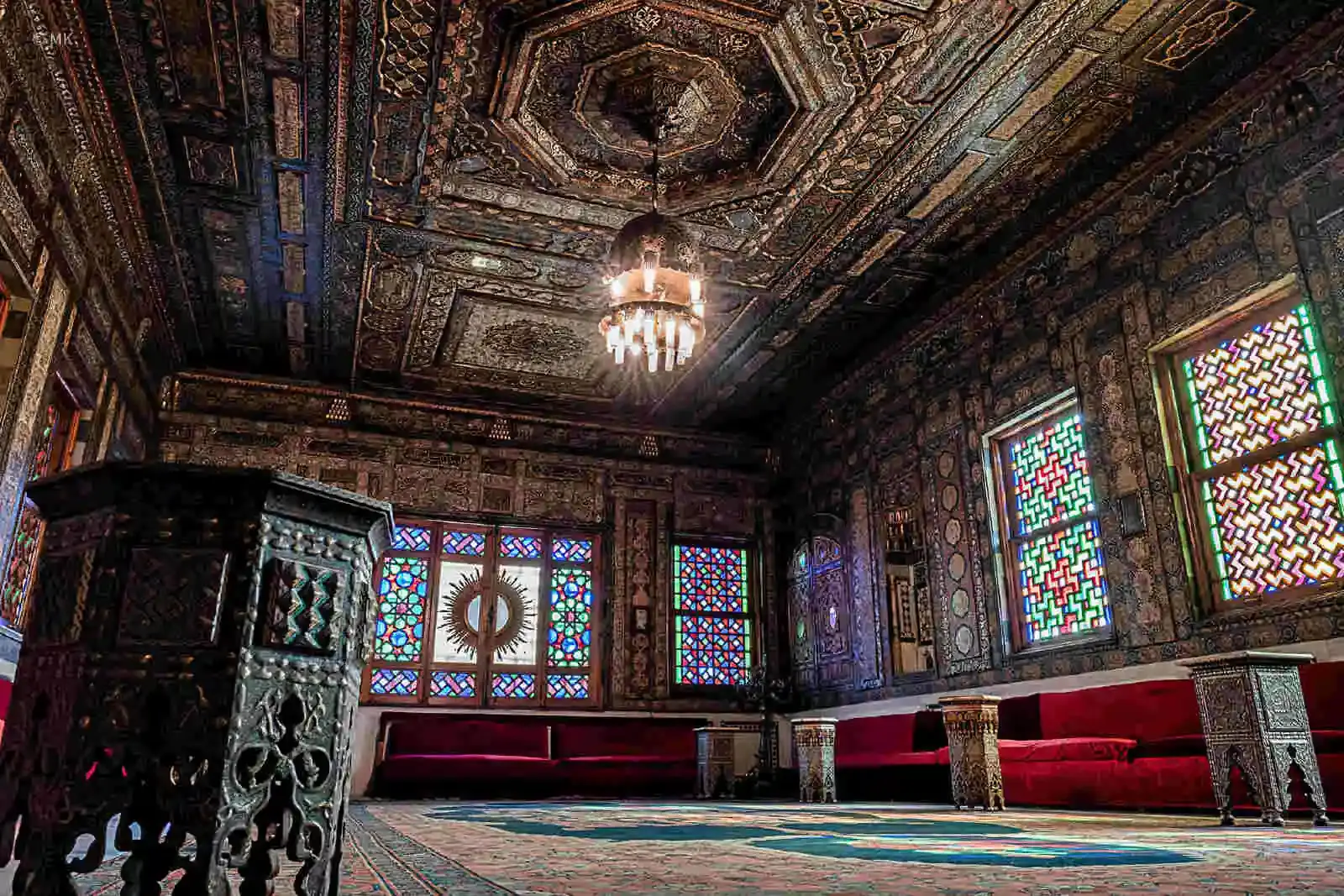
Behind the gate in the outer wall, the reception palace was where the prince received official guests. Its two floors have painted ceilings, Turkish tiles, crystal chandeliers and a Syrian room panelled in carved and painted wood. Beside it rises the clock tower, built in the style of a Moroccan or Andalusian minaret.
The mosque and the sabil
A small mosque with blue tiles and a richly painted ceiling, and a sabil (public water fountain) built as an act of charity. Visitors may enter the mosque quietly; women should cover their hair.
The residence palace
The heart of the visit. The prince lived here, and the rooms keep their furniture: salons in different regional styles, the dining room, the prince's bedroom, and corridors of tiles and stained glass. Look up: almost every ceiling is different.
The throne hall
A long ceremonial hall with a gilded ceiling, the throne, and portraits of the Mohamed Ali dynasty, from Mohamed Ali Pasha to King Farouk. It is the place to understand who is who in Egypt's last royal family.
The golden hall
A reception room covered in gilded decoration, one of the most photographed rooms in the palace.
The private museum
The prince's own collection: Qurans and illuminated manuscripts, carpets, textiles, ceramics, glass, silver and costumes. It reflects his interest in preserving Islamic art at a time when much of it was leaving Egypt.
The hunting museum
Added in 1963 along a long corridor by the northern wall, after the palace became public property. It displays about 1,180 mounted animals, birds and butterflies from the hunting collections of King Farouk, Prince Mohamed Ali and Prince Youssef Kamal, with horns, hunting tools and paintings. It also holds the skeletons of a camel and a horse that once carried the Kaaba cover in the Mahmal procession from Cairo to Mecca. Not for everyone, but popular with children.
The gardens
The garden covers about 34,000 square metres of an estate of some 61,700, and mixes the plan of a Persian garden with an English landscape park. The prince collected trees and plants from around the world: giant Indian fig (banyan) trees with aerial roots, royal palms with pale trunks, other rare palms, bamboo, ficus and a collection of cacti. Paths and small fountains link the buildings. In 1964 a hotel of wooden chalets was built in the grounds; in 1991 the government returned the gardens to the museum and the chalets were removed. Today the garden is shaded and quiet. The Ministry's museum page notes that the garden is not part of the visit route, so you see it mainly from the paths between the buildings; ask at the gate which areas are open.
Architecture and decorative arts
The Ministry describes the palace's style as modern Islamic, combining Persian, Mamluk, Syrian, Moroccan, Andalusian and Ottoman elements. In practice that means every building has a different character, and the details reward slow looking:
- Tilework: walls and fountains are faced with glazed tiles in the Ottoman manner, with blue and turquoise floral patterns; the mosque and the residence have the finest panels.
- Painted and gilded ceilings: wooden ceilings carved in geometric stars and painted or gilded, each room with its own design.
- Mashrabiya: turned wooden screens on windows and balconies, which let air and light in while keeping the rooms private, a feature of old Cairene houses.
- Stucco and stained glass: carved plaster window grilles filled with coloured glass throw patterns of light across the floors in the morning.
- Calligraphy: Quranic verses and poetry run along walls and doorways in carved and painted bands.
The palace closed for restoration in 2005 and reopened in 2015 after ten years of work, which put back the collapsed historic ceiling of the throne hall and added a textile display space and a restoration workshop. The prince mixed these traditions on purpose: at a time when wealthy Egyptians built in French or Italian styles, he wanted a palace that showed the value of Islamic art, and he planned it to become a museum after his death.
Best photography spots
- The clock tower framed by palms from the entrance garden.
- The tiled facade and fountain of the residence palace.
- The long perspective of the throne hall with its portraits.
- The banyan trees with their hanging roots in the garden.
- Stained-glass windows in the residence in the early morning light.
Use natural light; flash is not appropriate on the old textiles and paintings.
How long to spend and the best time to go
- Time needed: one and a half to two hours for all the buildings and the garden; allow longer if you love decorative arts or photography.
- Best time of day: just after 9:00, when the rooms are empty and the light through the stained glass is soft. School groups tend to arrive later in the morning.
- Best season: any time; the buildings are cool and the garden is shaded, which makes it a good choice for a hot afternoon too.
How to get to the Manial Palace
The palace is on Al Saray Street at the northern end of Roda Island (the Manial district), between Garden City and Giza.
- Taxi or ride-hailing: the easiest way; about 10 to 15 minutes from downtown or Garden City, 20 to 30 minutes from Zamalek depending on traffic.
- Metro: Sayeda Zeinab station on Line 1 is about a 20-minute walk across the Nile bridge.
- On foot: from the Garden City hotels you can walk across the bridge in about 15 to 20 minutes.
Combine the palace with nearby sights
Roda Island is easy to pair with other places on the south side of central Cairo:
- The Nilometer and the Manasterly Palace at the southern tip of Roda, about ten minutes by car. See our article on the Manasterly Palace.
- Old (Coptic) Cairo with the Hanging Church and the Ben Ezra Synagogue, 15 minutes south.
- The National Museum of Egyptian Civilization in Fustat, with the royal mummies.
- The Citadel and Islamic Cairo for the afternoon. Our guide to the Museum of Islamic Art is a natural follow-up for anyone who enjoys the prince's collection.
For other palaces and museums, see our list of museums to visit in Cairo.
Is the Manial Palace worth visiting?
Yes, if you have more than two days in Cairo or have already seen the pyramids and the big museums. It is the best place in the city to see Islamic decorative arts in a lived-in setting, it is rarely crowded, and the garden makes it a restful stop between busier sites. Travellers with only one day in Cairo should keep it for a next visit; those interested in architecture, interiors or the last royal family should not miss it. It also pairs well with the Museum of Islamic Art: one shows the objects, the other shows how a prince lived with them.
Visitor tips
- Wear comfortable shoes; the visit means walking between buildings and up and down stairs.
- Dress modestly, with shoulders and knees covered, because of the mosque.
- There are toilets on site but little food; bring water.
- Some rooms are roped off and seen from the doorway; a guide helps you understand what you are looking at, as labels are short.
Plan it with us
We add the Manial Palace to a private Cairo day with an Egyptologist guide and a driver. Our Old Cairo tour passes close by, and our Cairo day tours can be adapted to include the palace.
Manial Palace: quick answers
How much is the Manial Palace ticket?
EGP 220 for a foreign adult and EGP 110 for a foreign student, according to the Ministry of Tourism and Antiquities site on 4 November 2026. Children under 6 are free.
What are the Manial Palace opening hours?
Daily from 9:00 to 17:00, with the ticket window closing at 16:00. In Ramadan, 9:00 to 15:00.
How long do you need at the Manial Palace?
About one and a half to two hours for the buildings and the garden.
Who built the Manial Palace?
Prince Mohamed Ali Tewfik, brother of Khedive Abbas Hilmi II, between 1900 and 1929.
Ahmed Samir writes and updates the Egypt travel guides of Egypt Online Tour, a licensed tour company based in Cairo (ETAA licence 1466). Our travel advisors review each guide before it is published.
All guides by Ahmed Samir