Standard
Standard hotelsComfortable, well located
$1,315per person
- Cairo 2 nightsBarceló Cairo Pyramids or Jaz Pyramid Cairo, or similar

3 days, 2 nights based in Cairo: the Egyptian Museum and the Pyramids of Giza, then a day trip by air to Luxor for Karnak, Luxor Temple, the Valley of the Kings and Hatshepsut's temple. Includes a hotel with breakfast, both flights, private guided tours and entrance fees.
This three-day trip is built for travelers who only have a long weekend or a stopover but want to see both of Egypt's great ancient capitals. On the day you arrive, your guide takes you to the Egyptian Museum and the Pyramids of Giza. On the second day you fly to Luxor early in the morning, see Karnak and Luxor Temple on the East Bank and the Valley of the Kings, the temple of Hatshepsut and the Colossi of Memnon on the West Bank, and fly back to Cairo in the evening. On the third day you fly home.
The guide and vehicle are private, the domestic flights from Cairo to Luxor and back are included, and you stay two nights in the same Cairo hotel, so you travel to Luxor with only a day bag. A local lunch and bottled water are included on the Cairo day, and a local SIM card keeps you connected.
It is a weaker fit if you want time to rest: Day 1 begins soon after you land, and Day 2 lasts from before dawn to the evening. With one or two more days, the 5-day Cairo and Alexandria tour or a Nile cruise gives a gentler pace; see our Egypt budget tours for other short trips.
It also does not suit travelers with limited mobility who would find two long days tiring, or families with small children who need a midday rest. The Valley of the Kings involves walking down sloping corridors and steps into the tombs, and Karnak is a large site covered on foot. If that describes your group, a version with a night in Luxor, or a Nile cruise between Luxor and Aswan, spreads the same sites over more days.
The pace is fast. Plan your international flight to land in the morning of Day 1, ideally before about 10 am, so that the museum and Giza fit comfortably into the afternoon.
The upside of this plan is that you never change hotel: you leave your luggage in Cairo, travel to Luxor with a day bag and sleep in the same room both nights.
Ancient Thebes, today's Luxor, sits on both banks of the Nile. The temples of the living, Karnak and Luxor Temple, are on the East Bank, in and around the modern town; the tombs and mortuary temples are on the West Bank, under the Theban hills. Your Luxor guide and driver plan the order around the heat and your flight times: usually the West Bank first, while it is cool, then lunch, then Karnak and Luxor Temple in the afternoon. The crossing between the banks is by road over the Luxor bridge, about 20 to 30 minutes from the East Bank to the Valley of the Kings. Flight schedules on the Cairo to Luxor route change by season and day of the week, so we confirm the exact times when you book, and the order of visits may change with them.
Memphis, near Cairo, was the capital of the Old Kingdom, when the pyramids were built around 2600 to 2500 BC. Thebes, today's Luxor, became the religious capital of the New Kingdom a thousand years later, when the kings were buried in rock-cut tombs instead of pyramids and spent their wealth on the temples of Amun. Seeing Giza and Luxor on consecutive days shows you both high points of ancient Egypt, and the Egyptian Museum on Day 1 connects them, with objects from both periods under one roof.
Our representative meets you in the arrival hall of Cairo International Airport, helps with the visa and arrival formalities and drives you to your hotel in Cairo or Giza in a private air-conditioned vehicle, 30 to 60 minutes depending on traffic. You receive your local SIM card on the way. After check-in, or a short rest in the lobby if the room is not ready, your guide collects you, usually around midday.
The Egyptian Museum on Tahrir Square, opened in 1902, still holds tens of thousands of objects from 5,000 years of history: the Narmer Palette, which records the unification of Egypt, Old Kingdom statues, painted coffins, jewellery and papyri. Tutankhamun's treasures have moved to the Grand Egyptian Museum and the royal mummies to the National Museum of Egyptian Civilization, so your guide picks a route through the highlights that remain. Among them are the seated statue of Khafre, builder of the second pyramid at Giza, the painted statues of Rahotep and Nofret, the rooms of Akhenaten's Amarna period and the gold of the royal tombs of Tanis. The visit takes about 90 minutes, and it gives you the background for both Giza this afternoon and Luxor tomorrow.
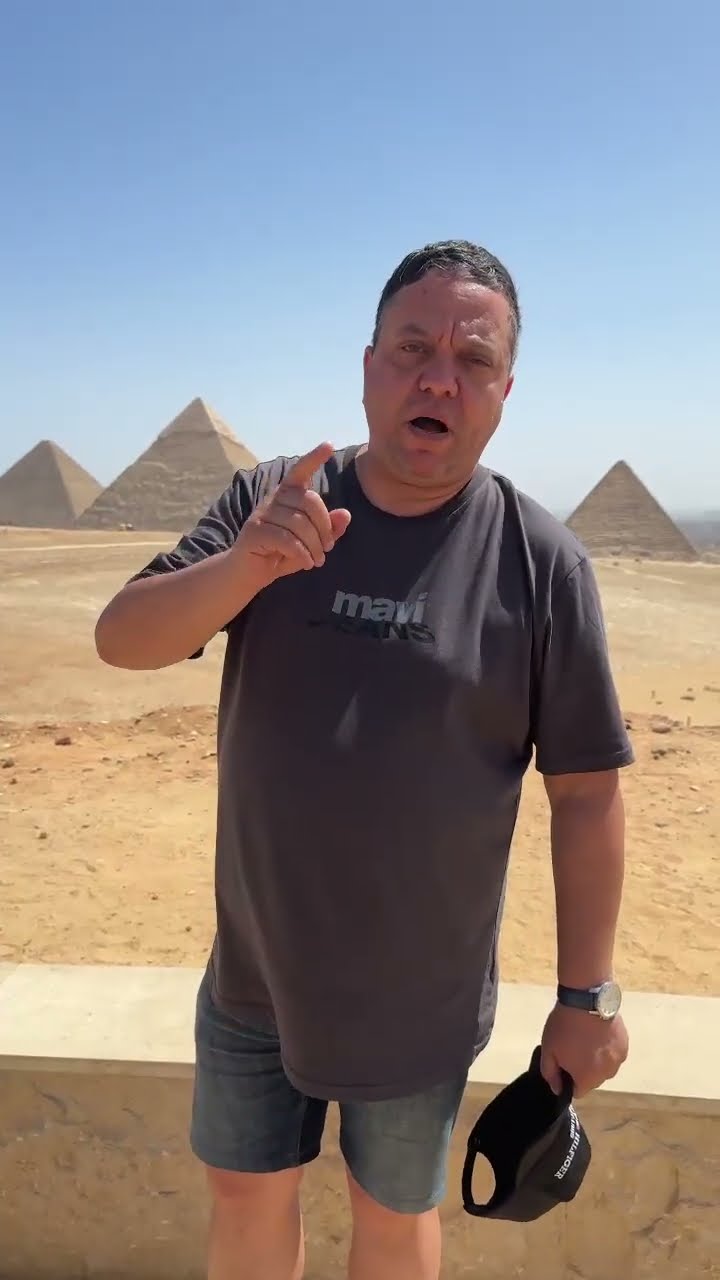
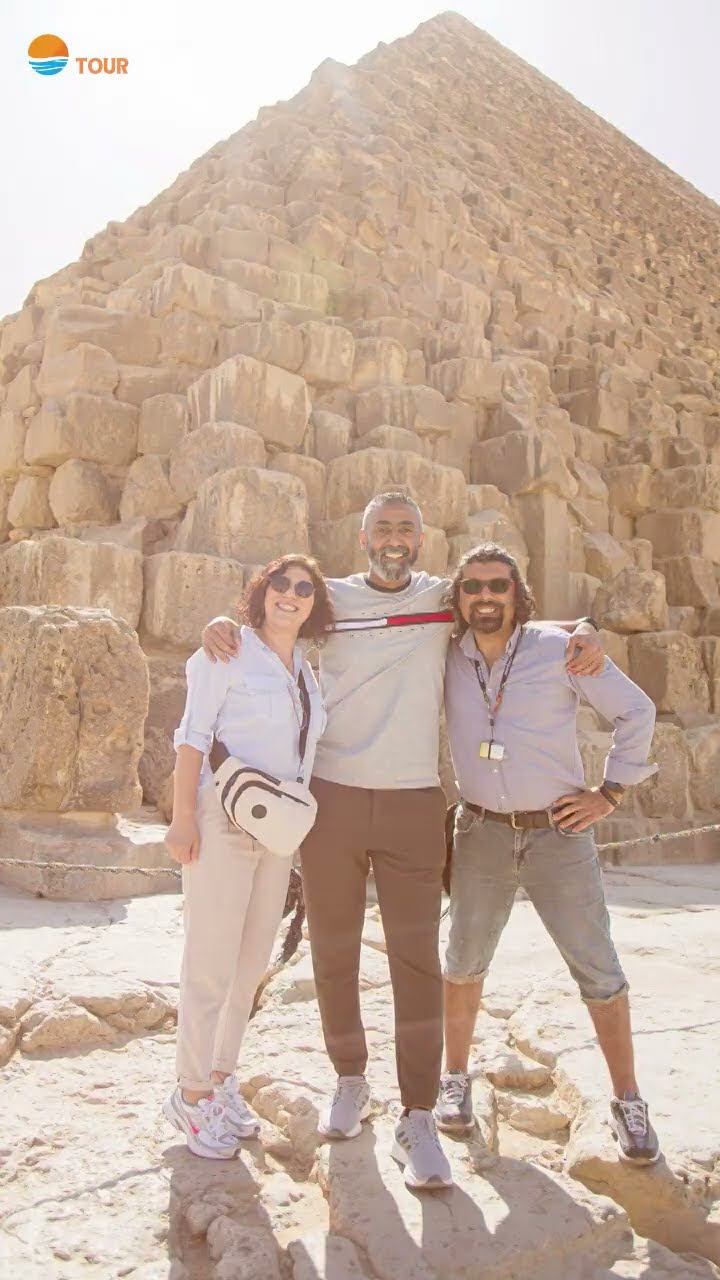
After a local lunch you drive to Giza, about 45 minutes to an hour from Tahrir. The Great Pyramid of Khufu, built about 4,500 years ago, is the only one of the Seven Wonders of the Ancient World still standing; your guide explains how it was built and how the plateau worked as a royal cemetery. From the panoramic viewpoint you see the three pyramids of Khufu, Khafre and Menkaure in one line. Below them lie the Great Sphinx, carved from the bedrock, and the Valley Temple of Khafre, built of huge granite blocks, where the king's funeral rites began. Going inside the Great Pyramid needs a separate ticket bought at the site. The plateau closes in the late afternoon, and the light then is good for photographs.
You return to your hotel in the early evening. Dinner is not included. A Nile dinner cruise or the Sound and Light show at the pyramids are optional extras, but keep the night short: Day 2 starts very early, and the hotel can prepare a breakfast box if you ask at reception tonight. Overnight in Cairo.
A driver takes you to Cairo airport before dawn for the flight to Luxor, about one hour. Bring your passport and a light layer, as the early morning and the aircraft cabin can be cool. Your Luxor guide meets you on arrival, and the drive from Luxor airport to the West Bank takes about 30 to 40 minutes.
You cross the Nile while it is still cool. The Valley of the Kings holds more than 60 tombs cut for the pharaohs of the New Kingdom, from around 1500 to 1070 BC; the standard ticket opens three tombs among those open on the day, with painted corridors showing the king's journey through the underworld. The tombs open in rotation to protect the paintings, so your guide chooses the three best open on your day. The tombs of Tutankhamun, Seti I and Ramses VI need a separate ticket bought at the site. A small electric train carries you from the visitor centre to the entrance of the valley, and inside the tombs you walk down sloping corridors and some steps.
At Deir el-Bahari the temple of Queen Hatshepsut rises in three terraces against the cliffs. She ruled as pharaoh for about two decades in the 15th century BC, and the reliefs on the middle terrace record her trading expedition to the land of Punt, with ships, incense trees and exotic animals. On the way back you stop at the Colossi of Memnon, two statues of Amenhotep III about 18 metres tall, which once stood at the gate of his mortuary temple, now almost entirely gone.
Lunch is at a local restaurant, usually on the West Bank or near the bridge, before you cross back to the East Bank. It is also the hottest part of the day, a good time to be indoors. Lunch on this day is not listed among the inclusions, so it is paid locally unless your booking says otherwise. Local dishes in Luxor are simple and filling: grilled chicken or kofta, rice, vegetable stews, salads and fresh bread, with fresh juices such as mango or sugarcane in season.
Karnak, the temple of Amun, was enlarged by pharaoh after pharaoh over some 2,000 years: you walk along the ram-headed sphinxes and into the Great Hypostyle Hall with its 134 columns, the tallest about 21 metres, and see the standing obelisks of Thutmose I and Hatshepsut and the sacred lake. Allow about two hours. Luxor Temple, in the centre of town, was built mainly by Amenhotep III and Ramses II for the Opet festival, when the image of Amun was carried here from Karnak along the Avenue of Sphinxes. One of its two obelisks still stands at the entrance; the other has been in the Place de la Concorde in Paris since 1836. It is especially good in the late afternoon light, and its floodlights come on at dusk.
You transfer to Luxor airport, about 20 minutes from the town centre, for the evening flight to Cairo. Our driver meets you at Cairo airport and takes you back to your hotel, where you arrive late in the evening. Dinner is not included; a light meal at the airport or at the hotel is the easiest choice. Overnight in Cairo.
After breakfast at your hotel, your driver takes you to Cairo International Airport in time for your flight; airlines usually ask you to be there three hours before departure. This is the end of the tour.
If you have more time, ask us about extending with the Grand Egyptian Museum or a Nile cruise; see the 6-day Cairo and Nile cruise package.
After the late return from Luxor, a slow morning helps. Hotel check-out is usually at noon; if your flight is in the evening, the hotel can keep your bags, and a late check-out can be requested at extra cost, depending on availability. With a free afternoon, the Grand Egyptian Museum near Giza, Khan el-Khalili or the Citadel can be added as optional extras with a guide, so you leave having seen Tutankhamun's treasures too. The drive to the airport takes 30 to 60 minutes, more at rush hour, and we time the pick-up with a margin.
Comfortable, well located
More space and better ships
Our highest level
Children pay less, see the children policy below. Christmas, New Year and Easter dates add 25%. Prices are per person in US dollars.
October to April is the most comfortable time for a short trip like this: Cairo is around 18 to 25 °C and Luxor 22 to 28 °C by day. From May to September, Luxor often passes 40 °C by midday, so the West Bank visits are done first and Karnak later in the afternoon. Christmas, New Year and Easter are the busiest weeks for flights.
The Cairo to Luxor flights are short domestic flights, and you need your passport to check in and pass security at both airports. Because you return to the same Cairo hotel, leave your main luggage there and travel with hand luggage only; liquids, sharp objects and power banks follow the usual airline security rules. Our driver brings you to Cairo airport with time to check in, and your Luxor guide meets you in the arrival hall.
Phones and cameras without flash are allowed at Giza, Karnak, Luxor Temple and Hatshepsut's temple. In the Valley of the Kings photography rules can change, and some sites charge for cameras; your guide tells you on the day. Drones need a permit in Egypt and should not be brought without one.
Many nationalities can buy a tourist visa on arrival at Cairo airport or apply for an e-visa on visa2egypt.gov.eg. Rules and fees depend on your passport. Your passport should be valid for at least six months from arrival and is needed for the domestic flights. The visa is not included in the price.
The currency is the Egyptian pound. Cards are accepted in hotels and larger shops, but keep small notes for toilets at the sites, drinks and small purchases, and for the extra tickets in the Valley of the Kings if you want them. Tips are not included; the tipping guide in the travel policies below gives the usual amounts for guides and drivers, and note that you have separate guides and drivers in Cairo and in Luxor.
A local lunch is included on the Cairo day. In Luxor your guide stops for lunch at a local restaurant between the two banks, and breakfast is at your Cairo hotel; on Day 2 the hotel can usually prepare a breakfast box for the early departure. Drink bottled water, carry some with you all day in Luxor, and tell us about allergies or diets in advance.
All prices are per person in US dollars. The price changes with the season (winter 1 October to 30 April, summer 1 May to 30 September), the accommodation level and the size of the group. Christmas, New Year and Easter dates add 25%. Your quote lists the final price and everything it covers. After the deposit, changes to your itinerary cost US$25 per request, plus any third-party fees.
A deposit of 30% of the total tour cost confirms your booking. We send you a secure payment link for the deposit; the balance is paid in cash or by card on arrival in Egypt, unless your written offer gives another date. We never ask for card details by email, chat or WhatsApp. We confirm every booking by email.
No-show travelers are charged 100%. During peak events in Egypt, hotels and Nile cruises do not refund deposits. Groups of more than 10 people may have different terms.
Add each child and their age in the enquiry form so the quote is exact.
Optional visits, such as a hot air balloon ride in Luxor, a Sound and Light show or a felucca ride, are not in the price. Tell us which ones you want and we add them to your quote with their cost.
Not included in the price: Egypt entry visa; Personal expenses; Optional activities, such as a Nile dinner cruise or the Sound and Light show; Tips for guides and drivers; International flights to and from Egypt; Extra tickets at the sites: inside the Great Pyramid and the tomb of Tutankhamun.
Tipping is customary in Egypt and is not included in the price. A usual amount for a private tour is US$8 to 10 per person per day for your guide, US$4 to 5 for your driver and US$5 to 8 per person per day for the crew on a Nile cruise. Your guide can advise you on the day.
Yes, the main sites. With the early flight and a private guide you see the Valley of the Kings, Hatshepsut's temple, the Colossi of Memnon, Karnak and Luxor Temple, and fly back in the evening. It is a long day; with more time, a night in Luxor or a Nile cruise is more relaxed.
Ideally in the morning of Day 1, so there is time for the museum and the pyramids. If you land later, we move the Egyptian Museum to the morning of Day 3 when your departure flight allows it.
No. Day 1 visits the Egyptian Museum on Tahrir Square. Tutankhamun's treasures are now at the Grand Egyptian Museum near Giza, which we can visit in place of the Tahrir museum on request.
Independent reviews on the platforms travelers already trust.
Amazing Egyptian vacation! We did an 11 day private tour of Cairo, cruise on the Nile between Aswan and Luxor and a 4 day stay in Hurghada. The guided tours were very interesting, with extremely knowledgeable guides, attentive and helpful.
Egypt package to the Pyramids of Giza and Saqqara was a fascinating journey through Egypt's ancient past ,guide knowledge, the majesty of the pyramids, and the historical depth of Saqqara made this tour truly enriching!
our honeymoon to Egypt ,Giza and Saqqara was a magical escape into history The pyramids looming in the distance, the quiet serenity of the desert, and the ancient wonders of Saqqara created moments that will be with me forever!
Answers to the questions travelers ask before they book.

Looking for the cheapest time to go to Egypt? Discover the best months for affordable travel, great deals, and fewer crowds. Plan your budget-friendly trip now!
Read the guide
Wondering how much does it cost to go to Egypt? Explore 7-day trips, budget, solo, and luxury options. Start planning your affordable Egyptian adventure today!
Read the guide
Follow this Egypt Budget Travel Itinerary to see Cairo, Luxor and Aswan in 7 days with affordable hotels and transport. Explore the full plan today.
Read the guideWe always use the cookies this site needs to work. With your permission we also use the optional ones listed under Settings. You can change your choice at any time. Privacy policy