
Visiting Egypt for the first time works best with 7 to 10 days. Five days is enough for Cairo and Giza with one extra stop; seven days covers Cairo, Luxor and Aswan; ten days adds a Nile cruise, Abu Simbel or a few days on the Red Sea without rushing. The most common first-trip mistake we see is not too little time but too many cities: Egypt rewards a simple route, early starts and a guide at the big sites.
Below are the routes our planners suggest for 5, 7, 10 and 14 days, then the practical side: best season, visa and money, safety, clothes, transport, food and tipping, and the mistakes to avoid.
How many days do you need in Egypt for a first visit?
| Trip length | Best for | Main route |
|---|---|---|
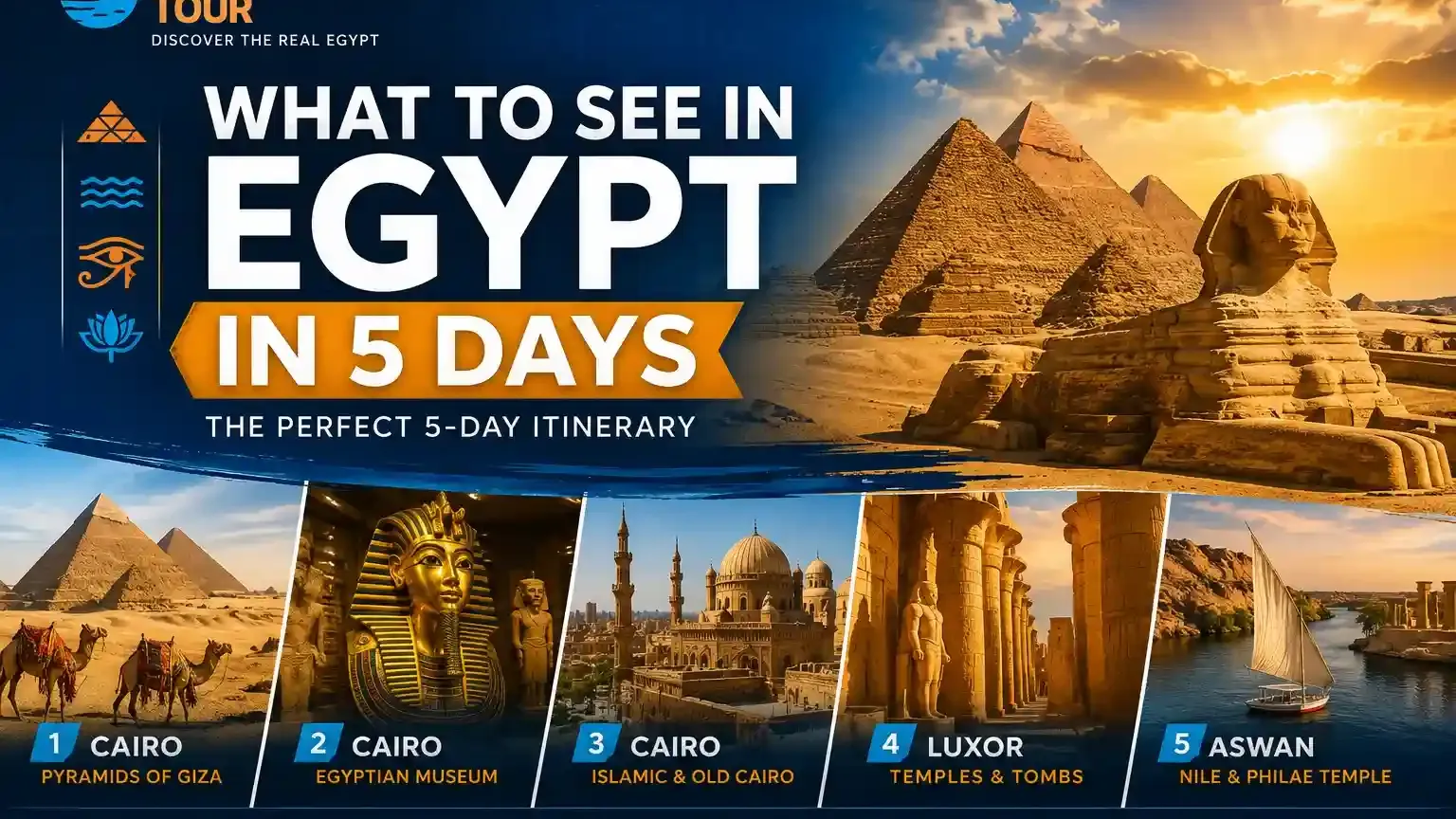
| 4 to 5 days | A short first look | Cairo and Giza, plus Saqqara or one flight to Luxor |
| 7 days | The classic first trip | Cairo and Giza, Luxor, Aswan |
| 10 days | The full first trip | Cairo, a 3 or 4-night Nile cruise, Abu Simbel, 2 to 3 days on the Red Sea |
| 14 days | A relaxed trip with extras | The 10-day route plus Alexandria, more beach time or the Western Desert |
If you have fewer than five days, stay in Cairo and Giza. Adding Luxor to a four-day trip is possible, but it means early flights and long days. If your international flight lands late at night, keep the next morning free: the Pyramids at 7am after a night flight is a poor first impression.
How many days in Cairo and Giza?
Plan two to three full days. One day for the Giza Pyramids and the Sphinx (with Saqqara if you start early), one for the Grand Egyptian Museum, and one for Old Cairo, Islamic Cairo and Khan El Khalili. Two days works if you combine the museum with the Pyramids, which are about 2 km apart.
How many days in Luxor?
Two days is the minimum: one for the West Bank (Valley of the Kings, Hatshepsut's temple, the Colossi of Memnon) and one for the East Bank (Karnak and Luxor Temple). A third day lets you add a sunrise balloon ride, the Valley of the Queens or a quieter afternoon. First-timers usually do best staying on the East Bank, where most hotels and restaurants are; the West Bank is 10 to 15 minutes away by ferry or car and is quieter, with fewer services at night. Our guide to how many days in Luxor goes into more detail.
How many days in Aswan, and is Abu Simbel worth it?
One day covers Philae Temple, the High Dam and the Unfinished Obelisk; two days adds a felucca ride, the Botanical Island and a Nubian village. Abu Simbel takes most of a day from Aswan: about three and a half hours each way by road, or a short flight. It is worth it if you have the energy; with young children or a tight schedule, it is the first stop to drop.
Is a Nile cruise worth it on a first trip?
For most first-time visitors, yes. A 3 or 4-night cruise between Luxor and Aswan is your hotel, your transport and your restaurant at once, and it stops at Edfu and Kom Ombo, two temples you would struggle to reach otherwise. Four nights is more relaxed than three. If you prefer to move faster, stay in hotels and drive between Luxor and Aswan (about three hours). See how to choose the best Nile cruise in Egypt for the differences between ships and dahabiyas.
Should you add the Red Sea or Alexandria?
Add Hurghada, Sharm El Sheikh or Marsa Alam if you have ten days or more and want to end with two or three days of rest and snorkelling. With only seven days, an extra day in Cairo or Luxor gives you more than a rushed beach stop. Alexandria is a good day trip from Cairo (about three hours each way by road or train) if you like Greco-Roman history and the Mediterranean; on a first visit, choose Aswan over Alexandria if you have to pick one, because it completes the Nile route. Our guide to one day in Alexandria shows what fits.
Best Egypt itineraries for first-time visitors
5-day itinerary
| Day | Plan |
|---|---|
| 1 | Arrive in Cairo, airport pickup, light evening |
| 2 | Giza Pyramids and Sphinx, Saqqara |
| 3 | Grand Egyptian Museum, Old Cairo or Islamic Cairo, Khan El Khalili |
| 4 | Early flight to Luxor for a full day on both banks, or a day trip to Alexandria |
| 5 | Free morning, departure |
7-day itinerary: Cairo, Luxor and Aswan
| Days | Plan |
|---|---|
| 1 to 3 | Cairo and Giza: Pyramids, Sphinx, Saqqara, the Grand Egyptian Museum, Old Cairo |
| 4 to 5 | Fly to Luxor: West Bank and East Bank |
| 6 | Drive or sail to Aswan: Philae, felucca, Nubian village |
| 7 | Abu Simbel early, or fly back to Cairo for departure |
10-day itinerary with a Nile cruise and the Red Sea
| Days | Plan |
|---|---|
| 1 to 3 | Cairo and Giza |
| 4 to 7 | Fly to Luxor, 4-night Nile cruise to Aswan (Karnak, Valley of the Kings, Edfu, Kom Ombo, Philae), optional Abu Simbel |
| 8 to 9 | Hurghada: beach, snorkelling at the Giftun islands |
| 10 | Fly to Cairo for departure |
14-day itinerary
Use the 10-day route and add: a day trip to Alexandria from Cairo, a second day in Luxor (balloon at sunrise, Valley of the Queens), Abu Simbel from Aswan, and three or four days on the Red Sea instead of two. Keep one empty day in the middle; it is the day that makes the rest work.
What to skip if you do not want to rush
- Do not put Cairo, Luxor, Aswan, Abu Simbel, Alexandria, Siwa and a beach into one week.
- Skip the Red Sea or Alexandria before you skip Luxor.
- Abu Simbel is optional when time is short.
- Avoid a 2-night cruise; 3 or 4 nights is the right length.
- Do not plan a long transfer on arrival day.
When is the best time to visit Egypt for the first time?
October to April is the easiest season for sightseeing, and November to February is the coolest in Luxor and Aswan. Egypt works all year, but each season needs a different plan.
| Period | What to expect | How to plan |
|---|---|---|
| November to February | Mild days, cool nights, peak demand | Book cruises and hotels early, pack a warm layer |
| March, April, October | Warm, good balance of weather and crowds | Start early in Upper Egypt |
| May to September | Very hot in Luxor and Aswan, lower prices | Sightsee from 6 or 7am, rest at midday |
| Ramadan | Shorter site hours, lively evenings | Check opening hours, plan evening walks |
Christmas, New Year and Easter are the busiest weeks. For a month-by-month view read the best months to visit Egypt.
What to know before you travel
Visa and entry
Most visitors need a visa. Many nationalities, including US, UK and EU citizens, can apply for an e-Visa on the official portal, visa2egypt.gov.eg, or buy a visa on arrival at the airport bank counter before passport control (USD 30 in cash, according to UK travel advice). At the time of writing the official portal lists the single-entry tourist e-Visa at US$30 and the multiple-entry visa at US$65. Your passport should be valid for at least six months from arrival. Use only the official portal: look-alike sites charge extra.
Money
Egypt uses the Egyptian pound (EGP). Cards work in hotels, larger restaurants and many ticket offices (the Grand Egyptian Museum sells tickets online only), but you will need cash every day for tips, markets, taxis and small purchases. Withdraw from bank ATMs, keep small notes, and avoid street money changers.
Internet and arrival
Buy a local SIM or eSIM at the airport (Vodafone, Orange, Etisalat and WE all have counters); you need your passport to register it. Before you leave the arrivals hall, check your driver's name, your hotel address and that your phone has data. If you booked a transfer, ignore offers of transport from people inside the terminal.
Is Egypt safe for first-time visitors?
Egypt is safe for most first-time visitors who stay on the main tourist route: Cairo and Giza, Luxor, Aswan, Abu Simbel, Alexandria and the Red Sea resorts. These places have tourist police, guides and a long-established visitor infrastructure. Check your government's travel advice before you go, avoid remote border areas and demonstrations, and use licensed companies for desert trips and diving. Our articles on whether Cairo is safe for American tourists and safety at the Giza Pyramids cover the details.
Common tourist traps
- Someone tells you a site is closed and offers to take you elsewhere. It is almost never closed.
- A "free" photo, gift or camel pose turns into a payment request.
- A camel or horse ride with no agreed price, or a price that changes on the way back.
- Unofficial "guides" at site entrances.
The rule is simple: agree the full price before you accept anything, buy tickets at official offices, and say "la, shukran" (no, thank you) politely and keep walking.
Why a guide helps on a first trip
At Giza a guide handles the camel offers and knows the best viewpoints; at the Grand Egyptian Museum they take you straight to the highlights; in Luxor they choose the tombs open on the day and keep you out of the midday heat. For a first visit, a licensed Egyptologist at the main sites saves more time than it costs.
What to wear in Egypt as a tourist
Wear light, loose, modest clothes. In Cairo, markets and the countryside cover shoulders and knees; in mosques women also cover their hair (a scarf is enough) and everyone removes their shoes. At temples you need breathable clothes, a hat and closed walking shoes for sand and uneven stone. At Red Sea resorts beachwear is normal at the pool and beach, with a cover-up for the lobby and town. Men are fine in shorts at most sites, with long trousers for mosques and churches. From December to February bring a warm layer for early mornings, cruise decks and the desert at night.
Getting around Egypt for the first time
| Route | Flight | Train or road |
|---|---|---|
| Cairo to Luxor | About 1 hour | About 9 to 10 hours by train (sleeper available) |
| Cairo to Aswan | About 1 hour 20 minutes | About 12 to 14 hours by train |
| Luxor to Aswan | Not practical | About 3 hours by road, or 3 to 4 nights by cruise |
| Cairo to Hurghada | About 1 hour | About 5 to 6 hours by road |
| Cairo to Alexandria | Not needed | About 2.5 to 3 hours by train or road |
With a week or ten days, domestic flights save the most time. The overnight sleeper train between Cairo and Luxor or Aswan is a good alternative if you like trains, since it saves a hotel night. In Cairo use ride-hailing apps for short rides and a private driver for full sightseeing days and airport transfers. Do not book tight same-day connections between a flight and a cruise departure.
Tips for the Pyramids, museums and temples
- Giza Pyramids: arrive at opening. Decide in advance whether you want to go inside a pyramid (narrow and steep; skip it if you dislike tight spaces) and agree any camel ride price, duration and route before you mount.
- Grand Egyptian Museum: tickets are sold online only, on the official site. Allow at least three hours and do not squeeze it into the end of a long day.
- Luxor: start the West Bank at 6 or 7am, the Valley of the Kings first, then Hatshepsut's temple. The standard Valley ticket includes three tombs; Tutankhamun and Seti I need extra tickets. Visit Luxor Temple at sunset or after dark, when it is lit.
- Photos: phone photos are allowed at most sites; drones need a permit and should not be brought. Never photograph police, military sites or checkpoints, and ask before photographing people.
Food, water and health
Do not drink tap water; use sealed bottled water and avoid ice where you are unsure. Eat cooked food at busy places for the first two days, and peel fruit. Carry rehydration salts in the warm months. Try koshari, ta'ameya (Egyptian falafel made with fava beans), ful medames, molokhia, mahshi, grilled kofta and om ali, and hibiscus or mint tea. Ask your guide where locals eat: it is usually better and cheaper than the tourist strips.
Tipping and local customs
Tipping (baksheesh) is part of daily life in Egypt, so carry small notes. As a rule of thumb at the time of writing, our guides suggest about EGP 5 to 10 for a restroom attendant, EGP 50 to 100 for a hotel porter, EGP 200 to 300 a day for a private driver and EGP 400 to 600 a day for an Egyptologist guide; adjust for group size and service. Cruise crews usually share a pooled tip at the end. Greet with "salam alaikum", say "shukran" for thank you, keep your voice low in mosques and churches, and do not walk in front of people who are praying.
Mistakes first-time visitors make in Egypt
- Trying to see too much. Three bases (Cairo, Luxor, Aswan) in a week is plenty.
- Booking the cheapest tour without checking what is included. Ask about entry tickets, the guide, transfers and how many people share the car.
- Visiting the big sites without a guide. You save a little money and lose the story.
- Sightseeing at midday in summer. Start early, rest, and go out again at 4pm.
- No buffer on arrival. Flights land late; keep the first morning light.
- Using unofficial visa or ticket websites. Use visa2egypt.gov.eg and the official museum and monuments ticketing sites.
Plan it with us
Most of our first-time guests choose one of our classic Egypt tours: Cairo, Luxor and Aswan with a private Egyptologist, transfers and the domestic flights or sleeper train already included in the price. If you have about a week, the 8 days Pyramids and the Nile by air joins Cairo and the Nile Valley with domestic flights, and our Egypt vacation packages add the Red Sea or Alexandria. Tell us your dates and we will shape the route around them.
Ahmed Samir writes and updates the Egypt travel guides of Egypt Online Tour, a licensed tour company based in Cairo (ETAA licence 1466). Our travel advisors review each guide before it is published.
All guides by Ahmed Samir