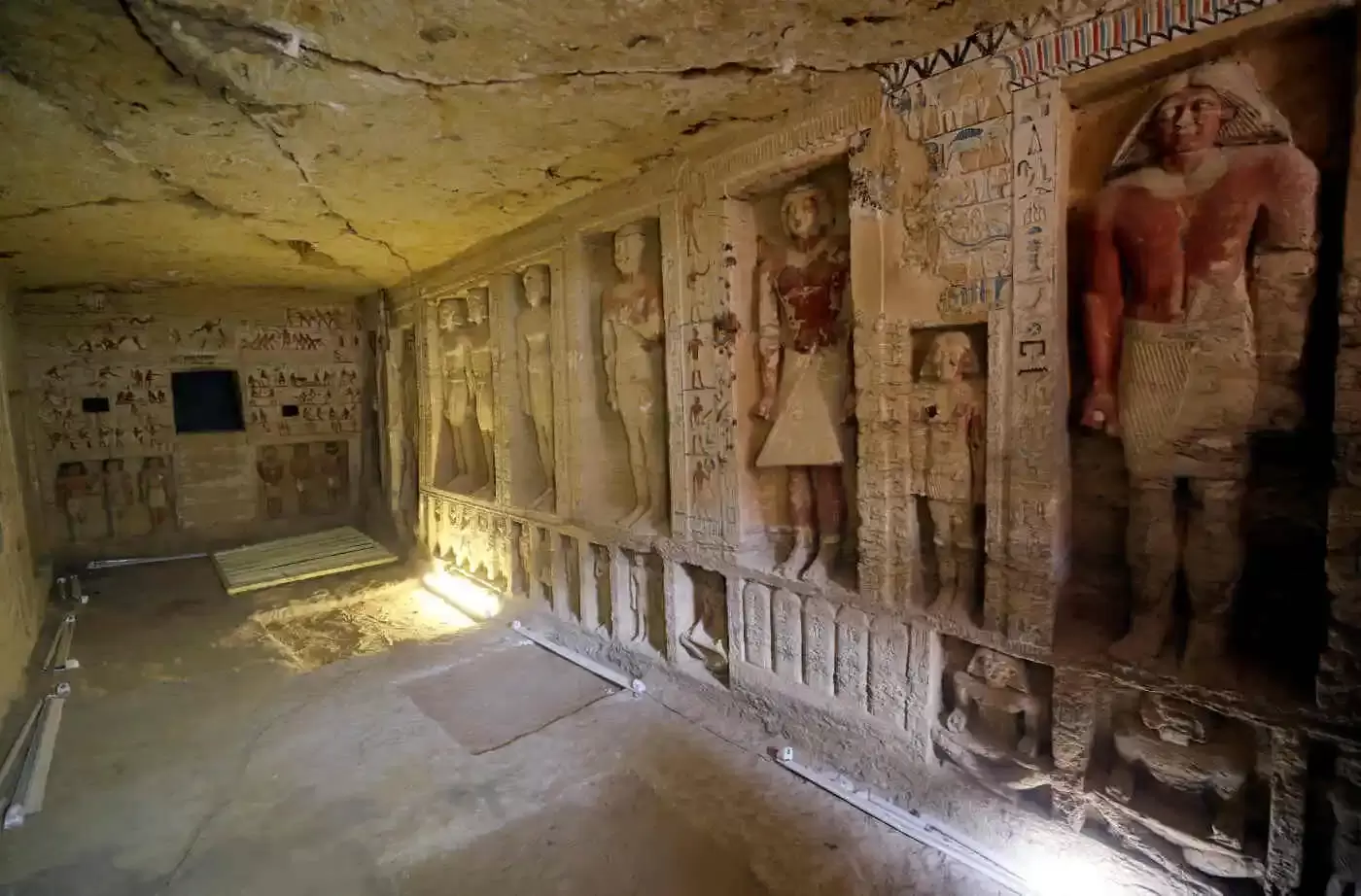
The tomb of Wahtye is the painted burial chapel of a royal priest of Egypt's 5th Dynasty, about 4,400 years old, found at Saqqara south of Cairo in 2018. Wahtye served King Neferirkare Kakai as a "royal purification priest", and his tomb was announced on 15 December 2018 as one of the best-preserved Old Kingdom tombs found in decades, with its reliefs still in their original colours. The tomb is not part of the standard Saqqara ticket: at the time of writing it is opened to visitors only by special permission, but the Ministry of Tourism and Antiquities publishes a free virtual tour of the interior.
This guide corrects some details that circulate online (including in the earlier version of this article): Wahtye served Neferirkare, not Djedkare Isesi, and his tomb is a single decorated chapel with burial shafts, not a 50-metre complex beside the Pyramid of Unas.
Who was Wahtye?
Wahtye (also written Wahty or Wahti) was a priest at the court of Neferirkare Kakai, the third king of the 5th Dynasty, son of Sahure, who reigned in the 25th century BC. The inscriptions in his tomb give him titles such as:
- Royal purification priest (a priest responsible for the ritual purity of the king)
- Royal supervisor of the sacred boat
- Inspector of the divine estate
- "Revered before the great god", a standard title of honour for the dead
The reliefs show him with his mother, his wife and other members of the family, which is what makes the tomb so personal. The 5th Dynasty was the age of the sun temples and of powerful officials, and tombs like this one show how much status a priest close to the king could reach.
What is inside the tomb
The tomb was cut into a rock ridge that had stayed buried under sand, which is why it was found untouched and unlooted. Its main room, the offering chapel, is a long rectangular hall, about 10 metres long, 3 metres wide and 3 metres high.
Painted reliefs
The walls carry scenes of daily life and of the funeral cult: making wine and pottery, music and dance, sailing, hunting, food being brought as offerings, and the funeral furniture being made. What surprised the excavators was the colour: yellows, blues and the red-brown skin tones of the figures are almost intact after 44 centuries.
Statues in the niches
More than a dozen niches are cut into the walls, and they hold statues carved from the living rock showing Wahtye and members of his family, standing or seated. Two large figures in high relief flank the entrance.
Burial shafts
Five shafts are dug into the floor along one wall. Some are unfinished; one was Wahtye's own burial shaft. When the tomb was announced the shafts were still sealed, and their clearing became part of the excavation filmed for the documentary Secrets of the Saqqara Tomb (Netflix, 2020).
Where the tomb is and how it was found
The tomb lies in the Bubasteion area of Saqqara, on the edge of the plateau above the Nile valley, part of the vast necropolis of Memphis that also holds the Step Pyramid of Djoser and the pyramids of Teti and Unas. It was found by an Egyptian mission of the Supreme Council of Antiquities under its secretary-general Dr Mostafa Waziri, whose team had been clearing the ridge for months. The then Minister of Antiquities, Khaled El-Enany, announced the find to the press inside the tomb in December 2018.
The same Egyptian team went on to make many of the Saqqara finds of the following years, including the sealed coffins of the 2020 season, which is why Saqqara has become the most active excavation site in Egypt.
Why the tomb of Wahtye matters
- Untouched: very few Old Kingdom tombs reach archaeologists without being robbed in antiquity or stripped of their reliefs in modern times.
- Colour: most Old Kingdom reliefs we see today have lost their paint; here the original palette survives.
- A family portrait: the many rock-cut statues show a priest's family as a group, which is rare.
- A date: the tomb is firmly tied to the reign of Neferirkare, which helps date other tombs on the same ridge.
Can you visit the tomb of Wahtye?
Not on an ordinary ticket. The tomb is not one of the monuments listed on the ministry's Saqqara tickets (the site ticket is EGP 600 for a foreign adult and the inclusive ticket EGP 1,400 when we checked on 5 November 2026, and neither names Wahtye), and at the time of writing it opens only for private visits with special permission from the Ministry of Tourism and Antiquities, arranged through a licensed operator and accompanied by an Egyptologist. Permissions depend on conservation work and are not guaranteed for a given date, so ask several weeks ahead if it matters to you.
Two easier ways to see it:
- The virtual tour: the Ministry's site egymonuments.gov.eg publishes a free 3D virtual tour of the tomb of Wahti. It is the best preparation for any Saqqara visit.
- Other painted tombs at Saqqara that are open: the mastabas of Ti, Mereruka and Kagemni, and the tomb of Ptahhotep show the same kind of daily-life scenes from the same period. Which of them are open changes from season to season, so your guide checks the day's list; with a guide you see several in one morning.
We last checked the access situation on 5 November 2026. It changes when the Ministry opens new tombs, so we confirm it again when we plan your trip.
How to plan a visit to Saqqara
- Distance: Saqqara is about 30 to 40 km south of central Cairo and 20 to 30 minutes by car from the Giza pyramids.
- Time: allow three to four hours for the Step Pyramid complex, one pyramid with Pyramid Texts (Teti or Unas, when open) and two or three mastabas.
- Best time: arrive at opening time. The site is open desert with little shade, and it is far quieter than Giza.
- Combine with: Memphis, 15 minutes away, and Dahshur with the Red and Bent Pyramids.
- Bring: water, a hat, closed shoes for the sand and a torch for the darker tombs.
Read our full Saqqara necropolis guide, the story of the Pyramid of Teti nearby, and our article on the Pyramid of Sahure in Abusir, the father of Wahtye's king. For the capital these officials served, see where Memphis is.
Plan it with us
Our Giza pyramids and Saqqara tour and the pyramids and Saqqara day tour include a private Egyptologist who chooses the open tombs of the day. If you would like to request the special permission for Wahtye's tomb, tell us when you book and we will try.
The tomb of Wahtye: quick answers
Who was Wahtye?
A royal purification priest of King Neferirkare Kakai of the 5th Dynasty, who lived about 4,400 years ago.
When was the tomb of Wahtye discovered?
The tomb was found by an Egyptian mission in 2018 and announced on 15 December 2018.
Is the tomb of Wahtye open to the public?
Not on the standard Saqqara ticket. At the time of writing it opens only for private visits with special permission. A free virtual tour is on egymonuments.gov.eg.