Premium
Premium hotelsMore space and better ships
$4,140per person
- Cairo 3 nightsSteigenberger Hotel El Tahrir or Ramses Hilton, or similar
- Dahabiya cruise 7 nights
- Cairo 1 nightSteigenberger Hotel El Tahrir or Ramses Hilton, or similar

Four nights in Cairo and seven nights on a dahabiya, a small traditional sailing boat, from Luxor to Aswan, with the pyramids, the Valley of the Kings, Edfu, Kom Ombo and Philae, and both domestic flights included.
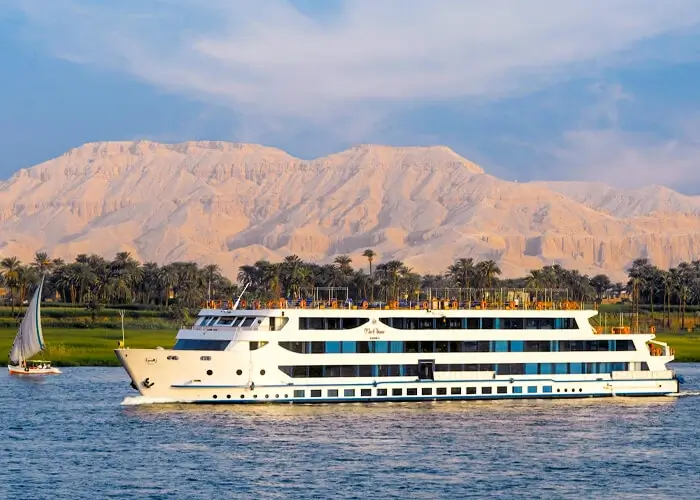
A dahabiya is a two-masted sailing boat of the kind that carried travelers up the Nile in the 19th century. Today's dahabiyas carry a small number of guests in a handful of cabins, sail when the wind allows and moor at islands and riverbanks where the large cruise ships cannot stop. This twelve-day tour gives the sailing a full week: seven nights from Luxor to Aswan, almost twice as long as a standard cruise, with time for quiet days on deck between the temple visits.
The trip begins and ends in Cairo. Before the cruise you see Memphis, Saqqara and the Pyramids of Giza, then the Egyptian Museum, the Citadel, Khan el-Khalili and the churches and synagogue of Old Cairo. You fly to Luxor for Karnak and Luxor Temple, cross to the West Bank for the Valley of the Kings, the Valley of the Queens and Medinet Habu, and sail south past Esna to Edfu, Kom Ombo and Aswan for the High Dam and Philae. A flight takes you back to Cairo for your last night. An English-speaking Egyptologist guides the visits, the transfers are private, and both domestic flights are included.
It is a weaker fit if you want nightlife and entertainment on board, or a pool: dahabiyas are quiet and simple in layout. Sailing depends on the wind, so the boat is sometimes towed by a tug. Read our comparison of a dahabiya and a Nile cruise, or see other luxury Egypt tours.
The Cairo days are full; the river days are slow, with one visit a day and two days of sailing with no fixed visits. Two days include a flight:
Your guide meets you at Cairo International Airport, helps with the visa and formalities and walks you to your private air-conditioned vehicle. The drive to your hotel by the Nile takes 30 to 60 minutes, depending on traffic.
At the hotel your guide goes through the itinerary and confirms the pick-up times. A welcome drink is served at check-in, and the evening is free.
After breakfast you drive south to Memphis, capital of Egypt for much of the Old Kingdom and, by tradition, founded by King Menes. Its open-air museum keeps a colossal limestone statue of Ramses II lying on its back and the Alabaster Sphinx. A few minutes away, at Saqqara, the Step Pyramid of Djoser, designed by the architect Imhotep around 2650 BC, is the earliest large stone building in Egypt and the model the later pyramids grew from.
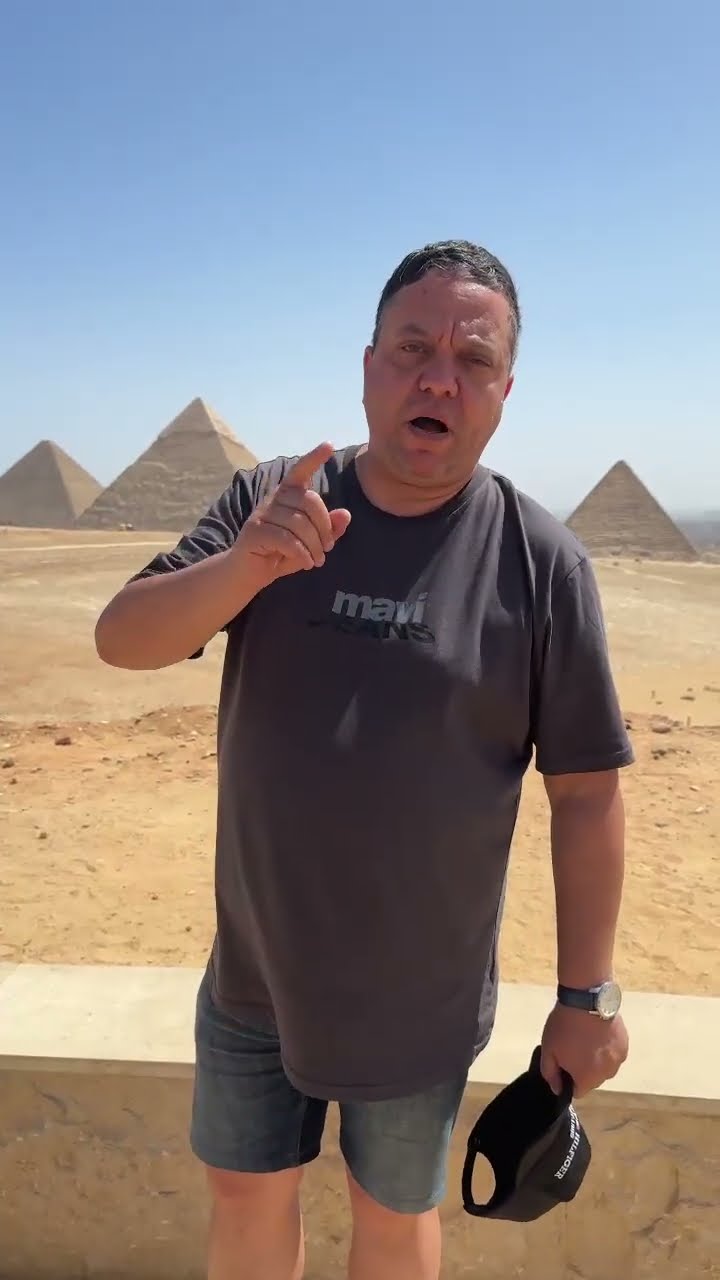
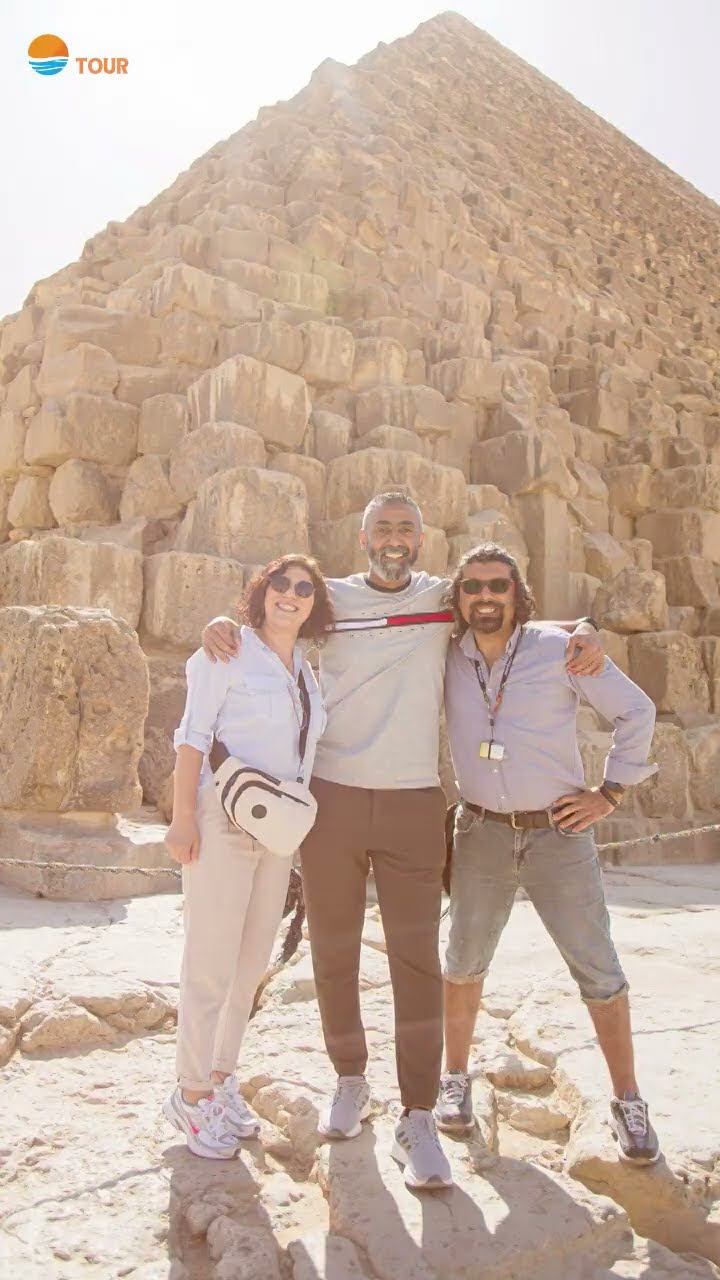
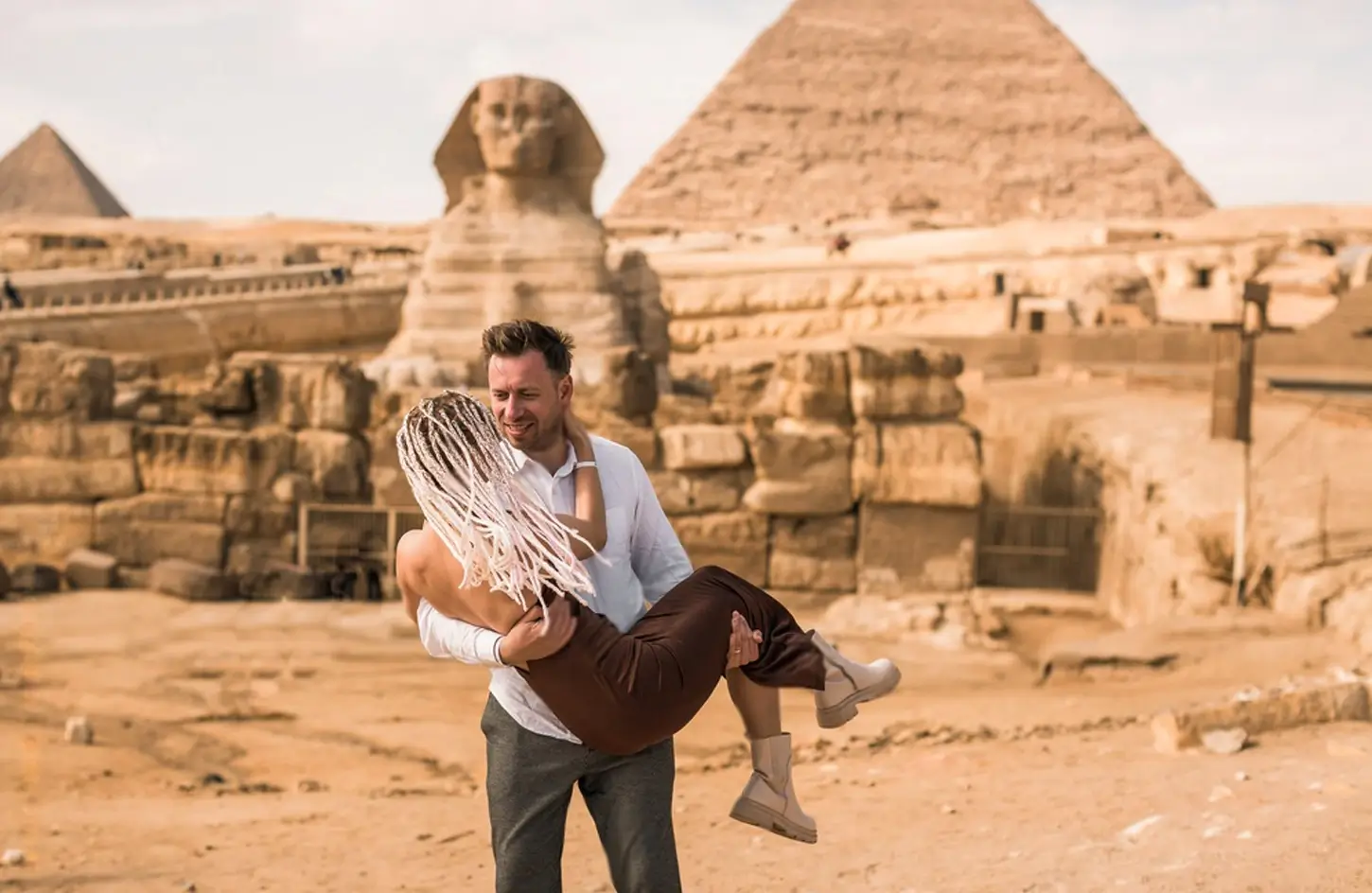
After lunch at a local restaurant you drive to Giza. The pyramids of Khufu (Cheops), Khafre (Chephren) and Menkaure (Mycerinus) were built about 4,500 years ago; the Great Pyramid is the only one of the Seven Wonders of the Ancient World still standing. You see the Great Sphinx and the Valley Temple of Khafre, where the king's funeral rites began.
You return to your hotel; the evening is free.
The Egyptian Museum on Tahrir Square, opened in 1902, still holds tens of thousands of objects, from the Narmer Palette and Old Kingdom statues to coffins, jewellery and papyri. Tutankhamun's treasures have moved to the Grand Egyptian Museum, so your guide plans a route through the highlights that remain.
The Citadel was begun by Saladin in 1176 to defend Cairo and was the seat of Egypt's rulers for some 700 years. Inside, the Mosque of Mohamed Ali, built in the Ottoman style and clad in alabaster, looks out over the city.
After lunch you walk through Khan el-Khalili, a market since the 14th century. Then you visit Old Cairo, built around the Roman fortress of Babylon: the Hanging Church above the old gatehouse, the Church of Saint Barbara, the Church of Saints Sergius and Bacchus (Abu Serga), which by tradition stands over a place where the Holy Family rested, and the Ben Ezra Synagogue, where the Cairo Geniza manuscripts were found.
After breakfast you check out and fly to Luxor, about one hour. Your guide meets you on arrival and takes you to the dahabiya, where the crew welcomes you aboard. Lunch is served on deck.
Karnak, the temple of Amun, was enlarged by pharaoh after pharaoh over some 2,000 years and is the largest temple complex in Egypt. You walk through the Great Hypostyle Hall, with its 134 columns, and see the obelisks of Thutmose I and Hatshepsut and the sacred lake.
Luxor Temple, built mainly in the 18th and 19th Dynasties under Amenhotep III and Ramses II, stands in the centre of the town. Its seated statues of Ramses II and its single obelisk glow in the light at sunset.
Dinner is on board, and you spend your first night on the dahabiya in Luxor.
After breakfast you cross to the West Bank. In the Valley of the Kings more than 60 tombs were cut for the pharaohs of the New Kingdom; you ride the small electric train from the visitor centre to the tombs and enter three of those open on the day. The tomb of Tutankhamun, found by Howard Carter in 1922, needs a separate ticket.
The Valley of the Queens holds the tombs of royal wives and princes of the 19th and 20th Dynasties, with brightly painted walls; the tomb of Nefertari has a separate ticket. On the way you stop at the Colossi of Memnon, two statues of Amenhotep III about 18 metres tall.
Medinet Habu, the mortuary temple of Ramses III, keeps some of the best-preserved reliefs in Egypt, including his battles against the Sea Peoples, with colour still on the ceilings.
Back on board, the dahabiya sets off south towards Esna. Dinner is on deck, and you moor for the night at a quiet place on the bank.
A day with no fixed visits. After breakfast the boat continues south, passing through the lock at Esna and on past palm groves, sugar cane fields and villages where farmers work the land and children wave from the bank. When the north wind is with you the crew raises the sails; when it drops, a small tug keeps the boat moving.
The day is for reading, watching the river and conversation over tea on deck. Lunch is prepared on board with fresh local produce. In the evening the boat moors by an island, and dinner may be served on the bank under the stars, depending on the boat and the weather.
After breakfast you sail on to Edfu, watching the fishermen in their small boats along the way.
A horse carriage takes you from the river to the Temple of Horus, built between 237 and 57 BC and the best-preserved temple in Egypt. The great pylon, guarded by granite falcons, the colonnaded courtyard, the roofed halls and the shrine still stand much as they were built, and the walls tell the battle of Horus and Seth.
Lunch is on board as the boat sails on. You watch the sunset from the deck, and dinner is served as the boat moors for the night.
Breakfast is on deck as the boat continues through the farmland of Upper Egypt, where the desert hills close in on the river.
Kom Ombo stands on a bend of the river. It is a double temple from the Ptolemaic period, with two entrances and two sanctuaries side by side: one for Sobek, the crocodile god, and one for Haroeris, Horus the Elder. Your guide points out the relief often read as a set of surgical instruments and the Nilometer. Next to the temple, the Crocodile Museum shows mummified crocodiles found nearby.
Lunch and dinner are on board, and you moor for the night near Kom Ombo.
Another day with no fixed visits, as the boat sails the last stretch towards Aswan. The landscape changes: the valley narrows, the golden dunes of the Western Desert come down to the water and the first granite rocks appear.
Breakfast, lunch and dinner are on board. In the afternoon tea is served on deck as the sun sets, and the boat moors for the night not far from Aswan.
After breakfast the boat sails into Aswan, past the granite islands of the first cataract and the feluccas of the town.
A motorboat takes you to Agilkia Island and the Temple of Isis at Philae. When the old Aswan dam left the temple under water for most of the year, it was dismantled and rebuilt on higher ground between 1972 and 1980, in a UNESCO campaign. The colonnades, the birth house and the Kiosk of Trajan stand around the island's edge.
Dinner is on board for your last night on the dahabiya, moored in Aswan.
After breakfast you disembark and drive to the High Dam, 13 km south of the town. Completed in 1970, it ended the yearly flood, supplies water and electricity to the country and created Lake Nasser, which stretches about 500 km to the south. From the top you see the lake on one side and the Nile on the other.
Lunch is at a restaurant with a view over the Nile in Aswan.
You transfer to Aswan airport for the flight to Cairo, about 1 hour 20 minutes. A driver meets you and takes you to your hotel. The evening is free for a last dinner in Cairo.
After breakfast and check-out, your tour manager helps with your luggage and documents, and a driver takes you to Cairo International Airport in time for your flight; airlines usually ask you to be there three hours before departure. This is the end of the tour.
If your flight is late, the Grand Egyptian Museum with its Tutankhamun galleries can be added as an optional visit.
More space and better ships
Our highest level
Children pay less, see the children policy below. Christmas, New Year and Easter dates add 25%. Prices are per person in US dollars.
Most dahabiyas sail from about September or October to April or May. In winter the days on deck are warm and sunny, around 23 to 27 °C in Luxor and Aswan, and the nights cool; in March and April the north wind is most reliable for sailing. Summer departures are fewer, as afternoons pass 40 °C. Cabins are few, so the Christmas, New Year and Easter dates sell out early.
Many nationalities can buy a tourist visa on arrival at Cairo airport or apply for an e-visa on visa2egypt.gov.eg. Rules and fees depend on your passport. Your passport should be valid for at least six months from arrival and is needed for the domestic flights and boarding. The visa is not included in the price.
The currency is the Egyptian pound. Drinks on board are usually settled at the end of the cruise. Keep small notes for the horse carriage drivers, markets and toilets at the sites. Tips are not included; on a dahabiya the crew is usually tipped together at the end. See the tipping guide in the travel policies below.
All prices are per person in US dollars. The price changes with the season (winter 1 October to 30 April, summer 1 May to 30 September), the accommodation level and the size of the group. Christmas, New Year and Easter dates add 25%. Your quote lists the final price and everything it covers. After the deposit, changes to your itinerary cost US$25 per request, plus any third-party fees.
A deposit of 30% of the total tour cost is required at the time of booking. The final payment is due 30 days before departure, and bookings made within 30 days of departure are paid in full. We accept Visa or Master Card by secure online payment, Visa or Master Card by email, and wire transfer. We confirm every booking by email.
No-show travelers are charged 100%. During peak events in Egypt, hotels and Nile cruises do not refund deposits. Groups of more than 10 people may have different terms.
Add each child and their age in the enquiry form so the quote is exact.
Optional visits, such as a hot air balloon ride in Luxor, a Sound and Light show or a felucca ride, are not in the price. Tell us which ones you want and we add them to your quote with their cost.
Not included in the price: International flights to and from Egypt; Egypt entry visa; Optional activities and excursions; Personal expenses and drinks; Tips for guides, drivers and the dahabiya crew; Extra tickets at the sites: inside the Great Pyramid and the tombs of Tutankhamun and Nefertari.
Tipping is customary in Egypt and is not included in the price. A usual amount for a private tour is US$8 to 10 per person per day for your guide, US$4 to 5 for your driver and US$5 to 8 per person per day for the crew on a Nile cruise. Your guide can advise you on the day.
A dahabiya is a traditional two-masted sailing boat with a small number of cabins, compared with the 50 to 80 cabins of a typical Nile cruise ship. It moors at islands and quiet banks rather than in the town centres, sails when the wind allows and has a calmer atmosphere, without a pool or evening shows.
Dahabiyas travel more slowly than motor ships and stop where the big ships cannot. The extra nights give two days of pure sailing and time to see Edfu and Kom Ombo without rushing.
The boat is towed by a small tug so the program stays on time. Sailing under canvas depends on the wind on the day.
The boat is shared with the other guests on board, a small group. If your party is large enough, a whole dahabiya can be chartered for you; ask us for a quote.
Independent reviews on the platforms travelers already trust.
Amazing Egyptian vacation! We did an 11 day private tour of Cairo, cruise on the Nile between Aswan and Luxor and a 4 day stay in Hurghada. The guided tours were very interesting, with extremely knowledgeable guides, attentive and helpful.
Egypt package to the Pyramids of Giza and Saqqara was a fascinating journey through Egypt's ancient past ,guide knowledge, the majesty of the pyramids, and the historical depth of Saqqara made this tour truly enriching!
our honeymoon to Egypt ,Giza and Saqqara was a magical escape into history The pyramids looming in the distance, the quiet serenity of the desert, and the ancient wonders of Saqqara created moments that will be with me forever!
From the same category, with the same private service.
We always use the cookies this site needs to work. With your permission we also use the optional ones listed under Settings. You can change your choice at any time. Privacy policy