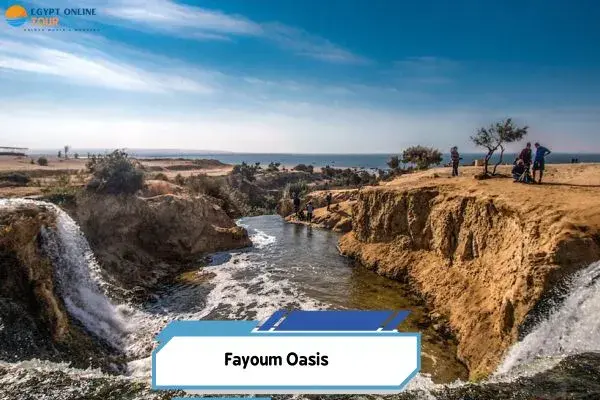
Fayoum Oasis is a green basin in the desert about 100 km south-west of Cairo, roughly two hours by car, and the easiest desert escape from the capital. Its highlights are the Wadi El-Rayan lakes and waterfalls, the 40-million-year-old whale skeletons of Wadi El-Hitan, a UNESCO World Heritage Site since 2005, the salt lake of Lake Qarun, the dunes around the Magic Lake and the potters' village of Tunis. You can see the main sights on a long day trip or, better, in two days with a night by the lake.
Fayoum makes a good break between Cairo's museums and the Nile, and it works well for families. This guide covers what to see, how to get there, when to go, what it costs and how to plan the day.
Fayoum Oasis at a glance
| Distance from Cairo | About 100 km to Fayoum city; about 150 km to Wadi El-Hitan |
|---|---|
| Driving time | About 1.5 to 2 hours from Giza; 3 hours or more to Wadi El-Hitan |
| Best for | Desert landscapes, fossils, lakes, sandboarding, birdwatching, pottery |
| Best season | October to April |
| Time needed | One long day; two days to see it without rushing |
Why Fayoum is different from other oases
Fayoum is not fed by springs like Siwa or Bahariya. Its fields are watered by the Bahr Yussef, a branch of the Nile that flows into the basin and ends in Lake Qarun. That makes it one of the oldest farming regions in Egypt and a green island of fields, palms, orchards and waterwheels surrounded by desert.
It has a long history too. Pharaohs of the 12th Dynasty, about 1900 to 1800 BC, used the lake as a reservoir and built pyramids at Hawara and Lahun. The Greeks called the capital Crocodilopolis, city of the crocodile god Sobek, and under the Ptolemies and Romans Fayoum became a granary of the Mediterranean world. The famous Fayoum mummy portraits, realistic painted faces placed over Roman-era mummies, come from here; you see examples in the Egyptian Museum in Cairo.
Top things to do in Fayoum Oasis
1. Wadi El-Rayan lakes and waterfalls
Two large lakes in a desert depression, created in the 1970s from the oasis's drainage water and joined by a channel with small waterfalls, the main attraction for Egyptian families. The protected area around them, declared in 1989, also holds Mudawara Mountain with its viewpoint over dunes and lakes, and springs where you may see desert foxes and birds. Read our guide to Wadi El-Rayan.
2. Wadi El-Hitan, the Valley of the Whales
The highlight for anyone curious about nature. Some 40 million years ago this desert was a shallow sea, and its rocks hold hundreds of fossil whales and sea cows, including complete skeletons of Basilosaurus, up to about 18 metres long, and the smaller Dorudon. They are early whales that still had small hind legs, which is why UNESCO listed the site in 2005 as a key record of how whales evolved from land animals. A marked trail of about 3 km leads past skeletons lying where they were found, and a museum of fossils and climate change sits at the entrance. Allow at least two hours on site.
3. The Magic Lake and sandboarding
A small lake below high dunes on the edge of Wadi El-Rayan, named for its colours, which change from blue to green to grey with the light. The dunes beside it are the best place in Fayoum for sandboarding; bring the board with your 4x4 driver. Late afternoon is the best time for the light and the cooler sand.
4. Tunis village and its pottery
A village on the hill above Lake Qarun, known since the 1980s for its pottery school and workshops, where local potters make glazed bowls and plates with birds, fish and village scenes. You can watch them at the wheel, buy directly and, in some workshops, try making a piece yourself. The village also has small guesthouses and cafes with views of the lake, and a pottery festival takes place there in some years.
5. Lake Qarun and Qasr Qarun
Lake Qarun is the remnant of the ancient Lake Moeris, now a large salt lake below sea level. Its northern shore is pure desert, its southern shore farmland, and in winter it attracts flamingos and other migratory birds. At its western end the Ptolemaic temple of Qasr Qarun is well preserved and rarely visited; see our article on Qasr Qarun temple.
6. Ancient sites
- Karanis (Kom Aushim): a Greco-Roman town with mudbrick houses, two temples and a small museum, at the entrance to the oasis on the Cairo road.
- Hawara and Lahun pyramids: the mudbrick pyramids of Amenemhat III and Senusret II; Hawara was beside the vast temple the Greeks called the Labyrinth.
- Medinet Madi: a Middle Kingdom temple with an avenue of sphinxes and lions, in the south-west of the oasis.
7. Fayoum city and its waterwheels
The wooden waterwheels (sawaqi) of Fayoum, turned by the current, have lifted water into the fields for centuries; a group of them stands in the city centre. Fayoum city itself is busy and not very scenic; most visitors pass through.
How to get to Fayoum Oasis
| Option | Pros | Cons |
|---|---|---|
| Private car with driver and guide | Flexible, comfortable, the driver knows the tracks | Costs more than public transport |
| Organised tour | Everything arranged, including 4x4 for the desert parts | Fixed schedule |
| Self-drive | Freedom | Desert tracks need a 4x4 and local knowledge; checkpoints on the way |
| Bus or microbus to Fayoum city | Cheap | Gets you only to the city; you still need a car for the sights |
The road from Giza runs through the desert and is fast. From Fayoum, Lake Qarun and Tunis are on paved roads; Wadi El-Rayan is reached by asphalt, but the Magic Lake dunes and Wadi El-Hitan need a 4x4 for the last part. Our advice for a first visit: a private car from Cairo to the edge of the desert and a 4x4 with a local driver for Wadi El-Hitan and the dunes.
Best time to visit Fayoum
- October to April: warm days and cool nights; the best time for the desert. Winter is also the birdwatching season on the lakes.
- May to September: very hot in the desert by late morning; go early and finish by lunch, or limit the trip to the lakes and Tunis.
- Weekends and holidays: Fridays and Egyptian holidays bring many families to Wadi El-Rayan; weekdays are calmer.
- Light: the desert is most beautiful in the first two hours after sunrise and the last two before sunset.
Tickets and fees
Wadi El-Rayan and Wadi El-Hitan are managed as a protected area, with fees paid at the gates. The amounts are not published on an official website and change, so we do not quote a figure; expect a per-person fee, a separate fee for Wadi El-Hitan, a vehicle fee and extra for camping. Archaeological sites have their own Ministry tickets: Qasr Qarun costs EGP 150 for a foreign adult (EGP 75 for students) on the Ministry price list. Carry cash in Egyptian pounds and small US dollar notes, and confirm the current fees with your driver or operator. On our tours that include a Fayoum day, the entrance fees in the programme are included.
Suggested Fayoum itineraries
Full day from Cairo (10 to 12 hours)
- Leave Giza at 7:00; arrive at Wadi El-Rayan around 9:30 for the lakes and waterfalls.
- Continue by 4x4 to Wadi El-Hitan for the fossil trail and museum.
- Late afternoon at the Magic Lake dunes for sandboarding and the sunset.
- Drive back to Cairo, arriving around 20:00 or later.
Two days: the relaxed version
- Day 1: Karanis on the way in, Lake Qarun and Qasr Qarun, afternoon in Tunis village with the potters, night in a guesthouse or lodge by the lake.
- Day 2: early start to Wadi El-Rayan and the waterfalls, Wadi El-Hitan in the cooler morning, the Magic Lake, then back to Cairo by evening.
Some travellers add a night camping in Wadi El-Hitan under the stars; ask in advance, as camping needs a permit and equipment.
What to pack
- Closed shoes for the fossil trail and dunes; sandals for the lakes.
- Sun hat, sunglasses, high-factor sunscreen and at least 2 litres of water per person.
- A warm layer for winter mornings and evenings.
- Cash; cards are rarely accepted outside the larger hotels.
- A scarf or buff against wind and sand.
- Binoculars in winter for the birds on Lake Qarun.
Safety and good practice
- Desert driving: do not drive into the dunes in a normal car; soft sand traps vehicles fast. Use an experienced 4x4 driver and never go alone.
- Checkpoints: there are police checkpoints on the roads; carry your passport.
- Swimming: the lakes have no lifeguards and steep, muddy edges; Lake Qarun is salty. Swim only where locals do and never alone.
- Fossils: it is forbidden to touch, move or take fossils at Wadi El-Hitan; stay on the marked trail.
- Heat: in summer start at dawn and stay out of the desert at midday.
Food and places to stay
Simple cafes at Wadi El-Rayan and along the lake serve tea, soft drinks and grilled fish or chicken. Tunis village has the nicest small restaurants and guesthouses in the oasis, many built in mudbrick and domes in the style of the architect Hassan Fathy, and there are a few larger hotels on the shore of Lake Qarun. For a picnic, the dunes above the Magic Lake and the viewpoint at Mudawara Mountain are the most beautiful spots.
Fayoum and the other desert trips from Cairo
Fayoum is the closest desert experience to Cairo. If you have more time, the Western Desert oases offer the White Desert's chalk formations and longer camping trips; see our guide to the Western Desert of Egypt. Fayoum's lakes also appear in our article on the lakes of Egypt, and hikers will find ideas in the best hiking trails in Egypt.
Plan it with us
Our Egyptian family holiday includes a desert day in Fayoum, and the 10 days Nile cruise Christmas tour includes a day in the oasis. For more desert ideas see our Egypt adventure tours.
Fayoum Oasis: quick answers
Is Fayoum Oasis doable as a day trip from Cairo?
Yes. A long day of 10 to 12 hours covers Wadi El-Rayan, Wadi El-Hitan and the Magic Lake. Two days are more relaxed.
Do I need a 4x4 in Fayoum?
For Wadi El-Hitan and the Magic Lake dunes, yes. The lakes, Tunis village and Fayoum city are on paved roads.
Why is Wadi El-Hitan a UNESCO site?
Its 40-million-year-old fossil whales, which still had hind legs, show how whales evolved from land animals. It was listed in 2005.
Can you swim in Lake Qarun or the Magic Lake?
People do, but there are no lifeguards and the edges are steep and muddy. Lake Qarun is salty. Swim only with care and never alone.
Ahmed Samir writes and updates the Egypt travel guides of Egypt Online Tour, a licensed tour company based in Cairo (ETAA licence 1466). Our travel advisors review each guide before it is published.
All guides by Ahmed Samir